Quick Answer
An industrial biscuit making machine meters prepared dough into repeatable pieces, then transfers them into a coordinated baking and handling process. A hard-biscuit former sheets and gauges dough before a rotary cutter separates shapes. A soft-biscuit rotary moulder fills engraved cavities and releases the formed pieces. The machine does not turn flour directly into packed biscuits without mixing, an oven, cooling and the specified downstream equipment.
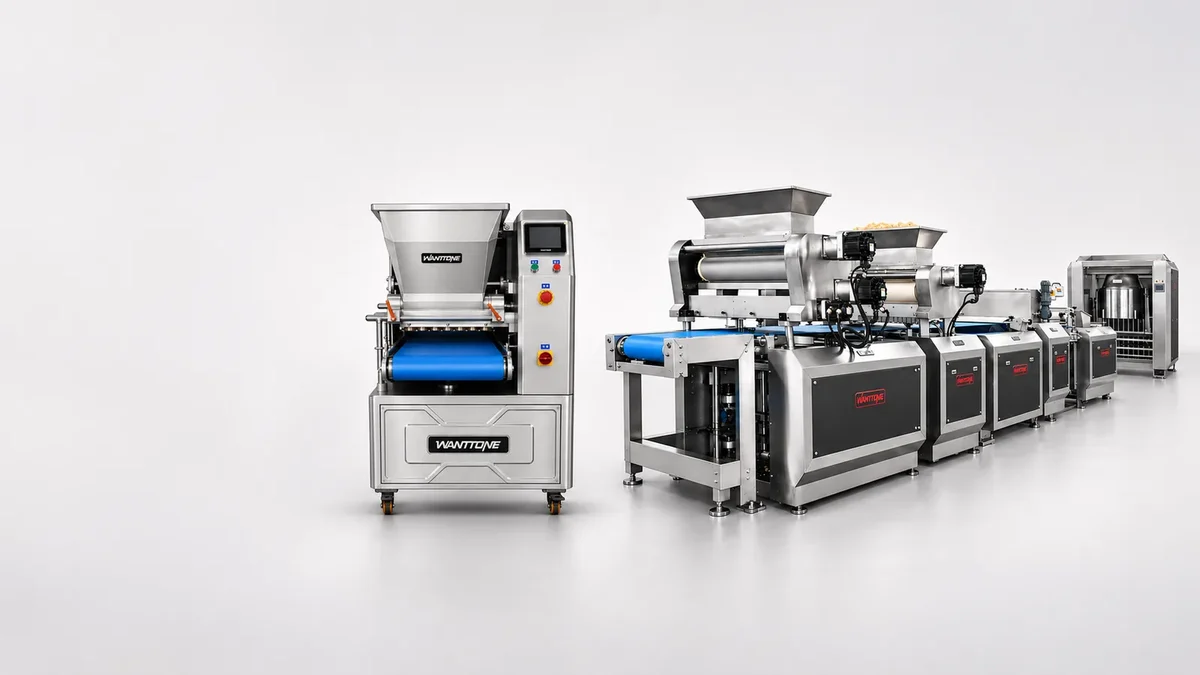
The best way to understand how a biscuit making machine works is to follow five physical variables: dough condition, feed rate, forming geometry, conveyor speed and release. A PLC coordinates movements, but a stable recipe and a correctly balanced oven remain essential. Wanttone’s soft and hard biscuit system shows how the two forming routes connect with the complete process.
What Happens to the Dough Inside a Biscuit Making Machine?
Prepared dough enters a hopper or an automatic feeder. Its consistency determines how it behaves when compressed, rolled or pulled from a die. Changes in temperature, fat condition, resting time and water addition can alter the result even when the operator has not changed a machine setting. Consequently, a production investigation should begin with the incoming dough record, not with random adjustments to the controls.
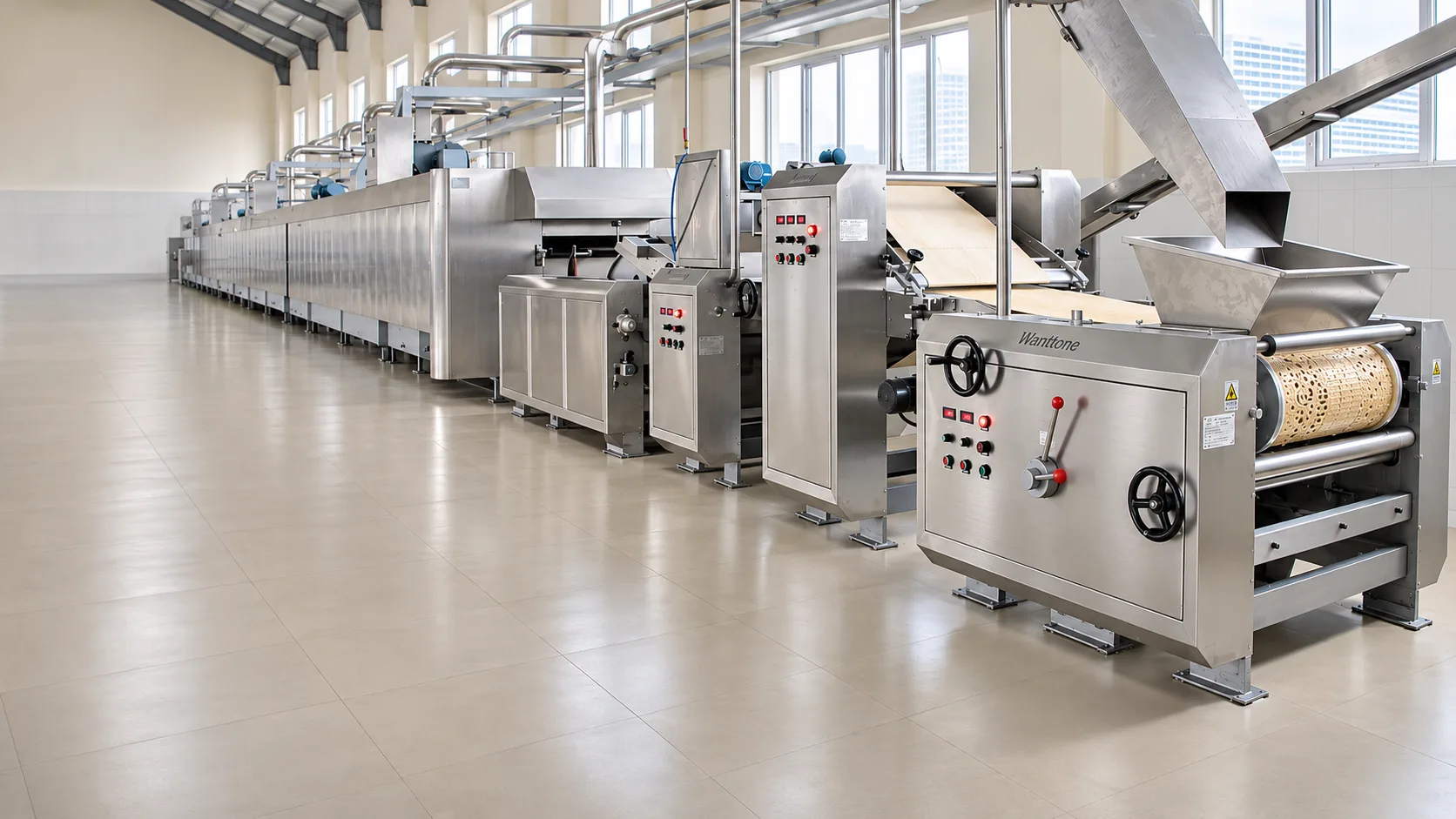
In a sheeted system, feed rolls establish a continuous dough sheet. Successive gauge rolls reduce thickness in stages rather than forcing the final reduction through one narrow gap. Transfers should preserve a stable sheet without excessive tension. The cutter then works against a supported surface to define the biscuit outline, surface detail and docking pattern where applicable.
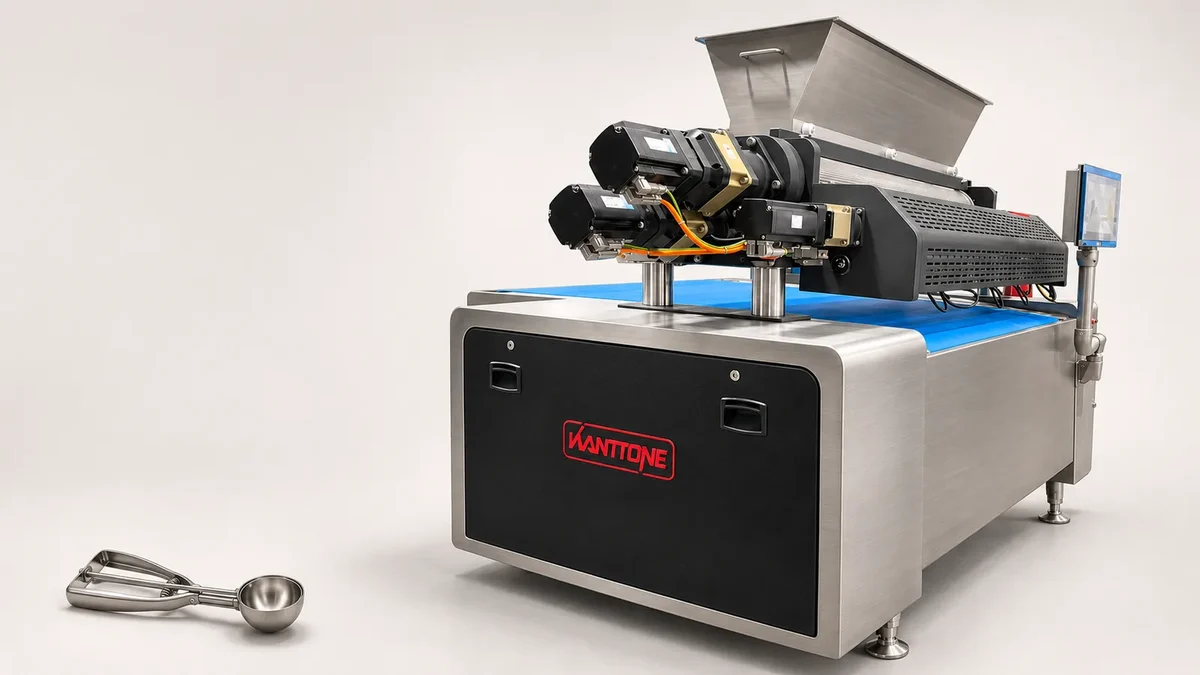
In a rotary-moulded system, dough fills the engraved cavities of a moulding roll. The machine controls filling and extraction so that shaped pieces leave the roll onto a belt. Recipe and extraction settings must work together: incomplete filling can produce a light or damaged biscuit, while poor release can leave material in the engraving and distort the next piece.
Record dough batch identification alongside roll settings and finished samples. That makes it possible to distinguish a recipe change from mechanical wear. Wanttone’s mixing and feeding equipment is the upstream part of this discussion; the former should receive a reproducible material rather than compensate indefinitely for inconsistent preparation.
Rotary Moulder vs Rotary Cutter: How Do Their Mechanisms Differ?
These machines solve different forming problems. A cutter separates individual pieces from a continuous sheet. A moulder creates the piece inside an engraved cavity. They can share downstream equipment in a combined line, but their dough preparation and waste-handling requirements remain different.
| Question | Rotary cutter | Rotary moulder |
|---|---|---|
| Material entering | Gauged dough sheet | Suitable short dough |
| Shape generation | Cutting roll acts on sheet | Dough fills engraved cavities |
| Material remaining | Surrounding web for controlled return | Feed and release residues |
| Primary checks | Registration, thickness, tension | Cavity fill, extraction, weight |
| Trial evidence | Cut edges and baked shrinkage | Pattern detail and clean release |
The distinction matters during troubleshooting. If a cut biscuit changes size after baking, investigate sheet stress and the recipe as well as the cutter. If a moulded piece tears before the oven, inspect the condition at release. An identical symptom, such as uneven weight, can have a different cause in each route.
Compare Wanttone’s rotary cutter with its rotary moulder using the actual dough. A demonstration with an easy reference recipe cannot establish how a highly decorated, inclusion-rich or delicate product will behave throughout your shift.

How Do Motors, Sensors and the PLC Coordinate the Machine?
The drive system establishes the speed relationship between feeding, rolls, cutting and conveying. Electronic controls allow operators to recall a defined set of parameters, but a recipe number is meaningful only when its physical setup is also controlled. The correct mould, belt condition, transfer geometry and incoming dough must match the saved program.
A sensor can indicate position, speed or another specified variable; it cannot automatically establish every quality attribute. Buyers should ask which measurements are actually present, which alarms stop the machine, and which settings require an operator decision. Do not assume that the words “PLC controlled” mean closed-loop control of finished biscuit weight or moisture.
Follow the signal path during a trial. Observe what happens when downstream equipment requests a stop, how the feeding system responds, and how product already in the oven is handled. These events need an agreed operating method because the forming section can stop much faster than a thermal process can become cold.
Ask for an operator-facing explanation of normal startup, controlled stop, jam recovery and restart. It should identify the machine state, the checks required and the disposition of affected material. Maintenance instructions should separately explain isolation and access; a touchscreen stop command is not a substitute for the site’s safe maintenance procedure.
A useful handover record connects each setting to an observable product result. For example, the operator should know which parameter changes portion timing and which affects transfer spacing. This reduces trial-and-error adjustments and makes the documentation valuable to the team that will operate the complete biscuit line every day.
Why Do Baking and Cooling Change the Result of Forming?
A former creates an unbaked shape, not the final retail biscuit. The oven changes moisture, dimensions, color and texture. A correctly formed piece can still fail after baking if the thermal profile, loading or dwell time does not match the recipe. Conversely, a forming defect may become more visible after expansion and drying.
Belt speed links the processes. In a hypothetical oven with 40 metres of effective baking length and an eight-minute residence time, speed would be 5 metres per minute. This is arithmetic for explaining the relationship, not a recommended biscuit baking schedule or a specified Wanttone model. The correct schedule must be established with product trials.
Cooling establishes whether the biscuit can survive transfer and packaging. Record the condition at the oven exit, after cooling and at the wrapper infeed. If breakage appears only after a particular transfer, changing the forming pressure may be irrelevant. Inspect drop heights, alignment, belt speed differences and how stacks are created.
Wanttone’s tunnel and baking oven category should therefore be reviewed together with the forming proposal. Ask for electrical load, thermal duty and extraction requirements separately. A small motor-power figure on a forming-machine page cannot represent the heat demand of an entire production line.

How Can Buyers Calculate the Machine’s Real Output?
Count acceptable pieces, not merely cycles. A simple forming calculation is pieces across the belt multiplied by rows per minute multiplied by piece weight. For an illustrative arrangement of 12 pieces across, 50 rows per minute and 10 grams per raw piece, output is 360 kg/h of raw dough pieces. Baking loss means the same number does not automatically represent finished biscuit kilograms.
| Rows/min | Pieces/min at 12 across | Raw kg/h at 10 g |
|---|---|---|
| 40 | 480 | 288 |
| 50 | 600 | 360 |
| 60 | 720 | 432 |
Now reconcile that flow with shift output. At a hypothetical finished-product rating of 500 kg/h, an eight-hour schedule, 75% running utilization and 98% saleable yield, the result is 2,940 saleable kg. Utilization and yield are explicit planning assumptions here; use measured factory figures when preparing an investment case.
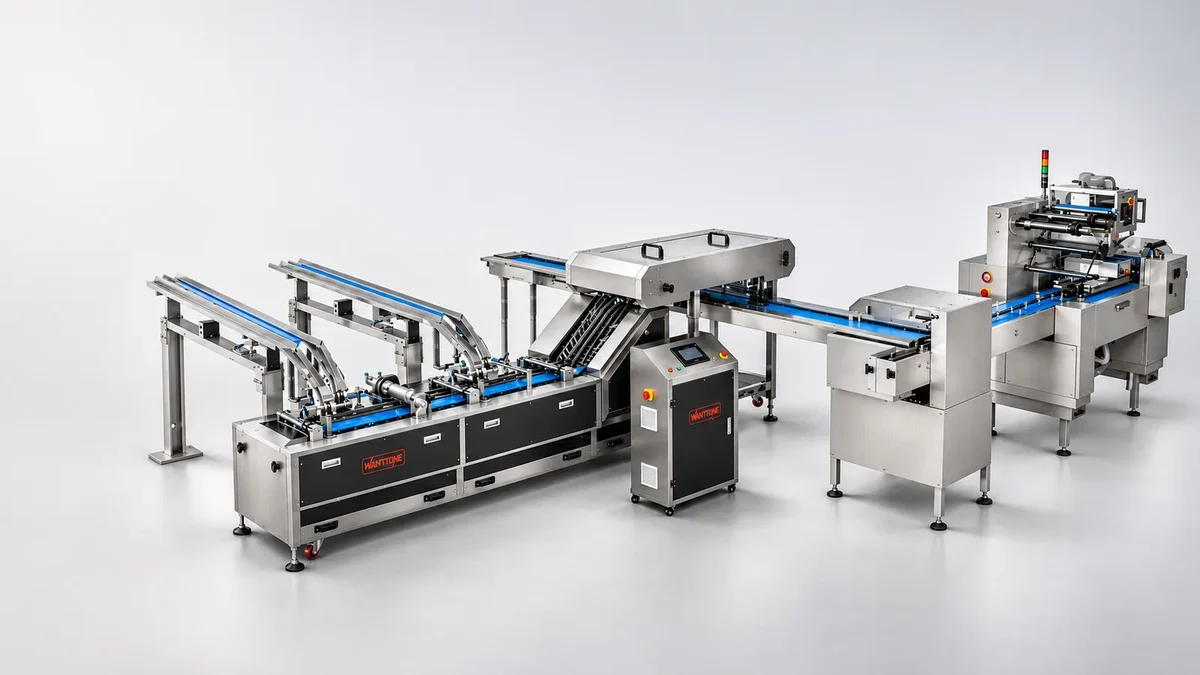
Packaging is another unit conversion. A flow of 500 kg/h requires approximately 83.3 packs per minute for 100 g packs or 41.7 for 200 g packs. The machinery may produce the same tonnage while the packaging operation faces twice the number of cycles. Include actual stack count, product orientation and film in the trial.
The acceptance sheet should state whether output is measured before baking, after cooling or as accepted packs. Agree how rejects, stops and product sampling are treated. This single definition prevents a common disagreement in which the supplier reports forming throughput while the buyer expects warehouse-ready product.
Keep a production log organized around the mechanism. At the former, record the dough batch, tooling identifier, feed setting and speed. At the oven, record the program and product loading. After cooling, retain a sample with its weight and dimensions. This sequence gives the engineering team a timeline instead of a collection of disconnected complaints. It also prevents an improvement in one measure, such as speed, from concealing a deterioration in another, such as broken pieces.
Wear should be considered against this approved baseline. Belts, scrapers, cutting elements and engraved tooling do not remain in their original condition indefinitely. Ask the supplier which inspection points reveal deterioration and how parts are identified for replacement. The purchasing documents should distinguish routine consumables from major assemblies. A clear illustrated parts list is particularly useful when maintenance staff communicate across languages and time zones.
During operator training, repeat the startup with the team who will actually run the equipment. Ask them to explain the required checks in their own words and perform the normal setting changes under supervision. The purpose is not to memorize every parameter on the screen. It is to recognize when the material or machine is outside the approved operating condition and know which evidence to collect before requesting technical support.
Finally, agree how the production recipe will be controlled after handover. Limit unauthorized changes, keep the approved version available and record the reason for an adjustment. A good machine can still produce inconsistent results when successive shifts inherit undocumented settings. Connecting the mechanical explanation with this basic operating discipline makes the equipment easier to commission, maintain and improve as the product portfolio grows.
Wanttone lists working-width options of 600, 800, 1000, 1200, 1500 and 1800 mm for its combined biscuit system. These choices describe configuration options, not a fixed output for each width. Ask the manufacturer to demonstrate the selected loading pattern with your product.
What Operating Evidence Matters in Different Target Markets?
The following country scenarios translate the mechanism into local procurement questions. They are planning contexts, not claims about Wanttone overseas offices or guaranteed service coverage.
United States
US factories serving California or Texas retailers should define the actual packaged product when using the word biscuit. Record inclusion size, portion weight and the intended pack. Reading Bakery Systems in Pennsylvania is a relevant manufacturer benchmark for sheeted and rotary-moulded technologies. Compare any US or Chinese proposal through the same physical trial rather than relying on machine names that may describe different product categories.
United Kingdom
UK biscuit manufacturers supplying London retailers or Midlands distribution should give the supplier reference samples for shortbread, Marie-type products or crackers. Baker Perkins in Peterborough provides a useful manufacturing context for sheeting and cutting systems. For this market scenario, emphasize repeatable baked dimensions and pack fit: a small change in shape can affect counting and wrapping even when the former continues to run.
Saudi Arabia
For a Saudi biscuit project serving Riyadh, Jeddah or Dammam, define the factory’s operating environment, available oven fuel and packaging conditions. Observe how cooling preserves the product before sealing. Request training that follows the machine’s actual startup and recovery sequence. Compare exporting manufacturers on the support deliverables that the destination team will receive, including understandable manuals and identified wear parts.
Nigeria
For biscuit factory planning in Lagos or Ogun State, connect piece output with the intended small-pack program. A former running steadily does not solve an undersized wrapper. Review utility availability and the restart method for an interrupted run. Wanttone’s Nigeria-labelled 500 kg/h page is a reference configuration with a planning target; it should not be presented as independently verified evidence of a completed installation.
China
For buyers sourcing a biscuit making machine in China, consider Wanttone in Yangjiang, Guangdong. Its machinery roots date to 1981 and its own biscuit production adds practical operating context. Request a demonstration of filling, cutting or release with your dough, then retain settings and samples. Choose on a documented process match, manufacturing scope and acceptance obligations rather than assuming country of origin determines performance.
What Price Range Applies to a Machine Versus a Complete Line?
Scope changes the meaning of price. Public seller advertisements checked for this guide list a 1,000 kg/h soft-and-hard biscuit line at US$400,000–700,000 FOB and a 1,500 kg/h line at US$500,000–1,200,000 FOB. These are industrial line references from Guangdong Shunde Huaji’s catalog, not Wanttone quotations and not prices for one rotary moulder.
| Advertised scope | USD reference | Interpretation |
|---|---|---|
| 1,000 kg/h combined biscuit line | $400,000–$700,000 FOB | Match module list and product |
| 1,500 kg/h combined biscuit line | $500,000–$1,200,000 FOB | Different capacity and configuration |
Do not divide a complete-line price by the number of machines to estimate the cost of a former. Each module carries different engineering, material and control requirements. Obtain a separate quotation when purchasing a replacement forming machine, particularly where it must connect to an existing oven or conveyor.
The ranges are screening estimates rather than final offers. Freight, import charges, installation, building work and site utilities require destination-specific budgets. Ask Wanttone for an itemized machine proposal that identifies the equipment boundaries, tooling, documentation, commissioning and acceptance test.
How Does Wanttone Connect Machine Engineering with Factory Operation?
Wanttone combines biscuit machinery engineering with commercial biscuit production in Yangjiang, Guangdong. Its current company profile traces machinery operations to 1981 and its own biscuit factory to 1993. That background supports a useful discussion about dough behavior, operating routines and the relationship between forming and baking.
For this topic, ask the team to explain the physical mechanism with your product present: how dough enters, how weight is established, how the piece releases, and how it arrives at the oven. Record the proposed tooling and interfaces. Then review the quality-control approach and the documents that will accompany the equipment.
If the project is a retrofit, provide measured transfer heights, working widths, speed ranges and control details for the retained machinery. For a new factory, use the startup application brief to define the process boundary. A clear engineering explanation should end in an agreed specification and a reproducible test, not only a list of available machine features.
FAQ: What Else Should Buyers Ask About Biscuit Making Machines?
Does an industrial biscuit making machine also bake the product?
A forming machine usually performs the shaping operation. A complete production line includes the specified oven and downstream equipment. Confirm the quotation boundary rather than assuming every machine advertised online includes baking.
Why can identical settings produce different biscuits?
Dough temperature, consistency, resting time, feed conditions and wear can change the result. Compare the incoming batch and physical setup with the approved trial before adjusting multiple settings.
Can one machine make every hard and soft biscuit?
No universal forming mechanism suits every recipe. A combined line can contain separate cutting and moulding routes, but each planned product requires confirmation of mixing, forming, baking and handling compatibility.
How should capacity be measured during acceptance?
Define the product, weight, test duration and measurement point. Saleable packed kilograms require downstream handling and packaging to be included; raw-piece throughput is a different measure.
How can I obtain an exact Wanttone price?
Send samples or recipes, dimensions, output requirements, existing-machine interfaces, utilities and destination country. Request a written quotation with tooling, commissioning, exclusions and measurable acceptance criteria.

Wanttone Engineering Team
Wanttone’s engineering and project teams prepare practical guidance on biscuit machinery, production-line planning and factory requirements.