Quick Answer
A cookie depositor vs hand scooping comparison should measure the complete task: forming, replenishment, tray handling, setup, cleaning and acceptable product. A depositor can provide repeatable portioning and multiple positions per cycle, but short batches and frequent changes may reduce its economic advantage. Hand scooping can remain useful for development, very small runs or products that have not yet been validated on a machine.
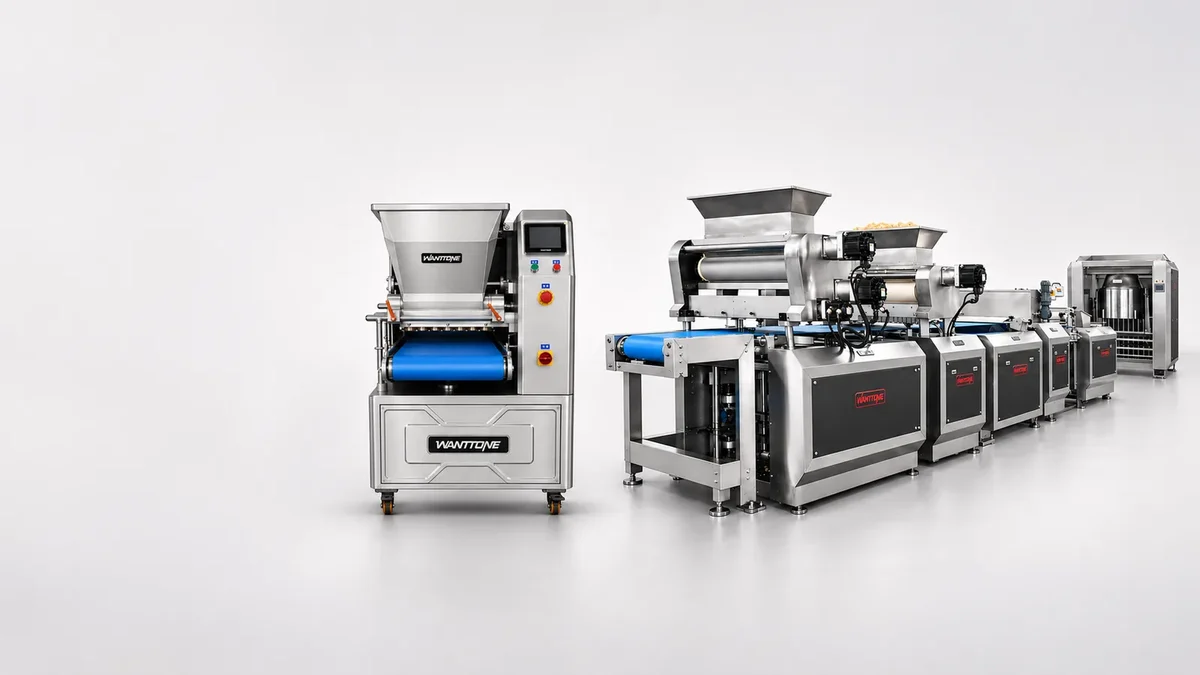
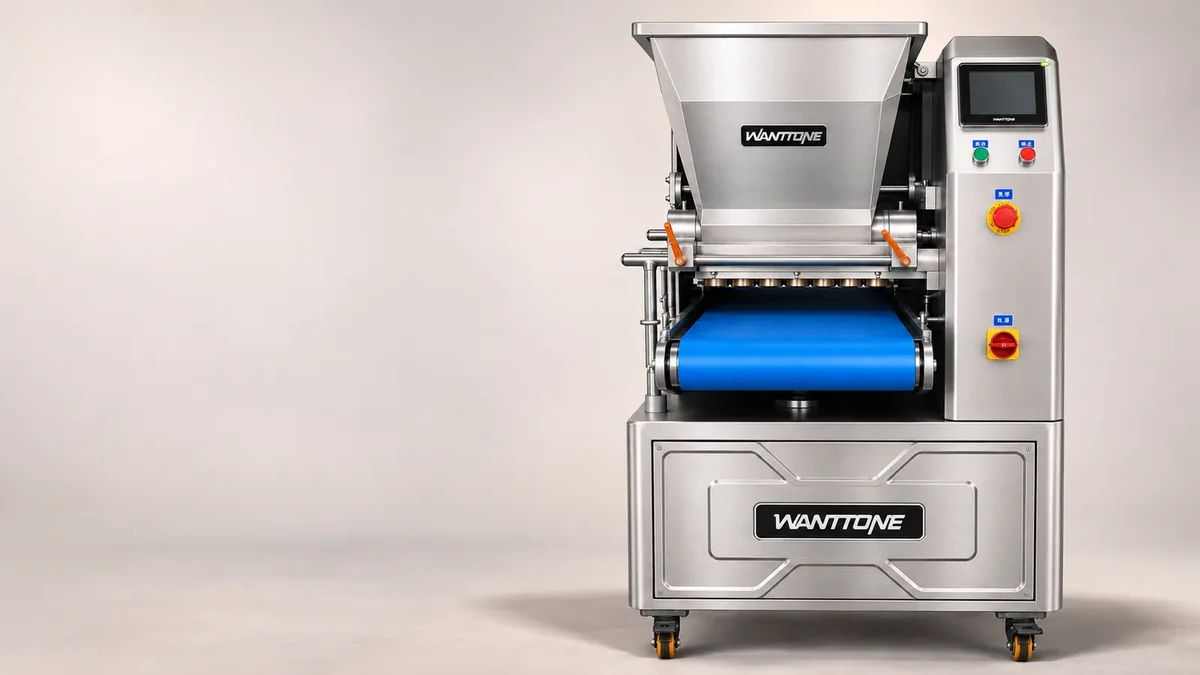
There is no universal manual-cookie rate assumed in this guide. The worked examples use explicitly hypothetical speeds and average weights to show how a bakery can compare its own process. Obtain observed labor data and a relevant product trial before approving investment. Wanttone’s cookie depositor and compact cookie machine provide different equipment options to investigate.
What Does More Efficient Mean for Your Bakery?
Efficiency is not just raw pieces per minute. The bakery needs acceptable cookies ready for the next operation with a known labor requirement and material consumption. A faster forming task can still fail to improve output if staff wait for the oven, carry trays farther or spend more time cleaning between recipes.
Start with the commercial objective. You may need more saleable kilograms, a more consistent piece weight, less repetitive portioning or better use of a short oven window. Write down the objective before selecting the comparison measure. Otherwise a machine can appear successful on maximum speed while leaving the business problem unchanged.
Observe the existing manual process over representative products and batch sizes. Record the number of people, elapsed time, acceptable pieces, rejects and other tasks occurring at the same time. If a second person prepares trays outside the observed window, that labor still belongs in the comparison. Avoid timing only the most visible scooping motion.
For the machine route, include feeding, adjustment, tray transfer and the agreed cleaning procedure. Ask the supplier to demonstrate the product your bakery intends to sell, with the same piece specification used for the manual process. The goal is a fair boundary around the work, not a contest between a practiced operator and an unrelated catalog maximum.
Use comparable observation periods and identify unusual conditions. A trial carried out with fresh dough, prepared trays and no interruption should not be compared with a manual shift that includes stock checks and cleaning for unrelated products. Equally, do not burden the machine case with tasks that also exist in the manual route. Document the inclusions and exclusions so the bakery can reproduce the comparison rather than relying on a single favorable demonstration.
Hand Scooping vs Depositing: How Do the Tasks Differ?
| Task | Hand scooping | Cookie depositor |
|---|---|---|
| Portioning | Operator creates and places each portion | Metering and forming through the selected head |
| Shape changes | Technique or tool change | May require nozzle, tooling or setting changes |
| Product development | Easy to trial a small amount | Recipe must be compatible with the forming route |
| Replenishment | Dough and tools still need organizing | Hopper feed and product condition must be managed |
| Cleaning | Tools and surfaces require the approved procedure | Head, hopper and other contact parts require access |
Hand scooping is not automatically inaccurate, and depositing is not automatically loss-free. Skilled people can produce an acceptable product, while a machine can create rejects when the dough, tooling or settings are wrong. Compare actual results rather than assigning quality to a technology before testing.
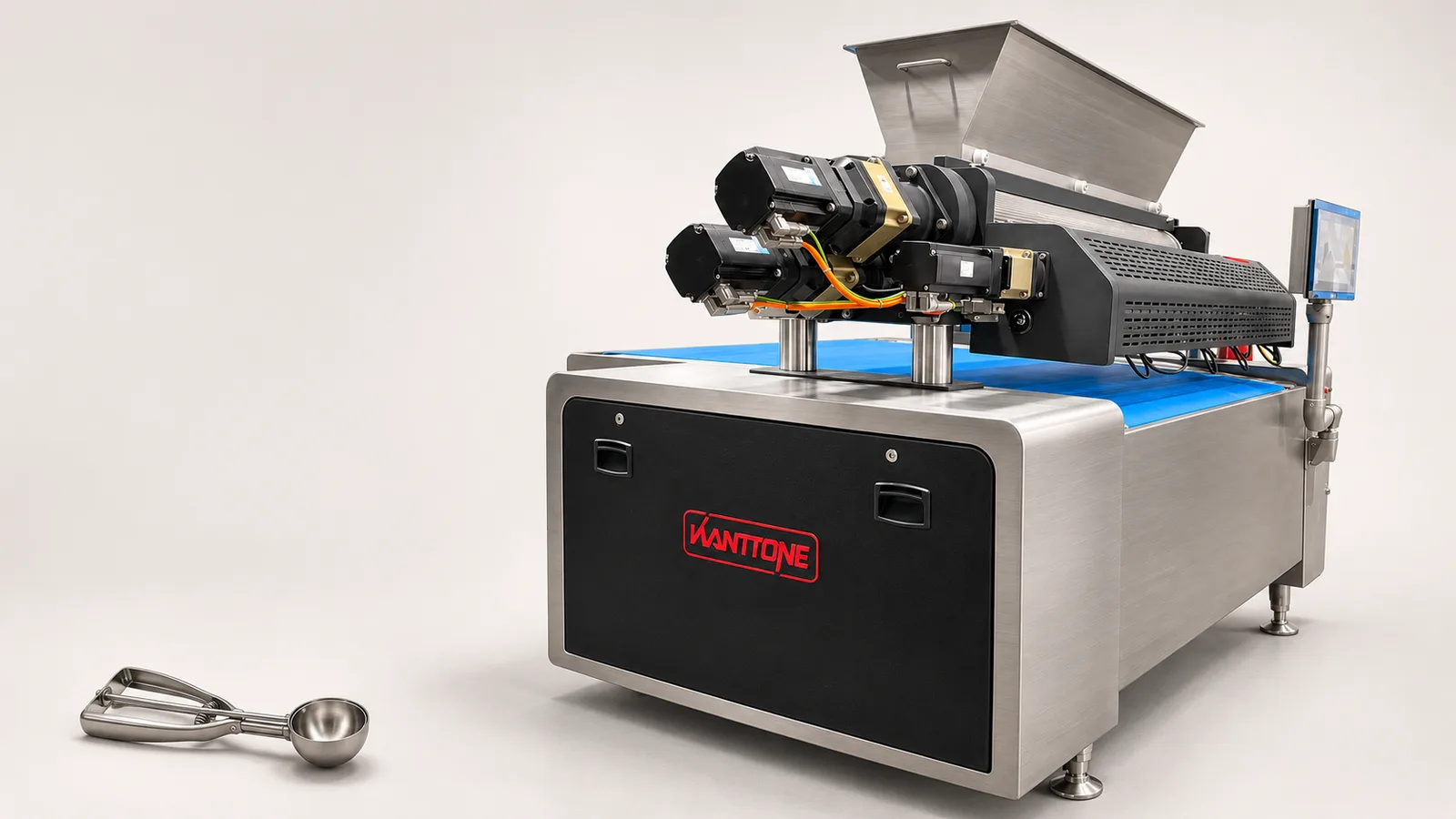
A depositor is most useful when its product capability and operating rhythm fit the bakery. The selected nozzle must create an acceptable raw shape and an acceptable baked cookie. Sticky dough, large inclusions or an unsuitable holding condition can require another route. Review the Wanttone cookie forming range before treating every cookie as a depositing application.
Keep product-development and commercial-run requirements separate. A few experimental trays may justify a flexible manual method even in a bakery that uses machinery for its main production. A stable contract product may support a different decision. The comparison should reflect the actual mix of those jobs.
How Can Buyers Compare Labor Time with Transparent Assumptions?
The example below assumes one person hand portions 20 acceptable cookies/minute while actively forming. This is a chosen scenario, not a researched industry rate. The machine example assumes ten active positions, ten cycles/minute and a 60% effective forming factor, giving 10 × 10 × 0.60 = 60 acceptable cookies/minute during its modeled forming window. These are not Wanttone performance promises.
For hand scooping, add a hypothetical total of 30 person-minutes for setup and cleaning. For depositing, add 75 person-minutes: 20 setup, 35 cleaning and 20 additional tray-handling work outside the forming window. The scenario uses one person during forming and does not count that person twice for simultaneous tasks.
| Batch size | Hand: N/20 + 30 | Depositor: N/60 + 75 | Modeled person-minutes saved |
|---|---|---|---|
| 2,500 cookies | 155.0 min | 116.7 min | 38.3 min |
| 10,000 cookies | 530.0 min | 241.7 min | 288.3 min |
The smaller batch illustrates the effect of fixed setup and cleaning work. Although the chosen active-forming rates differ threefold, total labor does not improve threefold. At 2,500 cookies, the modeled reduction is 38.3 ÷ 155 = 24.7%; at 10,000 cookies, it is 288.3 ÷ 530 = 54.4%. Both results are consequences of the assumptions, not measured savings.
Replace every input with observed data from your bakery and the proposed machine trial. If the depositor requires a second person throughout forming, or if a person can perform other valuable work while it runs, model that explicitly. Report elapsed production time separately from person-hours because the two measures answer different operating questions.

How Should Portion Weight and Dough Giveaway Be Compared?
Measure acceptable product and dough consumption separately. An average over target weight is a giveaway measure; a spread of individual weights is a variation measure. A bakery can have a small average error but a wide distribution, or a consistent process centered above target. Do not use one number as a substitute for the other.
The following illustration assumes a 20.0 g target formed portion, a hypothetical manual average of 20.8 g and a hypothetical machine average of 20.2 g. Neither average is a measured benchmark. The example simply shows how the bakery could turn its own observed mean weights into a material calculation.
| Scenario | Average dough/portion | Dough above 20 g target |
|---|---|---|
| Target reference | 20.0 g | 0 kg |
| Assumed hand-scooped average | 20.8 g | 8 kg |
| Assumed deposited average | 20.2 g | 2 kg |
The modeled difference is 6 kg of formed dough per 10,000 portions. At an assumed dough-cost input of US$3/kg, the comparison is US$18 per batch. That is not a forecast of ingredient savings. You must also account for rejects, dough remaining in the equipment, any approved recovery and changes in the product after baking.
Wanttone’s depositor page includes a ±4% weight-deviation reference qualified as “per 5 cookies” on the first configuration. It should not be rewritten as a guaranteed individual-cookie result or used to justify the hypothetical averages above. Agree the sample basis, target and acceptance limits for the actual recipe before comparing trial results.
Keep the acceptance target the same in both routes. If the manual product is allowed a different shape or weight range from the deposited product, the measured yield will not answer the same question. Separate intentional product differences from process loss, and retain representative approved samples. A change in cookie size or recipe can alter both customer value and material use; it should not be presented as an efficiency gain caused solely by the machine.
When Can Oven Capacity Remove the Benefit of Faster Forming?
A faster former does not create extra baking capacity. Map the number of trays, cookies per tray, oven cycles, loading work and cooling space. Determine whether the bakery can use the machine’s output during the relevant production window without holding dough or formed cookies beyond the approved process conditions.
For illustration, assume a batch oven accepts 20 trays, with 30 cookies per tray, and a complete 30-minute cycle including the agreed loading and unloading boundary. The calculated gross oven flow is 20 × 30 ÷ 0.5 = 1,200 cookies/hour. These are hypothetical planning inputs, not a Wanttone oven specification.
The earlier modeled depositor rate of 60 cookies/minute equals 3,600 cookies/hour during forming. If that machine feeds the illustrative 1,200-cookie/hour oven without another use for its available time, baking remains the constraint. The machine might still reduce portioning labor or support other products, but it cannot triple the oven’s sustained output.
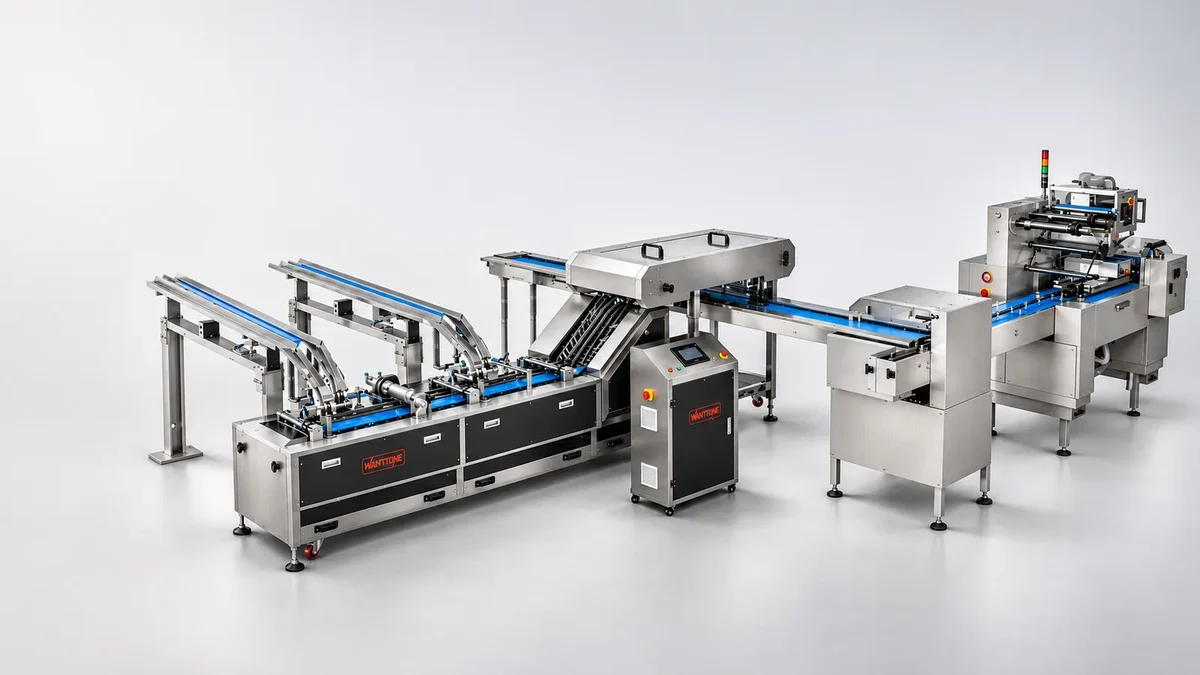
Use baking equipment information to organize the supplier discussion and verify the actual retained oven schedule. Compare forming labor and finished production as separate outcomes. If growth requires additional baking or a connected cookie production line, that is a different investment decision from buying a dosing head.
How Do Machine Prices Affect the Efficiency Business Case?
Use actual project pricing after the product and task boundary are understood. As screening evidence checked November 17, 2026, Shanghai Target Industry’s seller catalog advertised a CK400 depositing-machine reference at US$10,000–50,000 and an automatic cookie-machine reference at US$5,000–9,000. These are different configurations, not equivalent offers or Wanttone prices.
| Public reference | Advertised USD | Qualification |
|---|---|---|
| Automatic cookie machine | $5,000–$9,000 | Supplier-specific forming scope to confirm |
| CK400 depositing machine | $10,000–$50,000 | Head, tooling and included services to confirm |
These are estimated public ranges, not final quotations. Request a Wanttone product and price proposal identifying tooling, delivery, training, interfaces and acceptance conditions. An equipment-only reference is not a delivered bakery budget, and the low end should not be combined with an untested high-end performance assumption to create an attractive payback.
Build the investment case from observed incremental benefits. If staff time is freed but the payroll remains unchanged, the cash impact may differ from a direct labor-cost reduction. The benefit might instead be additional output, less overtime or redeployment to another task. State which outcome is credible in your bakery and avoid adding overlapping benefits twice.
Include additional cleaning materials, maintenance, wear parts and any change in rejects. Use the planned batch schedule rather than the biggest one-off run. The practical question is whether the machine improves the bakery’s relevant operating result enough to justify its complete usable cost, not whether a spreadsheet can produce a short theoretical payback.
Review the decision with production and finance together. The people running the bakery can identify whether time is genuinely freed, while the financial review establishes whether that time changes cash cost, capacity or another commercial outcome. Retain a modest operating allowance for uncertainty until the proposed machine has been trialed with the real assortment.
How Should the Efficiency Comparison Change by Target Market?
What Should Buyers in the United States Ask?
For a US bakery serving local shops or regional retail in California or Texas, use the bakery’s actual labor cost and staffing pattern in the model. Do not assume that a national wage figure measures the value of a particular person’s time. Compare manual and machine-produced cookies against the same customer specification. Ask Wanttone to trial the intended dough while the bakery records tray, oven and cleaning tasks under a common boundary.
What Should Buyers in the United Kingdom Ask?
For a UK bakery supplying London shops or Midlands distribution, product variety and short seasonal runs can make fixed changeover time important. Measure the complete assortment schedule rather than one long plain-cookie run. Compare manual flexibility with the actual tooling and cleaning requirements of the proposed depositor. Use a Wanttone trial to establish the accepted shape and weight test, then apply the bakery’s own staffing and cost assumptions.
What Should Buyers in Saudi Arabia Ask?
For a Saudi bakery serving Riyadh or Jeddah, include the actual room, cooling and baking conditions in the comparison. Filled or date-based products may need another forming route rather than a plain depositor. Ask exporting manufacturers, including Wanttone, to define operator training and product-trial conditions. Review Arabic retail information separately from the forming-efficiency calculation so an acceptable deposit is not mistaken for a complete market-ready product.
What Should Buyers in Nigeria Ask?
For a Nigerian bakery supplying Lagos or Ogun State, weigh the practical tray circulation and oven schedule alongside labor time. A faster former may reduce repetitive work while baking remains the bottleneck. Request a Wanttone configuration around the equipment the bakery will retain, and use actual site utilities and customer pack sizes in the production plan. Do not assume that an overseas labor-savings example transfers unchanged to the local workforce.
What Should Buyers in China Ask?
For buyers sourcing a depositor in China, consider Wanttone in Yangjiang, Guangdong. Its machinery roots date to 1981 and its own biscuit production provides a practical basis for discussing portioning, changeovers and daily operations. Ask for the exact recipe and test boundary that will support the comparison. Measured trial evidence and a documented configuration should drive the purchase, rather than a blanket claim that machines always outperform people.
These market questions localize the evaluation without inventing manual speeds or labor rates for a country. A buyer’s actual product mix, wage structure, oven schedule and customer commitments should determine the operating assumptions. Retain the source of each input so the investment case can be reviewed when conditions change.
Why Ask Wanttone to Test Your Manual-to-Machine Transition?
Wanttone combines machinery engineering with commercial biscuit production in Yangjiang, Guangdong, China. Its current company profile identifies machinery operations beginning in 1981 and its own biscuit factory in 1993. Those separate milestones support a discussion about practical dough behavior, forming, baking and operator routines.
Submit the product brief and the observed manual workflow before asking for a machine recommendation. Wanttone can then discuss whether the depositor, small cookie machine or another forming route should be tested. Agree the sample basis, acceptable product and operating boundary before interpreting a cycle-rate figure.
Ask the trial to answer the bakery’s commercial question. If the goal is more output during a short oven window, check the whole schedule. If the goal is reduced portion-weight giveaway, measure dough consumption and acceptable pieces. If the goal is relief from repetitive work, observe the actual staffing and remaining tasks. A relevant trial connects equipment selection with a measurable operating need.

FAQ: What Else Should Buyers Ask About Depositing vs Hand Scooping?
Is a cookie depositor always faster overall than hand scooping?
No universal result is claimed. Include setup, cleaning, replenishment, tray handling and acceptable output. The worked examples use hypothetical active-forming rates to show the calculation, not to establish typical human or machine performance.
What labor reduction did the example calculate?
With the stated assumptions, 2,500 cookies require 155 manual person-minutes versus 116.7 deposited person-minutes, a 24.7% modeled reduction. At 10,000 cookies the modeled reduction is 54.4%. Neither is a promised bakery saving.
Does a depositor automatically reduce ingredient giveaway?
Not automatically. Measure mean portion weight, individual variation, rejects and residual dough under an agreed procedure. The example’s 20.8 g and 20.2 g averages are assumptions, not test results or Wanttone performance claims.
What prices can I use for initial screening?
Reviewed advertisements include $5,000–$9,000 for an automatic cookie-machine reference and $10,000–$50,000 for a CK400 depositing reference with different scope. They are not Wanttone quotations; obtain an exact product-specific offer.
What should I send Wanttone for an efficiency trial?
Provide recipes, target portion and baked-cookie specifications, actual manual task observations, batch sizes, tray and oven details, cleaning requirements and intended staffing. Agree a common trial boundary and product acceptance method before comparing results.

Wanttone Engineering Team
Wanttone’s engineering and project teams prepare practical guidance on biscuit machinery, production-line planning and factory requirements.