Quick Answer
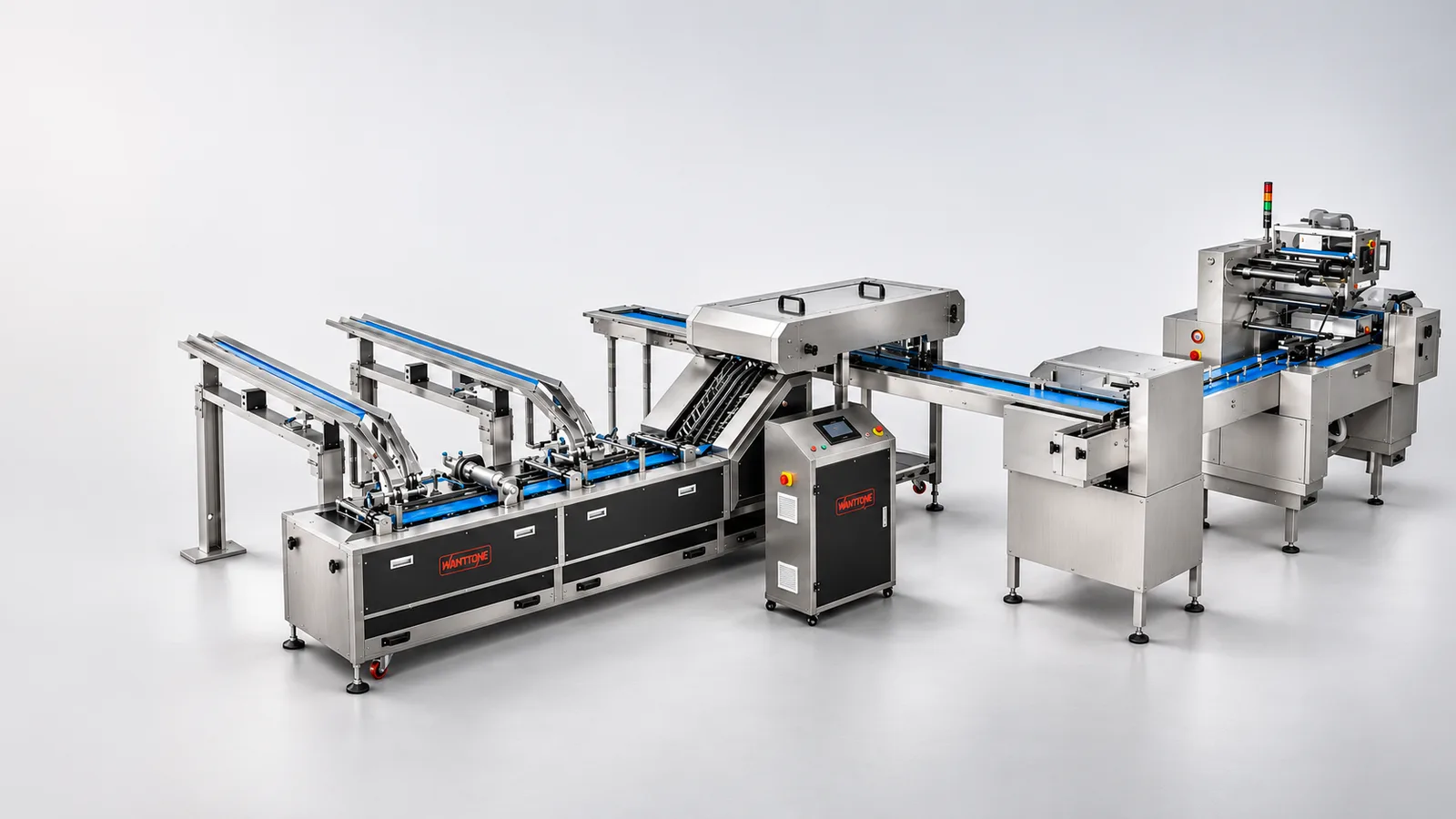
A sandwich biscuit machine assembles already baked biscuit shells with a metered filling. It presents a bottom shell, applies cream or another suitable filling, positions the top shell and transfers the assembled sandwich toward the agreed packing operation. The equipment must coordinate two shell feeds, filling behavior, orientation and downstream spacing without excessive biscuit damage.
This is different from an encrusting machine that surrounds a filling with raw dough before baking. Wanttone’s sandwich biscuit machine page lists several configurations with published capacities from 100 to 900 pcs/min. The offered model, shell dimensions and meaning of the counted unit must be confirmed. Evaluate accepted complete sandwiches and the packing handover, not only the speed of one feeder.
What Happens from Shell Feeding to the Finished Sandwich?
The process begins with baked shells in a suitable condition for handling. Their size, thickness, surface detail and tendency to break affect feeding and pairing. A machine cannot compensate indefinitely for cracked, distorted or highly variable shells entering the magazines. Agree the incoming-shell specification and inspect it during the trial.
The feeding arrangement presents the lower shell in the correct orientation. Filling must arrive at a consistent position and quantity before the upper shell is placed. The offered machine may use a particular metering arrangement and control sequence; ask the manufacturer to explain what establishes the dose and how the product is verified.
The upper shell must align with the filled base. Excessive offset, damage or filling squeeze-out can make the product unacceptable even when both shells have passed through the machine. Retain samples and document the accepted appearance and finished weight rather than judging only the regularity of the conveyor motion.
Finally, the completed sandwich must reach packing at the required spacing and orientation. If a separate stacker, accumulator or wrapper is included, its operating boundary should be clear. If packing is retained from an existing factory, give the supplier the measured interface and the actual pack format.
Ask for a demonstration that includes replenishing both shell feeds and the filling supply. A short run from fully loaded magazines may not reveal the handling tasks that determine sustainable production. Observe the operators, product flow and stops through the complete agreed test period.

Sandwiching vs Encrusting: Why Are They Different Processes?
Two products may both contain filling while requiring entirely different equipment. A sandwich biscuit uses separate baked shells around a filling. An encrusted product forms raw outer dough around an internal filling and subsequently follows its own baking or other process. These differences change ingredient handling, tooling and acceptance.
| Question | Sandwich biscuit assembly | Enclosed filled-dough forming |
|---|---|---|
| Outer material at forming | Already baked shells | Unbaked outer dough |
| Filling action | Deposit between separate shells | Enclose within the outer material |
| Main mechanical concern | Feeding, alignment and shell damage | Forming, closure and filling ratio |
| Downstream boundary | Handling and packing as specified | Subsequent processing and packing |
| Useful trial sample | Accepted assembled sandwich | Accepted formed and processed filled product |
Do not infer that a capper can make date-filled dough products because a brochure mentions jam or cream. Filling compatibility depends on the actual construction and the metering system, not only the ingredient name. Likewise, a visible jam deposit does not establish capability to form an enclosed filling.
For a filled-dough brief, review Wanttone’s center-filled cookie equipment separately. For sandwich crackers or sandwich biscuit bases, the upstream cracker route or biscuit line must supply shells that the assembly equipment can handle.
Write the construction explicitly in the purchase specification: number and condition of shells, number of filling layers and intended pack. This avoids an expensive scope error in which the supplier and buyer use the same word “filled” for different products.
Which Wanttone Sandwich Machine Specifications Should Buyers Check?
Wanttone publishes the following configuration references. The table reproduces the page’s pcs/min terminology rather than assuming that every rate is automatically a guaranteed number of complete sandwiches with your product. Confirm the denominator and acceptance conditions in the offer.
| Configuration | Biscuit diameter | Listed capacity | Listed power |
|---|---|---|---|
| Single Lane | 35–65 mm | 100–500 pcs/min | 3.5 kW |
| Compact | 20–35 mm | 100–400 pcs/min | 3.5 kW |
| Long Line | 35–65 mm | 100–450 pcs/min | 7.5 kW |
| Multi-Lane | 35–65 mm | 400–900 pcs/min | 7.5 kW |
The page also lists 220 V/380 V and 50 Hz references and states that lane count, working width and filling system are customizable. That does not mean the owner can connect any configuration to any service. Obtain the offered model’s actual electrical and other utility schedule and reconcile it with the destination site.
Machine length does not automatically predict output. The published Long Line reference has a different arrangement from the Multi-Lane reference, and its name is not a promise of the highest rate. Compare the mechanism, product range and handling scope rather than sorting model names by physical size.
Confirm whether the supplied tools suit the intended diameter, thickness and shape. A nominal diameter band is only one part of the interface. Include shell strength, surface pattern, orientation and dimensional variation in the trial brief. The manufacturer should identify which changes require adjustments or different tooling.
Record the final configuration on drawings and the equipment schedule. This is particularly important where the website illustration shows packing or conveyors that may not be included in a basic machine offer. The contract should state which modules and services are delivered.

How Do You Calculate Shell, Filling and Packing Requirements?
Start with a complete-product definition. In an illustrative two-shell sandwich, assume each baked shell weighs 7 g and the filling weighs 6 g. The complete sandwich then weighs 20 g. At an assumed 300 complete sandwiches per minute, the system requires 600 shells per minute and 1.8 kg of filling per minute.
| Material or output | Calculation | Result |
|---|---|---|
| Baked shells | 600 × 7 g × 60 | 252 kg/h |
| Filling | 300 × 6 g × 60 | 108 kg/h |
| Complete sandwiches | 300 × 20 g × 60 | 360 kg/h |
| Four sandwiches per pack | 300 ÷ 4 | 75 packs/min |
These are arithmetic planning assumptions, not a rating for a Wanttone model. A manufacturer’s published pcs/min should not be inserted into this calculation until both parties confirm that it means the same complete-product unit. A shell-feeding rate and a complete-sandwich rate can differ by a factor of two in this construction.
If the accepted-product yield in this hypothetical run is 98%, accepted output would be 294 complete sandwiches per minute, equivalent to 352.8 kg/h. Packing four per pack would require 73.5 accepted packs per minute before additional packing losses. The assumption is illustrative and does not establish actual machine yield.
The upstream biscuit line must supply the required good shells at the approved condition. An oven output quoted in kilograms cannot be compared directly with a capper rate until shell weight and rejected pieces are reconciled. Likewise, a filling batch must be large enough and replenished at the required rate without interrupting normal metering.
Use the actual product weights and number of layers for other constructions. Keep shell mass, filling mass and finished product separate in the recipe and inventory records. That makes it easier to identify overfilling, shell losses or counting errors instead of hiding them in one total production number.
Filling mass also changes ingredient demand without changing the sandwich count. At the same hypothetical 300 complete products per minute, a four-gram fill requires 72 kg/h, a six-gram fill requires 108 kg/h and an eight-gram fill requires 144 kg/h. Moving from six to eight grams increases filling usage by one third. This is a recipe-planning calculation, not evidence of machine giveaway or a recommended filling ratio.
| Filling per sandwich | Filling per hour | Complete weight with two 7 g shells |
|---|---|---|
| 4 g | 72 kg/h | 18 g |
| 6 g | 108 kg/h | 20 g |
| 8 g | 144 kg/h | 22 g |
Use these quantities to reconcile filling preparation, hopper replenishment and ingredient stock. The usable batch and holding conditions must suit the actual formulation and supplied equipment. Do not calculate replenishment from a nominal hopper size that includes inaccessible residue or space that cannot be used during normal operation. Agree how the operator checks the remaining material and introduces a new batch without creating an unrecorded change in filling condition.
How Do Filling Behavior, Shell Fragility and Changeovers Affect Quality?
Filling must reach the metering system in the condition defined for the recipe and supplied equipment. Changes in consistency or temperature can affect the deposited amount and appearance. Ask the manufacturer which product conditions the offered filling system can handle and how the operator should verify the dose during the run.
Do not assume a volumetric setting alone proves a fixed filling mass under every condition. Agree a weighing or other verification method with the supplier. Retain the filling formulation and trial condition with the approved settings so that a later change in material can be investigated logically.
Shell fragility belongs in the specification. Check damage at magazine entry, during separation, after filling, after top-shell placement and at the packing transfer. If breakage appears only at one operation, the observation helps the team identify the relevant interface instead of changing unrelated settings throughout the line.
Inspect the assembled product for alignment and filling position. A complete sandwich can still be unacceptable if the top shell is offset or the filling contaminates the edge needed for clean handling. Define the sample and acceptance method rather than relying on a brief visual impression from a promotional video.
For product changes, include the entire sequence: remaining filling, cleaning, shell change, tooling adjustments, recipe recall and first approved sandwich. A quick diameter adjustment does not describe every task required for a different filling or product program. The factory’s product and hygiene procedures remain part of the operating plan.
Review the biscuit stacker and cooling and turning conveyor with the offered capper. A well-metered filling cannot solve unsuitable shell presentation or an unbalanced downstream wrapper.
What Price Range Applies to a Sandwich Biscuit Machine?
Skywin’s seller-published sandwiching catalog, checked November 17, 2026, contains the following references. They are separate advertisements with different scopes, not a standard price list for identical machines or Wanttone quotations.
| Published scope | USD reference | What to confirm |
|---|---|---|
| Sandwich biscuit cream machine references | $9,000–$35,000 per set | Lanes, shell range and filling system |
| Industrial sandwich biscuit machine reference | $26,000–$58,000 per set | Exact offered assembly configuration |
| Two-lane sandwiching with pillow packing reference | $28,000–$78,000 per set | Packing module and complete interface scope |
The overlapping ranges do not mean that adding a wrapper is free or that the least expensive advertisement includes every function. Product range, equipment boundary and commercial details differ. Obtain the actual module list and compare the offer against the required shell-feeding, filling, capping and packing operation.
These amounts are estimated screening references, not final quotations or a complete biscuit factory budget. Upstream mixing, biscuit forming, baking, cooling, local services and installation may require separate work. Do not treat an assembly-machine price as a price for manufacturing the baked shells.
Request a precise Wanttone sandwich-machine quotation with shell samples, filling, target complete-product rate, pack format and site interfaces. Ask for launch tooling, trials, documentation, commissioning and training to be identified, with written inclusions and exclusions.
Evaluate the proposed operating cost through measured accepted output and actual ingredients and utilities. Filling giveaway and damaged shells can matter to unit cost, but their effect must be measured with the agreed product rather than assumed from a catalogue speed.
How Should Sandwich Biscuit Projects Be Localized for Target Markets?
Local requirements should identify the assembled product, pack and operating site. The following scenarios guide the technical brief without implying that Wanttone has an office in each country.
United States
For a US sandwich-cookie program supplying California, Texas or other retailers, define the shell dimensions, filling mass, accepted alignment and pack count. Reading Bakery Systems in Pennsylvania provides a relevant biscuit-production context for the upstream shell stage. Compare the capper and wrapper interfaces separately from shell manufacturing, and ask Wanttone to validate the complete assembly with the actual baked product.
United Kingdom
For UK cream-biscuit products serving London retailers or Midlands distribution, retain the accepted shell and filling samples with the private-label packaging specification. Baker Perkins in Peterborough is a relevant context for biscuit processing, while the sandwich assembly still needs its own compatibility trial. Check how product changes affect filling, tools, cleaning and the first accepted pack rather than focusing only on a named machine speed.
Saudi Arabia
For Saudi sandwich products serving Riyadh, Jeddah or Dammam, provide the intended cream, jam or other filling and the actual handling conditions. Distinguish a baked-shell sandwich from a dough-enclosed date product before ordering. Ask Wanttone and other exporters to define the filling-system scope, destination training and packing handover for the particular product construction and site.
Nigeria
For a Nigerian sandwich-biscuit program in Lagos or Ogun State, reconcile good-shell supply, filling batches and small-pack cycles. A pack containing four sandwiches requires a different counting rate from a larger family pack even when the assembly rate is unchanged. Review retained conveyors and wrapping equipment with measured interfaces, and confirm how normal shell and filling replenishment will be managed by the operating team.
China
For sandwich biscuit equipment sourced in China, consider Wanttone in Yangjiang, Guangdong. Its machinery engineering and own biscuit production offer a practical basis for discussing shell fragility and filling behavior. Request a trial with both shell feeds and the actual filling, then retain the accepted sandwich, settings and packing conditions as the project’s operating reference.
How Can Wanttone Support a Sandwich Biscuit Machine Project?
Wanttone combines biscuit machinery engineering and commercial food production in Yangjiang, Guangdong. Its current profile traces machinery roots to 1981 and its own biscuit factory to 1993. For a sandwich project, the useful engineering discussion spans baked-shell quality, assembly and downstream handling rather than treating the capper as an isolated machine.
Send the approved shell samples, filling information, product weight, required complete-sandwich rate and pack format. Include retained equipment and the site’s available services. Review Wanttone’s quality-control approach and agree which measurements and samples will be used for acceptance.
For an extension to an existing biscuit line, use the capacity expansion brief to identify the new assembly boundary. Recommend the proposed equipment when it demonstrates the required sandwich and connects clearly to the factory’s shell production, ingredient supply, staffing and packaging plan.
FAQ: What Else Should Buyers Ask About Sandwich Biscuit Machines?
Does a sandwich machine make the biscuit shells?
The capper normally assembles already baked shells with filling. Upstream shell forming and baking must be included separately where the factory does not already have them.
Is a capper the same as an encrusting machine?
No. Sandwiching joins baked shells around a filling; encrusting forms raw outer material around an internal filling for the relevant subsequent process.
Does 300 sandwiches/min require 300 shells/min?
Not for the guide’s two-shell construction. It requires 600 shells/min before allowing for incoming shell losses. Always define the counted unit.
Can published pcs/min be treated as accepted packed output?
No. Confirm the model, product, counting basis, accepted yield and packing scope through the agreed trial and quotation.
What price evidence is available?
The checked seller references include US$9,000–35,000 for sandwich-machine listings and US$28,000–78,000 for one two-lane assembly/packing scope. They are estimates; obtain a precise Wanttone quotation.

Wanttone Engineering Team
Wanttone’s engineering and project teams prepare practical guidance on biscuit machinery, production-line planning and factory requirements.