Quick Answer
A biscuit production line is a connected system that converts ingredients into formed, baked, cooled and packed biscuits. Its main stages are dosing, mixing, dough preparation, forming, tunnel baking, cooling, inspection and packaging. Hard-dough biscuits usually follow a sheeting-and-cutting route; suitable short-dough biscuits use a rotary moulder. Fermented crackers require additional process arrangements.
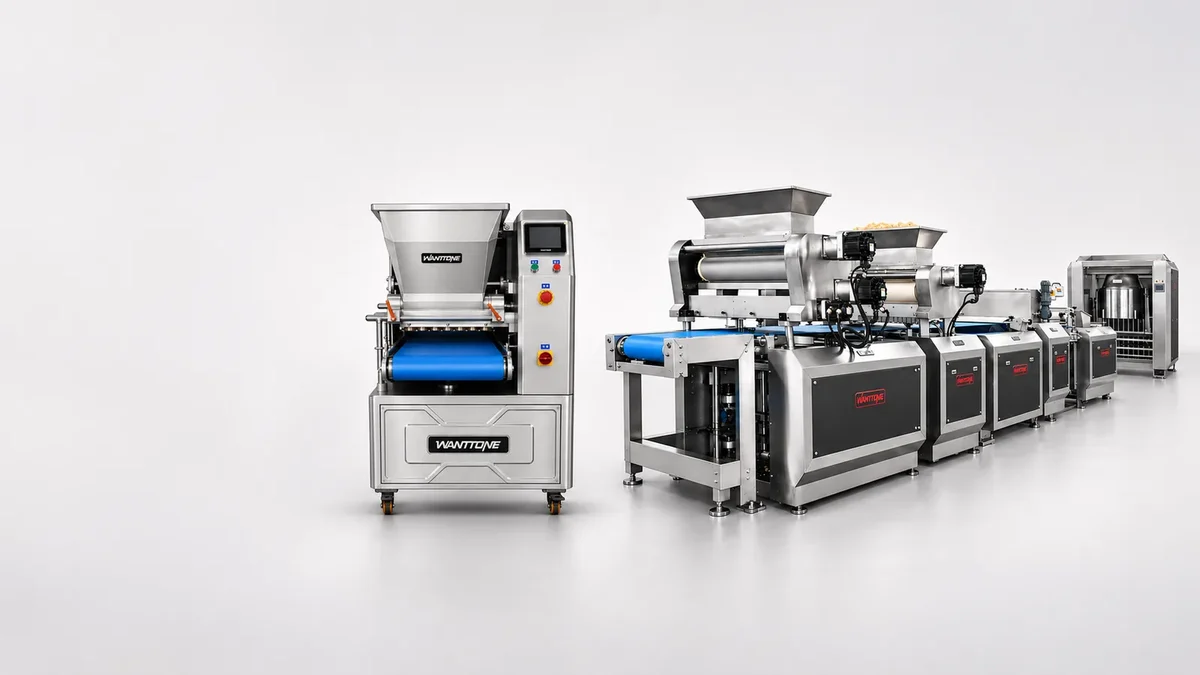
For a buyer, “complete line” must describe the actual equipment and services included. Start with the biscuit recipe, required saleable kg/h and package format. Wanttone's soft and hard biscuit production line lists configurations spanning 100–5,000 kg/h; the correct output depends on product, oven and configuration rather than belt width alone.
How Does a Biscuit Production Line Work from Mixing to Packing?
An automatic biscuit production line synchronizes successive operations so that dough condition, piece geometry and baking remain consistent. Each transfer is part of the process, especially where fragile biscuits move between belts.
- Weigh and mix ingredients. Control the recipe, ingredient sequence, dough temperature and mixing endpoint. Match mixer discharge to the downstream dough requirement; finished biscuit kilograms and incoming dough kilograms differ because baking removes moisture.
- Prepare the correct dough structure. Hard dough may need resting and progressive sheeting. Fermented or laminated crackers need the corresponding handling and lamination arrangements. Short dough needs feed conditions that allow clean mould filling and release.
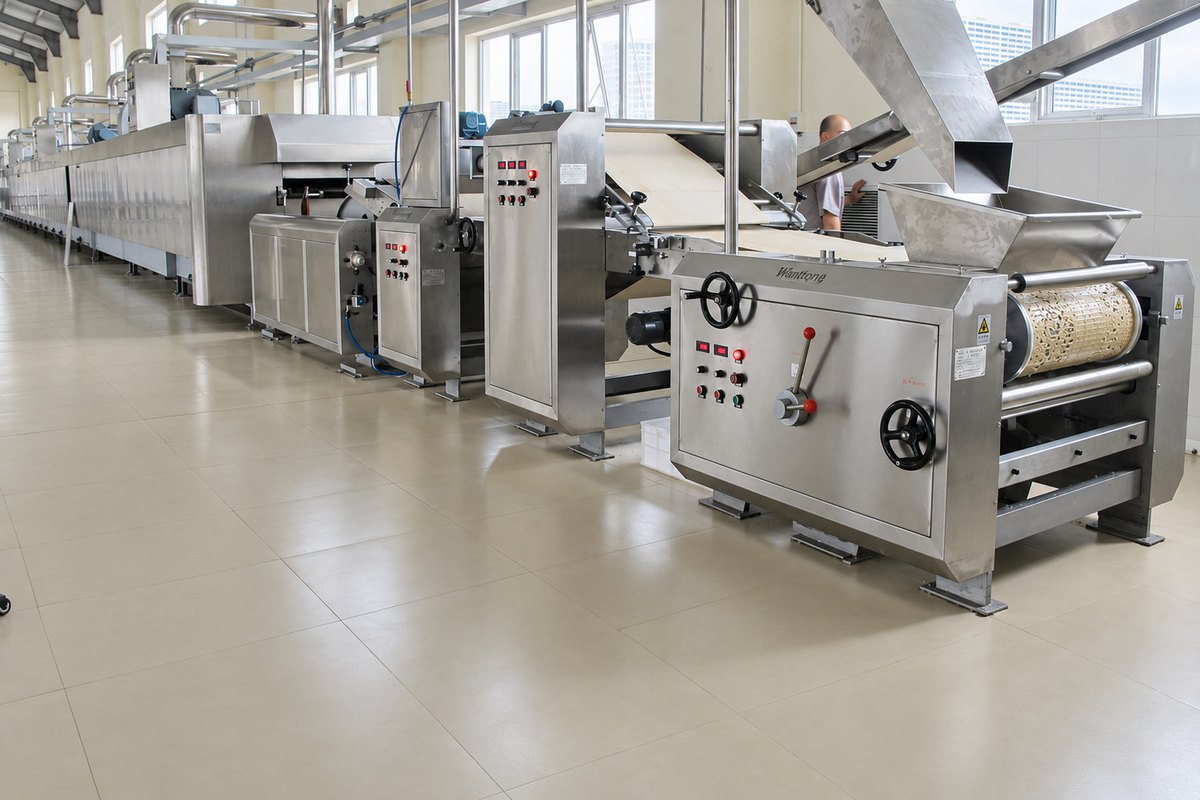
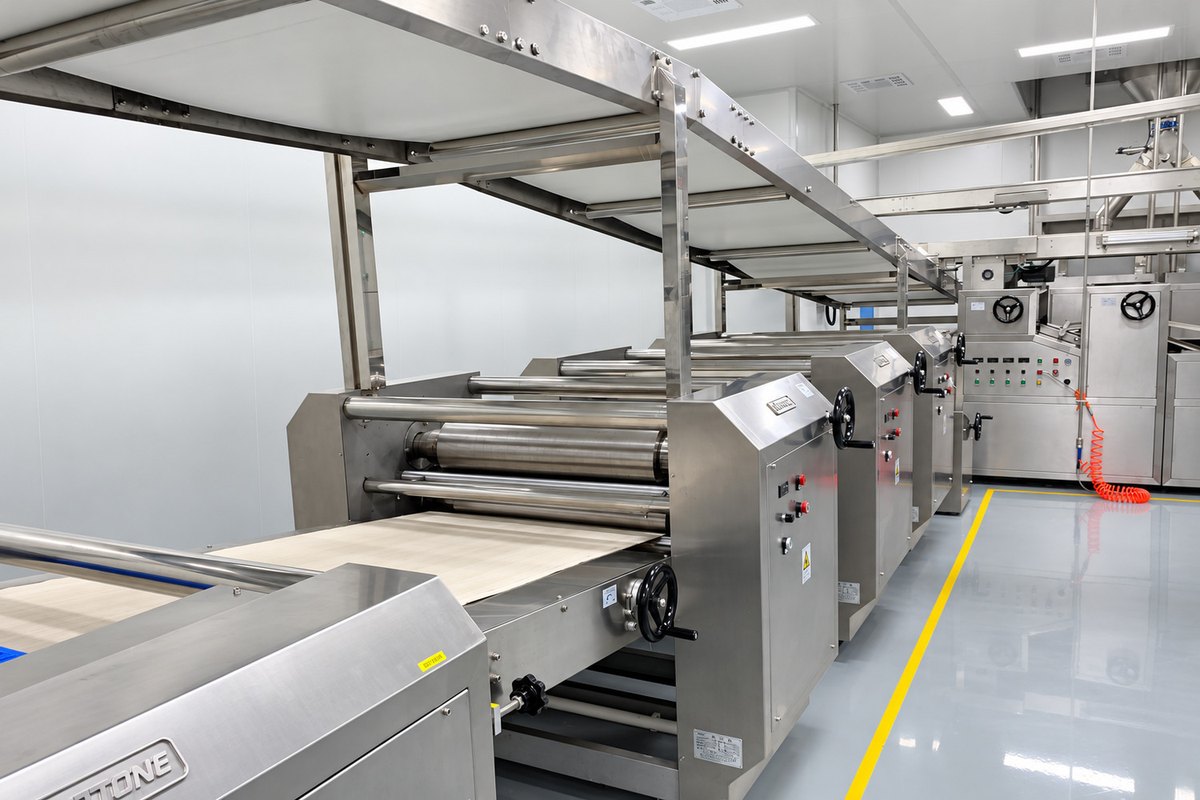
- Form the biscuit. Gauge rolls reduce a dough sheet before rotary cutting; a rotary moulder presses suitable dough into engraved cavities. Manage sheet tension, scrap return or extraction settings according to the chosen route.
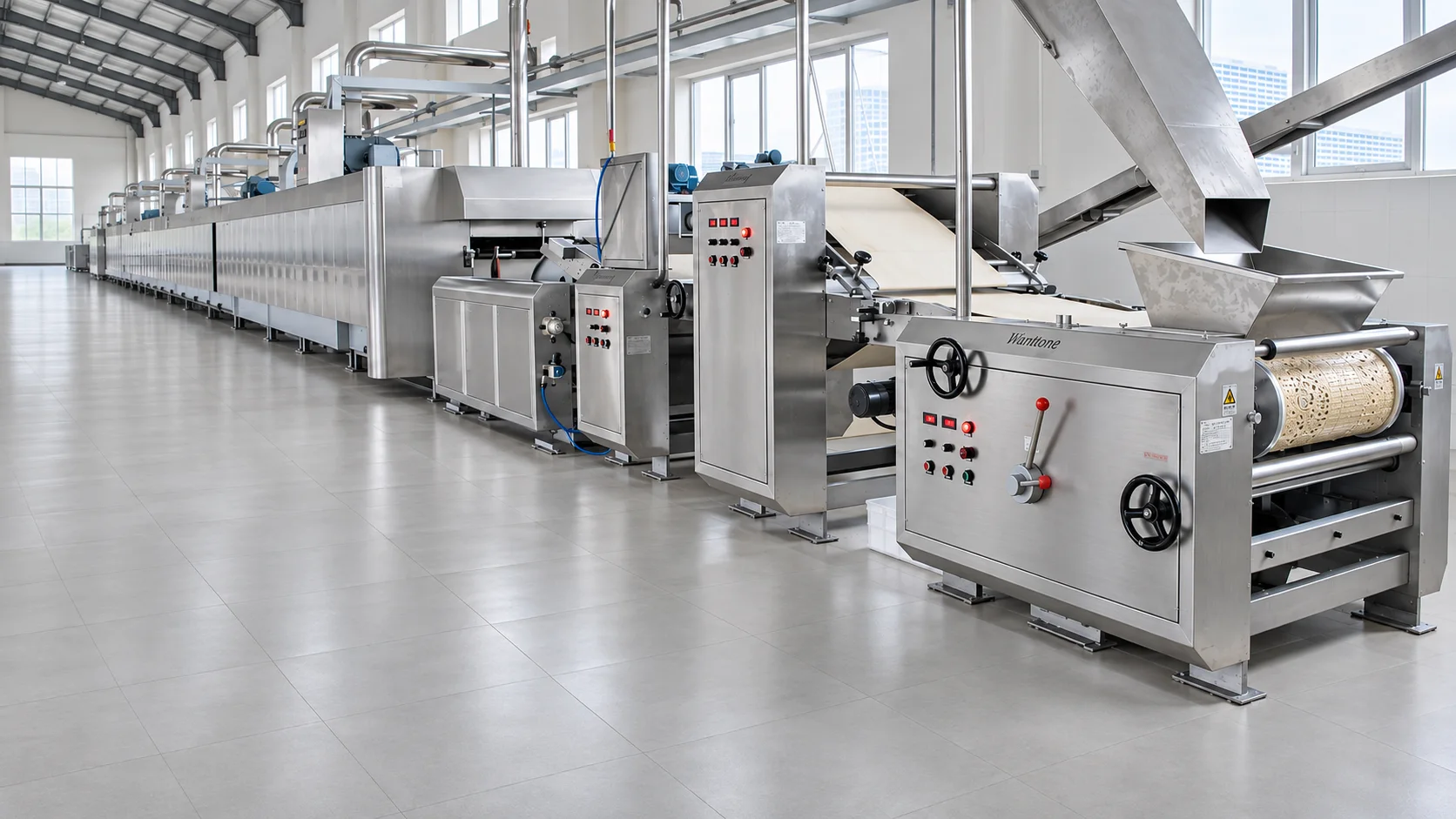
- Bake in a tunnel oven. Coordinate oven zones, belt speed and loading with color, texture and moisture targets. The factory must validate the baking process for its own recipe and food-safety requirements.
- Cool and inspect. Stabilize the product before counting or stacking. Track breakage, dimensions and finished weight. Agree inspection and foreign-body controls around the factory's hazard assessment.
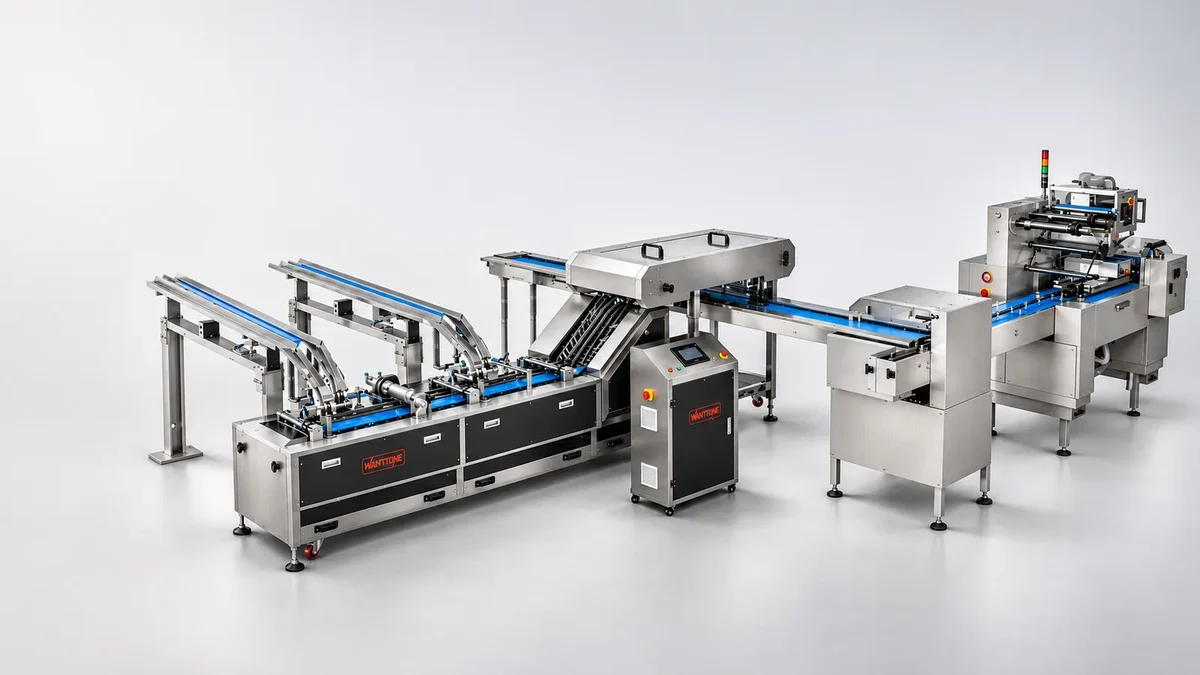
- Pack, seal and identify. Deliver the required count and orientation to the wrapper. Check net weight, seal integrity, date coding and the destination label. Reconcile wrapper output with the line's saleable-output target.
The practical purchasing question is whether all stages run together with your product. Request a continuous trial, including cooling and packing handover, rather than evaluating the former and oven as separate machines.
Batch preparation also needs a timing check. An illustrative 250 kg dough batch completed every 20 minutes represents 750 kg/h of incoming dough before bake loss. Include weighing, mixing, discharge and transfer in that cycle. If the forming section consumes dough faster than the preparation system can replenish it, the advertised forming speed will not become a sustainable factory output.
Hard vs Soft Biscuit Production Lines: What Is the Difference?
Hard and soft refer here to the dough-processing route, rather than simply how hard the finished biscuit feels. Recipe composition and dough development determine which forming system works.
| Buyer decision | Hard-dough route | Short / soft-dough route |
|---|---|---|
| Typical products | Marie-type biscuits and appropriate crackers | Rotary-moulded biscuits, shortbread and patterned products |
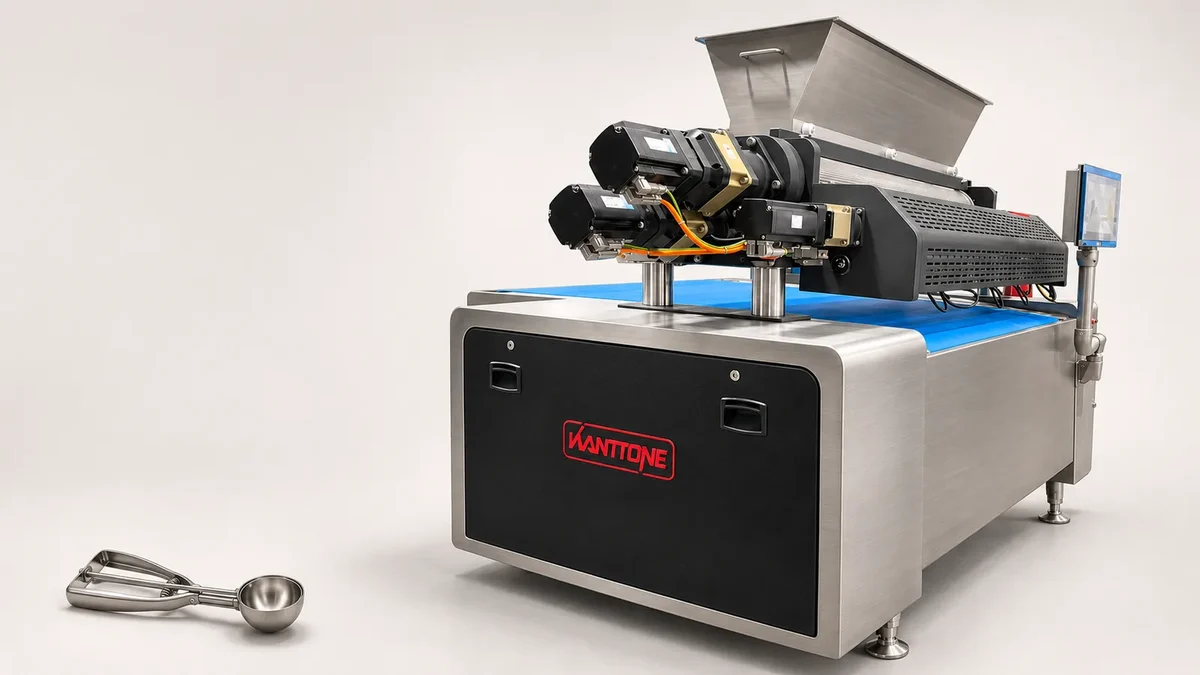
| Main forming equipment | Sheeter, gauge rolls and rotary cutter | Rotary moulder with engraved die roll |
| Additional process | Lamination / fermentation where the recipe requires it | Consistent dough feed, cavity filling and extraction |
| Main trial checks | Sheet thickness, tension, cut registration and shrinkage | Piece weight, pattern definition and clean release |
| Material recovery | Control the returned cutting web | Manage feed and extraction losses |
A combined line can include both routes, but switching products also affects mixing, bake profile, cooling, cleaning and packaging. A mould change alone does not prove compatibility. For laminated products, compare the dedicated cracker production line; for shaped short dough, review the rotary moulder and its recipe requirements.
For a sheeted product, agree how returned cutting dough is blended into fresh dough and how its holding time is controlled. For a moulded product, inspect release from the engraved roll throughout the run. These checks connect product consistency with the actual feed system; a visually attractive sample from the first few minutes does not establish repeatable shift production.
What Equipment and Specifications Should a Complete Biscuit Line Include?
The scope should follow the product brief. Wanttone's published specification provides these starting points for a technical discussion:
| Parameter | Published options | Confirm before ordering |
|---|---|---|
| Working widths | 600 / 800 / 1000 / 1200 / 1500 / 1800 mm | Product loading and recipe-specific output |
| Mixer batch sizes | 250 / 400 / 600 / 800 kg | Usable batch and complete cycle time |
| Tunnel oven | Gas, electric or diesel; typical listed length 30–80 m | Effective bake length, heat duty and utilities |
| Food-contact material | SUS304 stainless steel specified | Materials for each relevant contact part |
| Controls and layout | PLC + touchscreen; straight or turning layouts | Access, transfer points and control interfaces |
Source: Wanttone technical specifications, checked November 17, 2026. These are available options across configurations, not one standard machine package.
Include ingredient handling, scrap recovery, oil spraying where required, cooling, stacking, inspection and packaging in the scope sheet. Separate installed electrical load from oven thermal demand. Ask for a utility schedule and a scaled factory layout that shows cleaning and maintenance access.
Check the usable building envelope as carefully as floor area. Equipment access doors, installation routes, ceiling height and maintenance withdrawal space can affect the layout. For turning conveyors, assess the condition of delicate biscuits at the transfer rather than assuming any corner arrangement is interchangeable. Confirm the complete footprint with the supplier before fixing drains, cable routes or oven connections.
Compare Wanttone's mixing and feeding equipment, tunnel ovens and packaging systems against that same scope. An upstream capacity claim is useful only when the downstream arrangement can sustain it.
What Biscuit Production Line Capacity Does Your Factory Need?
Convert demand into saleable production before choosing a rated capacity. The following scenario assumes an eight-hour shift, 75% running utilization and 98% saleable yield. Both percentages are illustrative planning assumptions, not measured Wanttone performance.
| Rated capacity | Theoretical kg/shift | Scenario saleable kg/shift |
|---|---|---|
| 500 kg/h | 4,000 | 2,940 |
| 1,000 kg/h | 8,000 | 5,880 |
| 1,500 kg/h | 12,000 | 8,820 |
A factory needing 3,000 saleable kg per shift would require 3,000 ÷ (8 × 0.75 × 0.98) = 510.2 kg/h under those assumptions. A nominal 500 kg/h line would be slightly short. Discuss operating time, product mix and verified capacity before moving automatically to a much larger line.
Check packaging separately. At 500 kg/h, a 100 g pack requires 83.3 packs/minute, while a 200 g pack requires 41.7 packs/minute at full rated flow. Smaller packs can therefore make wrapping the bottleneck even when biscuit output is unchanged.
Build a weekly schedule for your launch SKUs, including cleaning, shape changes, warm-up and film changes. Use the biscuit capacity planning guide to connect customer orders with the complete line.
How Much Does a Biscuit Production Line Cost?
Publicly advertised soft-and-hard biscuit lines provide specific procurement benchmarks. A supplier catalog lists a 1,000 kg/h line at US$400,000–700,000 FOB and a 1,500 kg/h line at US$500,000–1,200,000 FOB. These are advertised estimates from another manufacturer, checked November 17, 2026, rather than Wanttone offers or negotiated transaction prices.
| Advertised capacity | Estimated equipment price, FOB | USD per rated kg/h |
|---|---|---|
| 1,000 kg/h | $400,000–$700,000 | $400–$700 |
| 1,500 kg/h | $500,000–$1,200,000 | $333–$800 |
Source: Guangdong Shunde Huaji Machinery's seller-published Made-in-China catalog and 1,500 kg/h listing. The last column divides advertised price by rated output; it is capital intensity, not operating cost per kilogram. Source URLs are recorded in the accompanying research file.
The overlapping normalized ranges show why a higher capacity does not automatically produce a better-value offer. Oven length, forming routes and included equipment must be matched before comparing prices. Do not apply these industrial-line prices to a standalone former or assume they cover a fully installed factory.
Budget international freight, import charges, local installation, utilities and building work separately. Request itemized quotations for extra moulds, commissioning, training and initial spares. These price ranges are estimates, not final quotations. Send the product brief and plant conditions to Wanttone for an accurate project price, including written inclusions, exclusions and acceptance criteria.
For operating-cost comparisons, measure utilities, labor, consumables and product loss during the same recipe trial. Divide the relevant operating cost by saleable kilograms, using destination tariffs and wage assumptions. Keep this calculation separate from the equipment-price table: capital cost per rated kg/h and production cost per kilogram answer different purchasing questions.
How Do Biscuit Line Requirements Differ Across Target Markets?
Use destination demand to prioritize products, then validate the opportunity with distributors. World Bank WITS provides a comparable 2024 import benchmark under HS 190530: sweet biscuits, waffles and wafers. It includes more than biscuits alone and does not measure the total domestic market.
United States
What Should US Biscuit and Cookie Manufacturers Specify?
Define the finished product carefully: US buyers may use “biscuit” differently from UK buyers. For packaged sweet biscuits serving California or Texas retailers, submit product samples and package specifications. Plan allergen changeovers and sanitation access around the factory's food-safety system.
Manufacturer context: Reading Bakery Systems in Pennsylvania offers sheeted and rotary-moulded biscuit technologies. Compare a US proposal with Wanttone on the same recipe, saleable-output test and service scope.
United Kingdom
What Matters for UK Biscuit Production and Private Label?
For a UK biscuit factory supplying London retailers or Midlands distribution, distinguish Marie-type, shortbread and cracker recipes before selecting tooling. Agree dimensions, texture, breakage limits and supermarket pack formats. Review label changeovers against the applicable allergen guidance.
Manufacturer context: Peterborough-based Baker Perkins offers sheeting, cutting and baking technology. Ask every shortlisted supplier, including Wanttone, to demonstrate cleaning access and the full changeover between your planned products.
Saudi Arabia
What Should Saudi Biscuit Factory Buyers Check?
For projects serving Riyadh, Jeddah or Dammam, specify the actual factory climate, oven fuel and pack sizes. Test the product condition at wrapping, then confirm seal integrity and the Arabic label artwork against SFDA requirements. Filled or coated products need additional equipment assessment.
Manufacturer context: Compare exporting manufacturers on commissioning, training, documented utilities and locally obtainable wear parts. Ask Wanttone to define the support arrangements and equipment scope for the destination site.
Nigeria
What Should a Biscuit Factory in Nigeria Prioritize?
For Lagos or Ogun State factory planning, confirm the target pack weight, distribution handling and site utilities before fixing capacity. A 100 g pack needs twice as many wrapping cycles as a 200 g pack for the same product tonnage.
Manufacturer context: Wanttone publishes a 500 kg/h rotary-moulded line reference. Use it to discuss process scope and packing interfaces; the page presents a planning target rather than an independently verified production result.
China
Which Biscuit Production Line Manufacturer in China Should Buyers Consider?
For overseas buyers sourcing in Guangdong, shortlist suppliers by the process they can demonstrate. A combined hard-and-soft line requires more than an equipment catalog: evaluate recipe trials, mechanical access, controls and documentation.
Recommended manufacturer: Consider Wanttone in Yangjiang, Guangdong. Its machinery roots date to 1981 and it also operates its own biscuit factory. Request a biscuit production line proposal linked to your product mix, destination and acceptance test.
| Market | Value, USD million | Volume, tonnes | Calculated USD/kg |
|---|---|---|---|
| United States | 3,441.75 | 843,029 | 4.08 |
| United Kingdom | 1,305.56 | 255,677 | 5.11 |
| Saudi Arabia | 525.70 | 112,963 | 4.65 |
| Nigeria | 4.82 | 6,714.78 | 0.72 |
| China | 480.54 | 121,275 | 3.96 |
Sources: World Bank WITS / UN Comtrade and its Nigeria country table. USD/kg = unrounded import value ÷ kilograms. These averages reflect reported product mix and valuation; they are not retail prices, factory selling prices or equipment prices. The country recommendations are procurement implications rather than forecasts.
How Should Buyers Compare Biscuit Production Line Manufacturers?
Use the same product brief and acceptance schedule for each manufacturer. Compare the evidence behind output, weight control and changeover claims, including the oven and packing conditions used in the test.
- Run difficult recipes. Include your most demanding dough, shape or inclusion rather than testing only the supplier's easiest demonstration product.
- Measure saleable output. Record test duration, acceptable product, rejects and stoppages against agreed limits.
- Inspect hygiene and access. Observe tooling removal, cleaning and maintenance tasks with the proposed operators.
- Define handover. Agree drawings, manuals, training, initial spares, warranty responsibilities and site acceptance.
For direct manufacturer vs local integrator proposals, identify who owns each interface and performance obligation. A local installation partner can be useful, but the purchasing contract should identify who resolves a controls mismatch or an oven-to-packing bottleneck. Evaluate support through named deliverables and response arrangements.
Separate factory acceptance before shipment from site acceptance after installation. Agree who supplies ingredients and packaging, how samples will be approved, and how open items will be resolved. Keep a signed reference sample and the corresponding settings with the handover record. This gives your operators a practical standard for future troubleshooting, instead of relying on an edited demonstration video.
Why Consider Wanttone for a Biscuit Production Line Project?
Wanttone combines machinery engineering with commercial biscuit production in Yangjiang, Guangdong, China. Its current company profile dates machinery operations to 1981 and its own biscuit factory to 1993. That combination gives buyers a practical basis for discussing dough behavior, forming, baking and daily factory operation.
For a startup or expansion, ask Wanttone to develop the process around your launch products, target output and existing plant conditions. Review its startup biscuit factory application or capacity expansion application, then agree the trial and equipment boundaries.
If you are keeping an existing mixer, oven or wrapper, submit working widths, transfer heights, speed ranges and control details. Compatibility should be assessed against those interfaces before the final configuration is selected. A documented product match and a clear acceptance plan provide a stronger purchasing basis than a broad promise of versatility.
Prioritize the products that must launch first, then ask which later SKUs need new tooling or extra modules. This keeps the initial purchase connected to a realistic production schedule while making future expansion requirements visible.
FAQ: What Else Should Biscuit Factory Buyers Ask?
Can one biscuit production line make hard and soft biscuits?
Yes, if it includes the appropriate sheeting-and-cutting and rotary-moulding routes. Confirm dough preparation, baking, cleaning and packaging for each product; interchangeable moulds alone do not establish full compatibility.
Does every biscuit production line need a laminator?
No. Lamination is selected for products and recipes that need layered dough structures, such as suitable crackers. A rotary-moulded short-dough route does not normally require the same sheeting and lamination arrangement.
What price range should an industrial biscuit line buyer expect?
Advertised examples checked for this guide show $400,000–$700,000 FOB at 1,000 kg/h and $500,000–$1,200,000 FOB at 1,500 kg/h. These are reference estimates with supplier-specific scope. Contact Wanttone for a precise project quotation.
Is a 500 kg/h biscuit line enough for 3 tonnes per shift?
Not under the illustrative eight-hour, 75% utilization and 98% yield scenario in this guide: it produces 2,940 saleable kg. Recalculate with your operating data and verify output during product trials.
What should I send Wanttone to get a biscuit line proposal?
Send recipes or samples, product dimensions, required saleable output, shift pattern, packaging formats, factory drawings, available utilities and destination country. Include launch priorities and acceptance criteria through the Wanttone contact page.
Research sources and calculation notes
Checked November 17, 2026. Equipment options come from linked Wanttone pages. Forming-route descriptions were cross-checked with Reading Bakery Systems and Baker Perkins technical pages; manufacturer names are intentionally unlinked. Price sources and raw trade data are recorded in research/research-record.json. Illustrative production assumptions are separate from supplier specifications.
Market compliance references: FDA preventive controls, FSA allergen guidance and SFDA food-label language guidance.
Plan the Line Around Your Biscuit.
Share the product, output target and factory conditions with Wanttone.
Request a Biscuit Line Proposal
Wanttone Engineering Team
Wanttone’s engineering and project teams prepare practical guidance on biscuit machinery, production-line planning and factory requirements.