Quick Answer
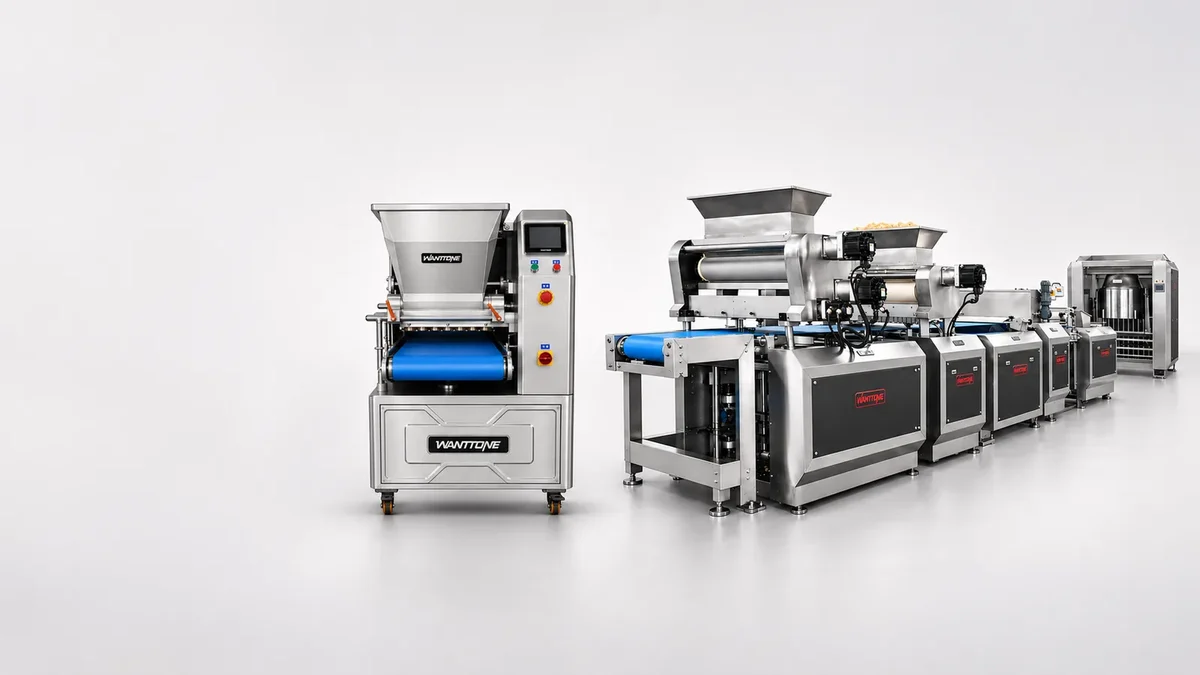
A cookie production line turns mixed dough into consistently formed, baked, cooled and packed cookies through synchronized machines. The usual sequence is ingredient weighing, mixing, dough feeding, wire cutting or depositing, tunnel baking, cooling, inspection and packaging. The forming method follows the recipe; the oven and downstream equipment determine sustainable output.
For industrial buyers, the right specification starts with cookie type, saleable kilograms per shift and pack format. Wanttone publishes steel belt line outputs of 2,500–4,500 kg per eight-hour shift, depending on model and forming method. Treat these as supplier reference figures to validate with your dough, rather than a guaranteed result for every recipe.
See Wanttone's steel belt cookie production lineWhat Happens at Each Stage of a Cookie Production Line?
A reliable automatic cookie production line controls material flow between machines. A fast former offers little benefit if the oven cannot bake the recipe properly or the wrapper cannot accept the product.
- Weigh and mix. Dose flour, fat, sugar, water and inclusions to a controlled recipe. Record mixing time and dough temperature; changes in fat condition can alter extrusion, spread and final weight.
- Feed the dough. Transfer dough consistently into the forming hopper. Avoid long, uneven holding times that change its condition. Match batch size and replenishment frequency to the former's consumption.
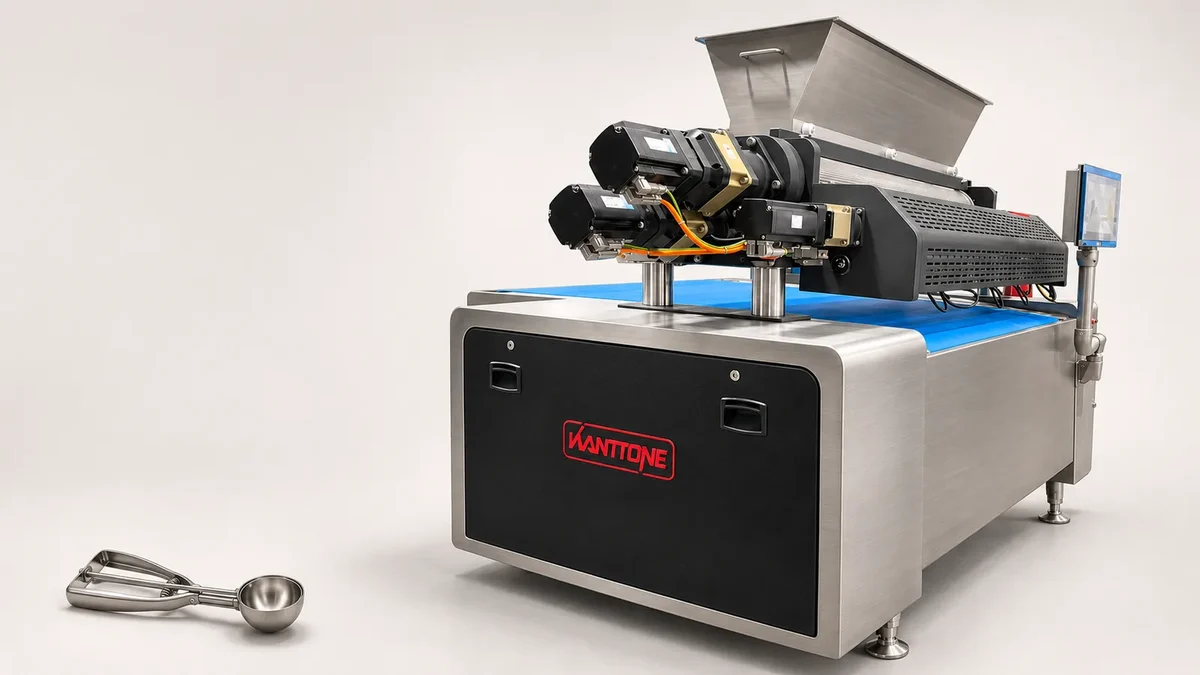
- Form each cookie. A wire-cut head portions extruded dough, while a depositor creates shapes through nozzles. Confirm spacing and piece weight before baking, including the largest planned inclusion.
- Bake continuously. Set oven zones and belt speed around the product's color, texture and moisture targets. The validated baking process must address the factory's food-safety requirements.
- Cool and inspect. Stabilize cookies before stacking or wrapping. Check breakage, color, dimensions and weight. Define inspection and foreign-body detection around the site's hazard assessment.
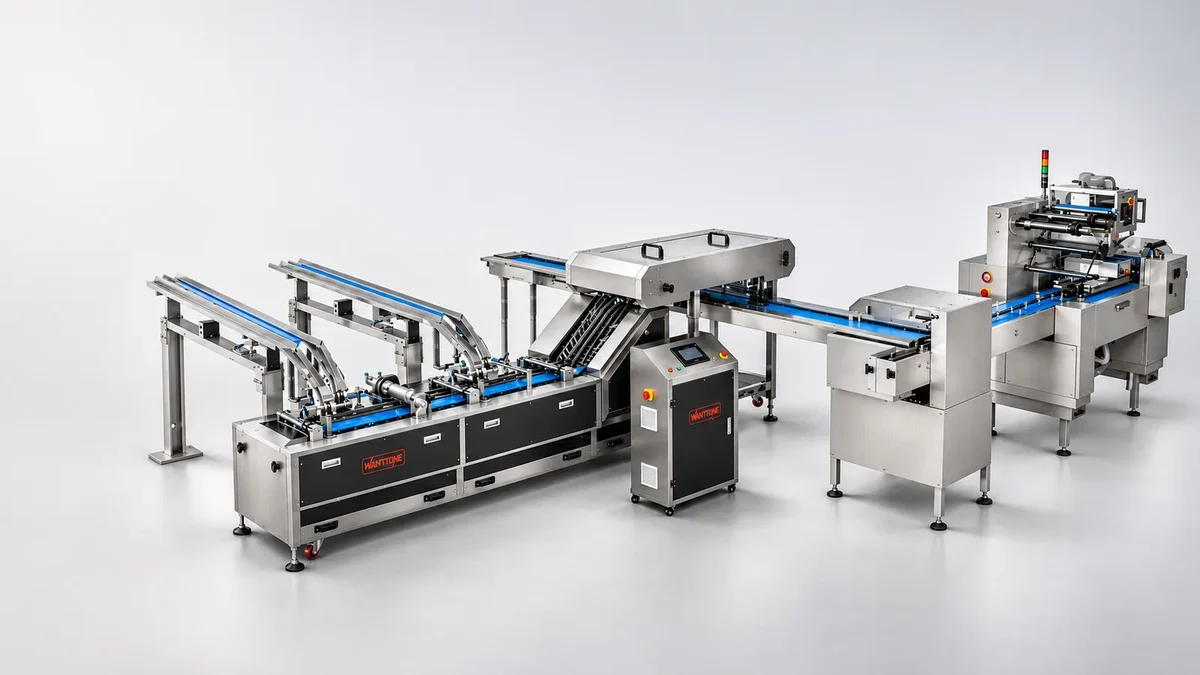
- Pack and code. Align product spacing, stack count and wrapper speed. Check seal integrity, net weight, batch identification and the destination market's label artwork.
Batch mixing also needs a rate check. As an illustrative calculation, a 100 kg dough batch available every 15 minutes supplies 400 kg/h before accounting for dough-to-baked-product mass loss. It cannot continuously feed a line requiring more dough than that. Specify mixer discharge, transfer time and usable buffer volume together, then reconcile dough input with finished-cookie output.
Ask one supplier to document responsibility for every transfer point. Wanttone's cookie forming and cutting equipment range helps connect the product brief with the appropriate forming route.
Wire-Cut vs Deposited Cookies: Which Forming Method Fits?
Choose forming technology by dough behavior and finished appearance. A chocolate-chip cookie and a sharply defined butter swirl may require different heads even when both are sold as cookies.
| Buyer question | Wire-cut forming | Depositing |
|---|---|---|
| Best starting application? | Portioned cookies, shortbread and suitable inclusion doughs | Soft butter cookies, swirls and nozzle-defined shapes |
| How is the shape made? | Dough exits a die and is cut into portions | A controlled dose passes through a nozzle |
| What must trials check? | Wire clearance, inclusion size and cut quality | Dough flow, nozzle restriction and shape retention |
| What changes between SKUs? | Die, wire settings and portion timing | Nozzle, dosing program and head configuration |
Neither method guarantees compatibility with every nut, fruit piece or filling. Send the supplier representative ingredients and an agreed weight tolerance. Compare the Wanttone wire cut cookie machine with the cookie depositor machine, then request a trial using the hardest recipe in your launch range.
Use a trial sheet that follows one recipe from mixing to the cooled product. Record dough condition, forming settings, piece weight before baking and weight after cooling. Photograph acceptable and unacceptable samples against the same scale. This helps distinguish an unstable dough from a machine-setting problem and gives both parties a practical reference when commissioning the purchased line.
How Does a Steel Belt Oven Control Cookie Quality?
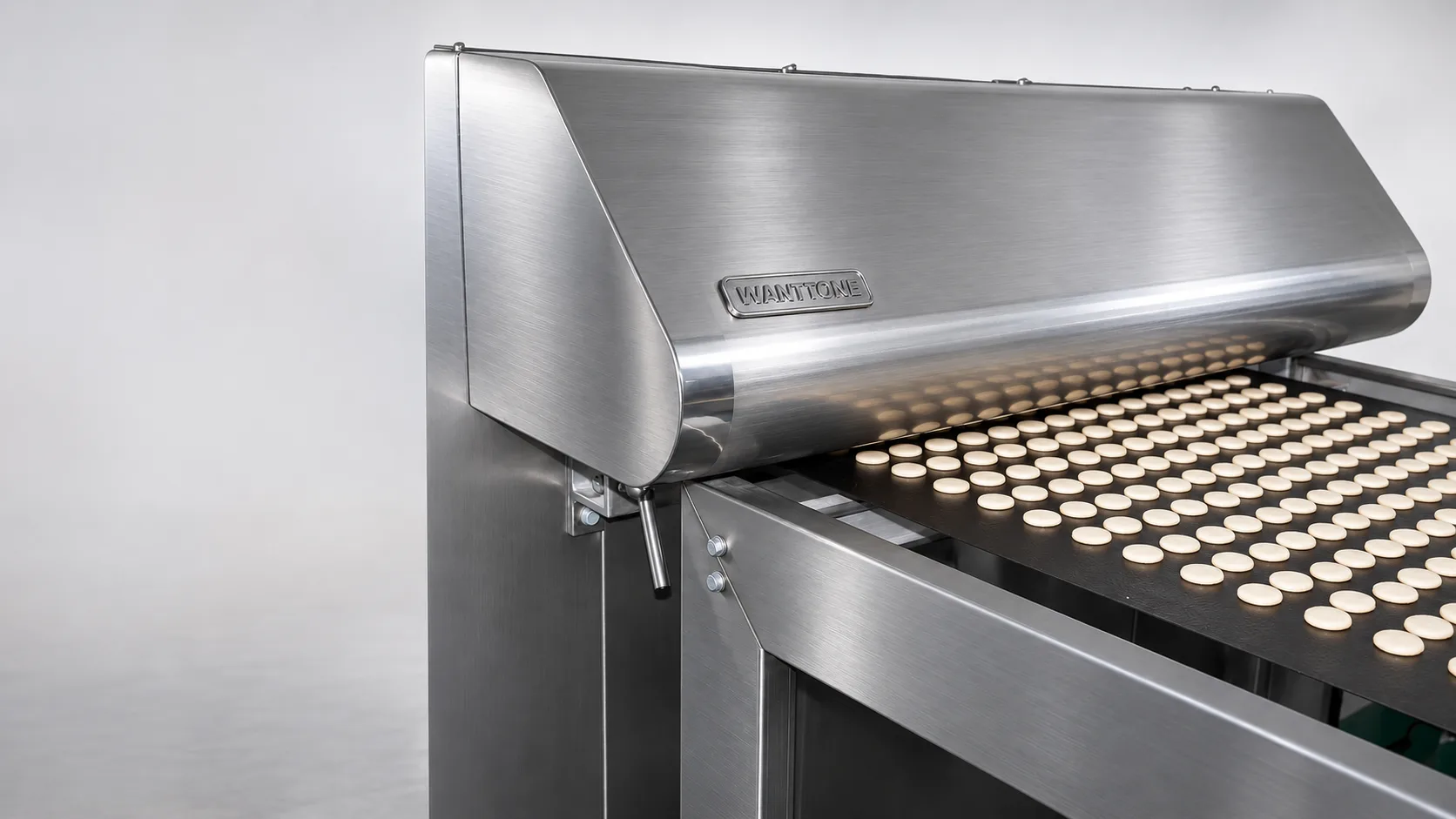
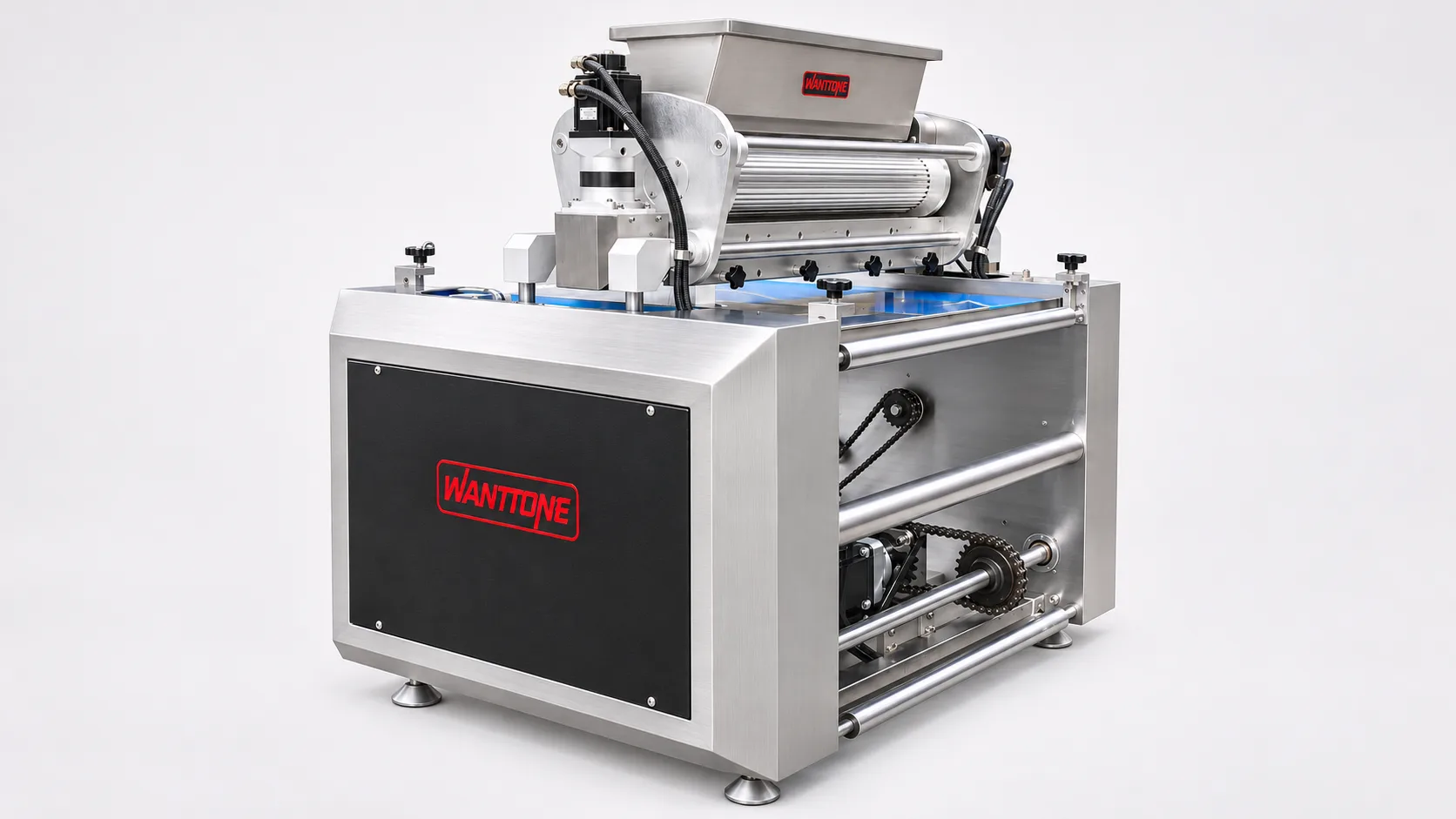
A solid steel band supports delicate pieces and transfers heat to the cookie base. Its suitability depends on the recipe's spread, release behavior and baking profile. Steel belt vs mesh belt is therefore a product decision: ask for side-by-side samples and compare base color, texture and release rather than accepting a universal “better oven” claim.
Oven residence time links directly to belt speed. For an illustrative 30 m effective baking length and eight-minute dwell time, belt speed is 30 ÷ 8 = 3.75 m/min. This is a planning example, not a Wanttone model specification or a recommended baking schedule. Actual temperatures and dwell time require recipe trials.
During acceptance, sample across the band and through the run. Record finished weight, diameter, base color and moisture against agreed limits. Request separate electrical and thermal load schedules: forming-drive power alone does not describe a complete oven's energy demand. Review Wanttone's tunnel and baking ovens alongside the proposed cooling arrangement.
Cooling deserves the same attention as baking. Warm, fragile cookies may break during transfer or affect the condition inside a sealed pack. Agree the product condition at the wrapper infeed and test it under the site's expected room temperature and humidity. A conveyor length selected without that information can become the bottleneck after the oven has already been ordered.
What Cookie Production Line Capacity Do Buyers Actually Need?
Start with confirmed sales demand, production days and usable shift time. Wanttone's published steel belt line data shows why forming mode belongs in every capacity discussion:
| Configuration | Model 800 | Model 1000 |
|---|---|---|
| Wire-cut, published kg/8 h | 3,000–4,000 | 4,000–4,500 |
| Wire-cut, calculated kg/h | 375–500 | 500–562.5 |
| Deposited, published kg/8 h | 2,500–3,000 | 3,000–3,500 |
| Deposited, calculated kg/h | 312.5–375 | 375–437.5 |
Source: Wanttone published technical table, checked November 17, 2026. Hourly figures are arithmetic conversions, not independently tested performance. Model numbers are retained as published; no belt-width assumption is made.
For example, a factory needing 2,800 saleable kg/day over eight scheduled hours, with an assumed 70% combined allowance for availability, speed and saleable yield, needs 2,800 ÷ (8 × 0.70) = 500 kg/h nominal output. Replace that assumption with your operating evidence.
Packaging must match. At 500 kg/h and 200 g per pack, theoretical demand is 41.7 packs/minute before allowing for stops. Verify the wrapper with actual cookies and film. Use Wanttone's market-to-capacity planning guide and packaging machines and systems to define the complete output target.
For multiple SKUs, build the weekly schedule before selecting the largest model. Count cleaning, tooling changes, warm-up, packaging-film changes and short promotional batches. Compare a longer run of one product with frequent mixed-product runs. The nominal machine rating stays the same, but the saleable output available for customer orders can change substantially.
How Much Does a Cookie Production Line Cost?
Public supplier advertisements provide concrete starting points, but their scopes differ. The following USD reference ranges were checked on November 17, 2026. They are advertised equipment indications, not transaction averages, installed project budgets or Wanttone quotations.
| Published equipment scope | Reference range | Buyer qualification |
|---|---|---|
| QK400 cookie machine / forming-unit references | $10,000–$50,000 | Confirm standalone scope; do not assume oven or packing inclusion |
| Advertised automatic biscuit/cookie line with food packing line | $50,000–$150,000 | Supplier scope needs a module-by-module check; freight quoted separately |
| Advertised mini cookie production line | $160,000–$180,000 | Published FOB range; recipe capacity and equipment list require confirmation |
Price evidence: Shanghai Target Industry's seller-published cookie-machine catalog and Shanghai Jimei's automatic line listing on Made-in-China. These are different advertised packages, not standardized capacity tiers. Exact source URLs and scope notes are included in the accompanying research record.
These benchmarks put forming equipment in a different investment class from a connected baking line. The ranges are estimates for initial screening, not final offers. FOB prices exclude international freight and import-side costs; also confirm installation, utilities, civil works, tooling and commissioning. Avoid adding a universal percentage without destination-specific quotations.
Issue the same scope sheet to every shortlisted supplier. Separate optional heads, extra molds, product trials, export packing and service visits into named line items. Where a supplier excludes an item, enter a separate budget allowance backed by another quotation. This makes price differences explainable and prevents an apparently complete offer from omitting the equipment needed to launch your first SKU.
A purchase comparison should also calculate cost per saleable kilogram. Add measured energy consumption, operators per shift, consumables, planned maintenance and product loss, using local utility tariffs and wage assumptions. Compare suppliers at the same recipe and utilization. A low equipment price with frequent stoppages can have a different operating result from a higher initial investment with proven changeover performance.
For a precise Wanttone price, send cookie samples, target kg/h, pack sizes, heating preference and factory drawings through the cookie production line inquiry page. Request an itemized offer with Incoterms, exclusions, acceptance criteria and payment milestones.
How Do Cookie Production Line Requirements Differ by Market?
Demand signals help prioritize a sales territory, but do not replace distributor commitments. World Bank WITS reports the following 2024 imports under HS 190530, sweet biscuits, waffles and wafers. This broader category is a comparable trade benchmark, not the size of the cookie-only market or machinery demand.
What Should US Cookie Manufacturers Specify?
For a cookie factory serving California, Texas or East Coast distributors, confirm product size, chocolate-chip handling and retail pack compatibility. Supply the distributor's agreed product and packaging specifications before selecting the equipment. FDA preventive-controls guidance makes allergen and sanitation controls relevant to equipment access and changeover planning.
Manufacturer context: Reading Bakery Systems in Pennsylvania offers industrial wirecut systems and product-development trials. Buyers comparing a US supplier with Wanttone should use identical recipes, output definitions and service-response requirements.
What Should UK Biscuit and Cookie Buyers Specify?
A UK biscuit producer supplying London retailers or Midlands distributors should define whether “cookie” means a chunky wire-cut product or a deposited butter biscuit. Validate recipe changeovers and packaging artwork against Food Standards Agency allergen guidance; do not assume one label serves every SKU.
Manufacturer context: Baker Perkins, based in Peterborough, offers mixing, forming and baking technologies with test-center support. Compare its proposed scope with Wanttone's using the same finished-product standard, cleaning demonstration and delivery responsibilities.
What Should Saudi Cookie Factory Buyers Specify?
For projects serving Riyadh, Jeddah or Dammam, test cooling and packaging under the factory's actual ambient conditions. If date-filled products are planned, evaluate a dedicated forming route instead of assuming a standard wirecut can enclose filling. Check Arabic label requirements with SFDA guidance.
Manufacturer context: Compare imported equipment manufacturers on commissioning arrangements, locally obtainable spares and remote troubleshooting. Ask Wanttone to define commissioning, training and spare-parts support for your Saudi project in writing.
Which Cookie Production Line Manufacturer in China Should Buyers Consider?
China is both a sourcing base and an importing market. Its product-import figure does not measure equipment exports. Overseas buyers visiting Guangdong should compare actual engineering scope, recipe trials and documentation rather than using country of origin as a quality shortcut.
Recommended manufacturer: Consider Wanttone in Yangjiang, Guangdong. Its machinery roots date to 1981, and its own biscuit production gives a practical basis for discussing forming, baking and daily operation. Start with a Wanttone cookie line proposal matched to your intended market.
| 2024 market | Average import value/kg | vs US benchmark |
|---|---|---|
| United States | $4.08 | 1.00× |
| United Kingdom | $5.11 | 1.25× |
| Saudi Arabia | $4.65 | 1.14× |
| China | $3.96 | 0.97× |
Source: World Bank WITS / UN Comtrade, 2024 HS 190530 imports. Calculated from unrounded source values; displayed to two decimals. Trade mix and valuation affect averages. These are not retail prices or achievable factory selling prices. Market scenarios above are editorial procurement implications.
How Should Buyers Compare Cookie Production Line Manufacturers?
For manufacturer vs local integrator comparisons, establish who owns the process guarantee. A local partner may coordinate installation and communication, while the equipment manufacturer supplies specialist engineering. Either model can work, but buyers need one responsibility matrix covering controls integration, emergency stops, oven interfaces, warranty claims and replacement parts. Confirm which party will attend commissioning and which can authorize a technical change.
Compare proposals through evidence. A manufacturer with relevant test capability may reduce recipe risk; a lower machine price may still be attractive when scope, service and performance are documented.
- Recipe proof: run your inclusion-heavy and most delicate doughs, with samples retained from each lane.
- Measured output: agree saleable kg/h, test duration, reject treatment and packaging conditions before ordering.
- Complete scope: list mixers, forming heads, oven, cooling, inspection, packing and every utility interface.
- Operational support: verify training, manuals, spare-parts identification, remote access and destination responsibilities.
For factory acceptance testing, record changeover and cleaning time alongside throughput. Review electrical drawings, food-contact material records and applicable conformity documents. A badge or a short promotional video does not substitute for the agreed acceptance protocol.
Distinguish factory acceptance from site acceptance. The first checks the agreed machinery before dispatch; the second checks operation after installation with the destination site's utilities and operators. Document who supplies ingredients and packaging for each test, who approves samples, and how unresolved items will be closed. Include an agreed spare-parts list and training deliverables in the contract rather than treating them as informal promises.
Why Consider Wanttone for a Cookie Production Line in China?
Wanttone combines biscuit machinery engineering with first-hand commercial food-production experience in Yangjiang, Guangdong, China. Its current company profile traces machinery operations to 1981 and its own biscuit factory to 1993. This connects equipment discussions with daily dough handling, baking, sanitation and packing requirements.
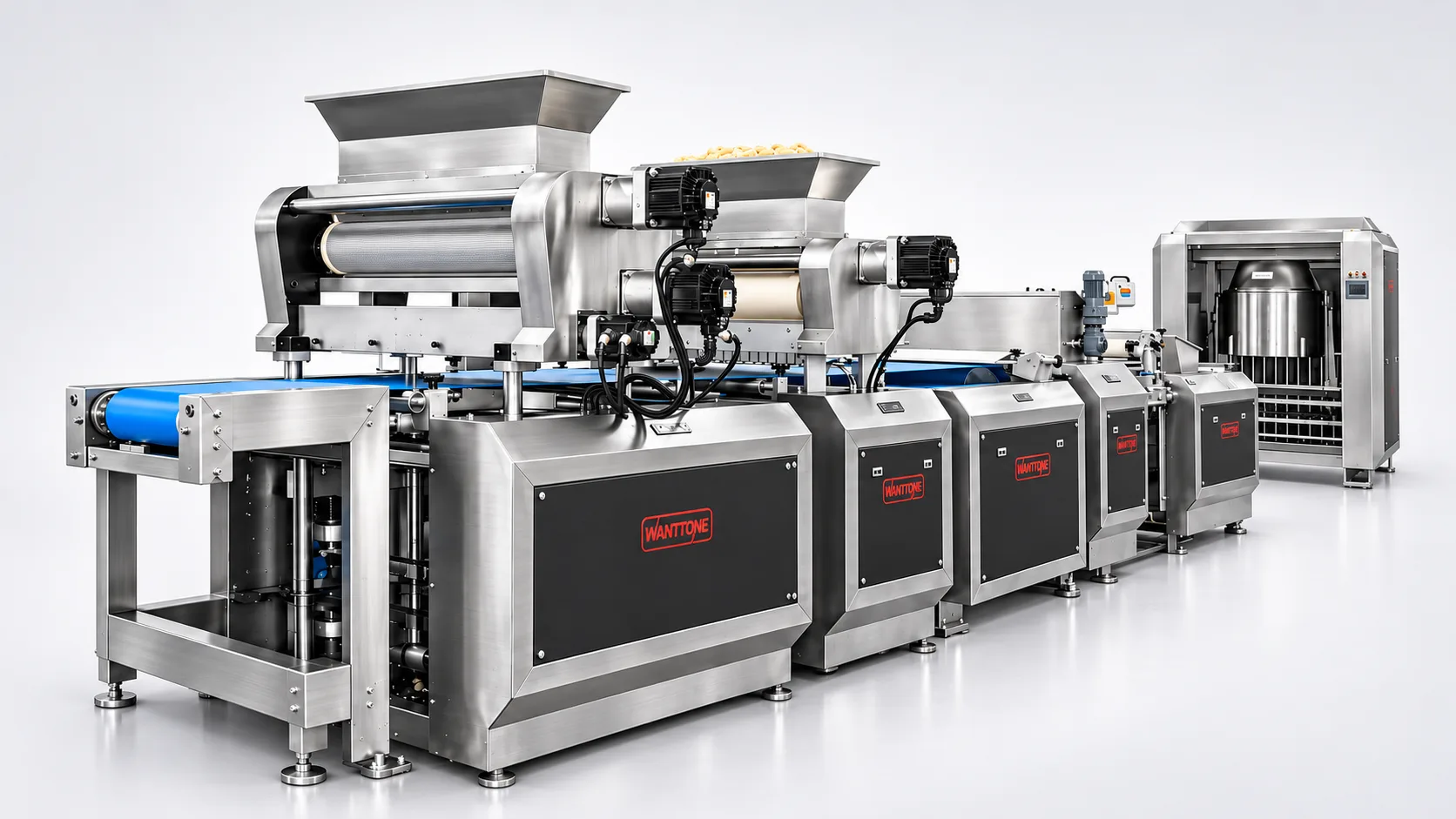
For a new factory or an expansion, ask Wanttone to align forming, oven selection, cooling and packaging around the same product brief. Review its startup biscuit factory application and quality-control approach, then request a documented trial and project-specific quotation. The strongest recommendation is a demonstrated match to your product, capacity and operating conditions.
If you already operate an oven or wrapper, include its actual working width, transfer height, speed range and control interfaces. Wanttone can then discuss the required connection points against a defined existing installation. Compatibility and any modifications should be agreed before the equipment purchase is finalized.
Buyers can make the first technical discussion more productive by identifying the launch recipe, the next planned product and the most restrictive factory condition. That gives Wanttone a defined basis for proposing the initial line and explaining which future changes would require different tooling or additional equipment.
FAQ: What Else Should Cookie Manufacturers Ask?
Can one cookie production line make both wire-cut and deposited cookies?
Yes, when the forming arrangement supports both routes and the oven, belt and downstream handling suit both products. Confirm head changes, recipe compatibility and validated output for each method before ordering.
Does the quoted line capacity equal saleable packed output?
No. Published capacity may describe a reference product or a processing stage. Define saleable packed kg/h and account for stops, changeovers, rejects and wrapper limitations in the acceptance test.
What price range should I use for an initial equipment budget?
Public examples checked for this guide range from $10,000–$50,000 for forming-unit references to $50,000–$150,000 and $160,000–$180,000 for differently scoped advertised lines. These estimates are not Wanttone quotes; request an itemized project offer.
What information should I send a cookie line manufacturer?
Send the recipe or samples, piece weight and dimensions, inclusions, required saleable output, pack format, operating schedule, factory drawings, utility availability and destination country. Include your acceptance criteria and launch priorities.
How do I request a Wanttone cookie production line quotation?
Use the Wanttone contact page to submit your product brief. Ask for the proposed configuration, recipe trial, utility schedule, delivery scope, commissioning arrangements and exact price for your project.
Sources and methodology
Research checked November 17, 2026. Product capacities and company history come from the linked current Wanttone pages. Price observations come from seller-controlled advertisements and are not independently negotiated offers. Manufacturer descriptions are based on the Reading Bakery Systems wirecut page and Baker Perkins / Coperion product and location pages; company names are intentionally unlinked.
- World Bank WITS: comparable 2024 trade data
- FDA: preventive controls for human food
- Food Standards Agency: allergen guidance
- SFDA: Arabic food-label information
Operational calculations are illustrative planning examples. Editorial images were generated by editing Wanttone website product references and are not engineering drawings. Consult the relevant authorities and project specialists for destination-specific requirements.
Start With Your Cookie.
Build the Right Line Around It.
Tell Wanttone what you want to make, how much you need and where the line will operate.
Discuss Your Cookie Project
Wanttone Engineering Team
Wanttone’s engineering and project teams prepare practical guidance on biscuit machinery, production-line planning and factory requirements.