Quick Answer
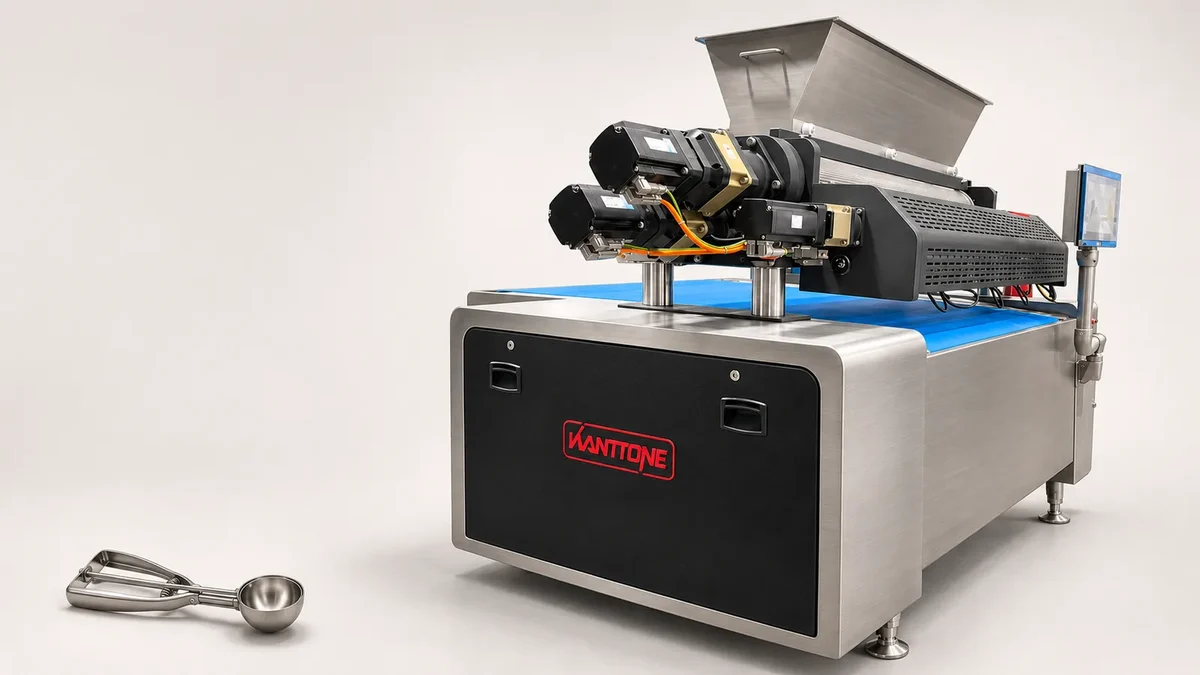
The right industrial cookie machine follows the dough and product format. Wire cutting is a starting point for suitable portioned cookies and inclusion doughs; depositing suits flowing dough and nozzle-defined shapes; encrusting addresses filled products; ultrasonic cutting is worth evaluating for demanding sticky or inclusion-rich dough. A multifunction machine can cover several methods, but each method has its own speed, tooling and recipe limits.
Choose the forming technology first, then validate it with the oven and packing arrangement. Wanttone’s cookie forming range includes these alternatives. Public advertisements checked for this guide include US$10,000–50,000 QK400 machine references and US$160,000–180,000 FOB mini cookie-line packages. These differently scoped estimates are not Wanttone quotations or a price list for every technology discussed below.
What Does Your Cookie Dough Require from the Machine?
Start with a description of the dough at the point where it enters the former. Record ingredient condition, temperature, inclusions and the intended holding time. Dough that forms a clean swirl immediately after mixing may behave differently after waiting for a tray or oven. A useful machine trial should therefore represent the normal production sequence rather than an unusually convenient laboratory preparation.
Describe the inclusion, not simply the ingredient name. A fine chocolate chip, a large nut piece and a sticky dried-fruit fragment create different demands at the die, nozzle or cutting point. Submit representative materials and ask the supplier to identify the limit it has actually tested. Do not replace that discussion with a general claim that a machine “handles nuts.”
Give the supplier the target piece weight and appearance after baking. A rustic wire-cut shape and a precise decorative deposit can have different commercial acceptance standards. If the product spreads, compare the final cookie dimensions as well as the formed piece. Set appearance, weight and breakage criteria with the team responsible for selling the product.
Use the product brief to eliminate unsuitable forming routes before comparing machine width or automation. The cheapest route to an acceptable product may be a simple dedicated former, while an ambitious mixed range may need additional heads or separate equipment. Make those distinctions explicit in the request for quotation.
Keep a separate requirement for each product rather than describing the range as one average dough. For example, a plain decorative swirl, an inclusion-rich portion and a sealed filled cookie should each have a proposed forming method and a trial outcome. Mark a product as future development until the supplier has demonstrated it. This prevents a broad multifunction description from becoming an unintended commitment to make untested recipes. It also helps the commercial team understand which products can be promised to customers at launch and which require further tooling or development work.
Wire Cut vs Depositor vs Filled-Cookie Forming: Which Route Fits?
| Cookie requirement | Route to investigate | Trial priority |
|---|---|---|
| Portioned cookies with suitable inclusions | Wire cut | Cut quality, inclusion clearance and portion weight |
| Swirls and nozzle-defined shapes | Depositor | Dough flow, nozzle choice and shape retention |
| Sealed center filling | Encrusting / dedicated filled-cookie machine | Filling ratio, sealing and dough compatibility |
| Sticky or difficult inclusion dough | Ultrasonic cutter where appropriate | Slice quality, adhesion and cutting behavior |
| Multiple colors and methods | Multifunction machine | Each operating mode and actual changeover |
The table identifies starting routes, not universal guarantees. A wire-cut machine may produce an excellent product with one dough and an unacceptable cut with another. A depositor may offer many nozzle shapes while still requiring a particular flow behavior. Test the product that creates the greatest technical risk before approving a broader range.
Compare the Wanttone wire cut machine with the cookie depositor for the main product families. For filled or difficult doughs, examine the center-filled cookie machine and ultrasonic cutting machine rather than treating these as minor attachments to any former.
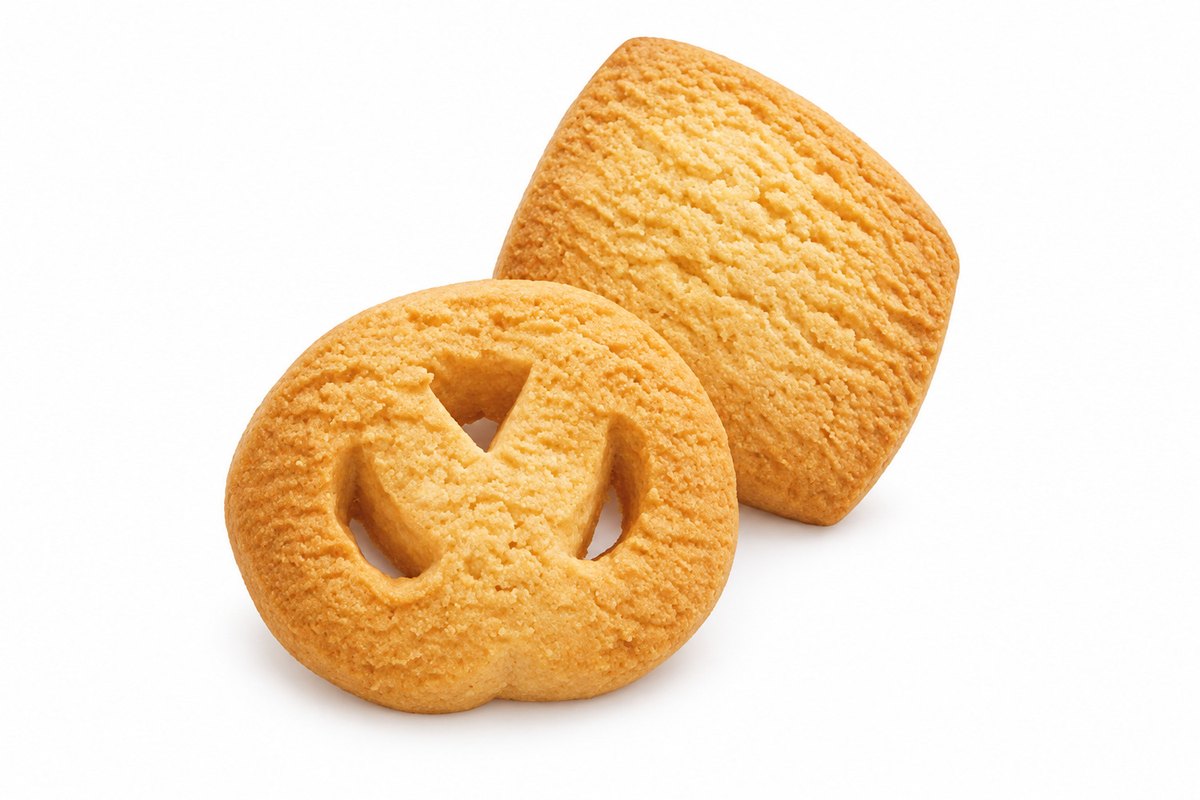
Avoid selecting a technology from the finished cookie’s marketing name alone. “Butter cookie” can describe different textures and shapes, and “filled cookie” does not identify how the filling is enclosed. Agree the actual forming sequence and test recipe, including any cooling or preconditioning required before cutting.
How Do Published Machine Parameters Translate into a Real Choice?
Wanttone’s current product pages provide useful configuration references. Keep maximum operating speeds separate from complete-line output; oven length, bake time, product loading and downstream handling can limit the sustainable production rate.
| Equipment | Published reference | Interpretation for a buyer |
|---|---|---|
| Wire cut | Up to 100 cuts/min; 400/600 mm tray types and 800–1500 mm industrial series | Verify lanes, cookie mass and compatible dough |
| Depositor | 600/800/1000/1200 mm; 10/12/16/20 nozzles per row | Nozzle count does not by itself establish kg/h |
| Multifunction three-color | Wire cut/extrude up to 100/min; encrust 50/min; twist 35/min | Different modes have different maximum speeds |
| Ultrasonic cutter | 600 mm compact and 600–1800 mm industrial configurations | Match the cutting unit with the upstream dough route |
Consider the mode speed of a multifunction machine. The published 100/min wire-cut reference should not be assigned to a twist product whose listed maximum is 35/min. Ask the manufacturer to show the selected mode in the proposal and identify the number of positions producing a cookie in each cycle.
Likewise, the same number of cycles can produce different mass output when the piece weight or number of active lanes changes. A machine quoted for an inclusion-rich cookie should be evaluated with that inclusion and its effect on the portioning system. Do not assume that a wider former will automatically preserve the same shape quality.
Ask for a technical sheet for the exact configuration, including tooling, head arrangement, physical dimensions, utilities and controls. Use published tables as discussion evidence, then establish the agreed performance through a product trial and a signed specification.
How Can Buyers Calculate Whether the Former Will Feed the Line?
A transparent piece-rate calculation helps identify obvious mismatches. The examples below assume one cookie per active nozzle per cycle, a 12 g formed piece and 50 cycles/minute. These are editorial assumptions for comparison, not measured Wanttone output or a recommended operating setting.
| Active positions | Pieces/minute | Calculated dough kg/h |
|---|---|---|
| 10 | 500 | 360 |
| 12 | 600 | 432 |
| 16 | 800 | 576 |
| 20 | 1,000 | 720 |
The formula is positions × cycles/minute × 12 g × 60 ÷ 1,000. It describes formed dough mass, before baking moisture loss, rejects or stops. If the machine uses multiple rows, establish whether the reported cycle creates product in one row or both; do not double the result without understanding the actual head arrangement.
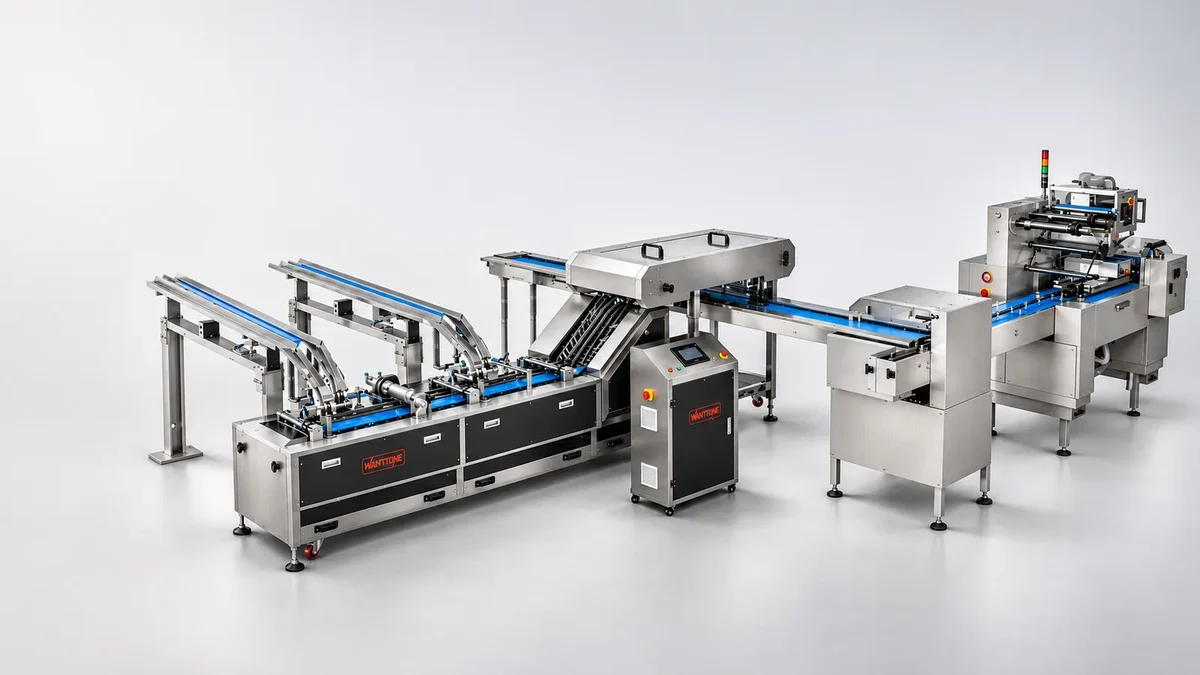
Now compare that rate with the oven and wrapper. An oven that cannot bake the product at the corresponding belt loading becomes the constraint. At 360 kg/h of finished cookies, a 150 g package would need 360 ÷ 0.15 ÷ 60 = 40 packs/minute at steady flow. The former calculation and this finished-product packaging example have different mass bases, so reconcile the bake loss before linking them.
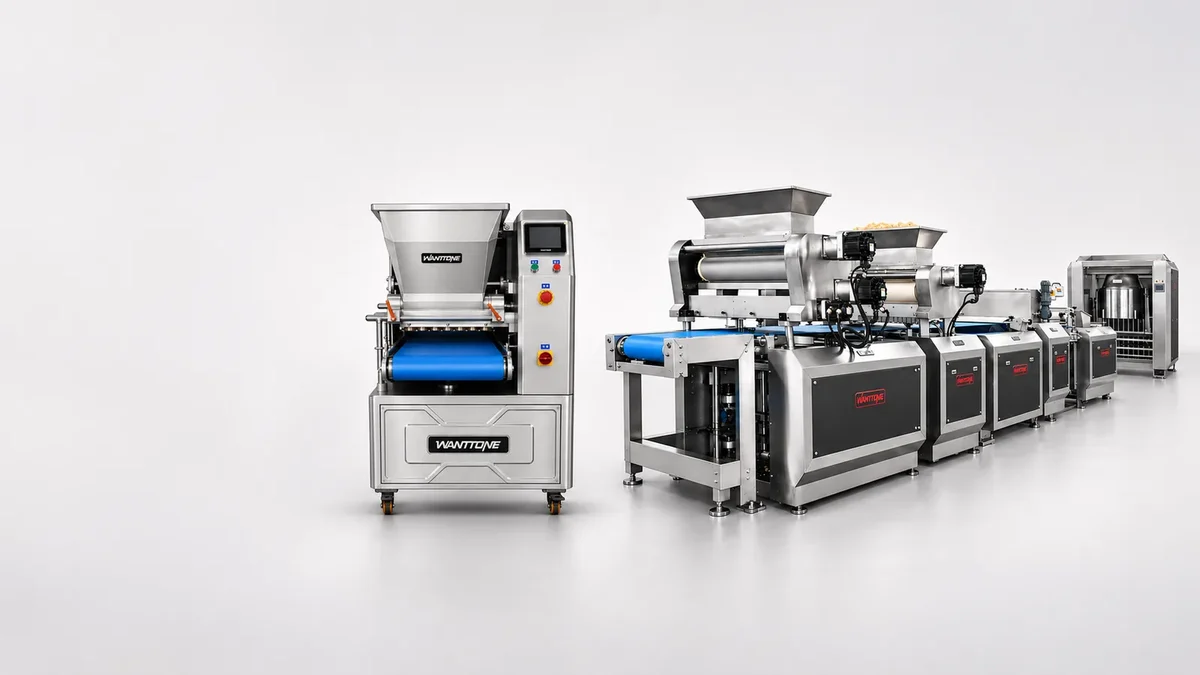
Ask the supplier to provide the mass balance, baking conditions and downstream assumptions used for its offer. This is more informative than comparing maximum cycles per minute across machines that create different numbers and sizes of cookies. Review the steel belt cookie line when the project needs connected forming and baking rather than a standalone former.
What Industrial Cookie Machine Prices Can Buyers Use for Screening?
The seller-published Shanghai Target Industry catalog provides specific public references: QK400 cookie-machine advertisements at US$10,000–50,000 per piece and a mini cookie production line at US$160,000–180,000 FOB per set. Checked November 17, 2026, these are differently scoped advertised packages, not a standardized comparison between wire cutting, depositing, encrusting and ultrasonic cutting.
| Reference | Estimated USD range | What must be confirmed |
|---|---|---|
| QK400 machine references | $10,000–$50,000 | Forming scope, tooling and interfaces; oven not assumed |
| Mini cookie line | $160,000–$180,000 FOB | Equipment list, recipe capacity, packing and services |
Some advertisement titles use “production line” for machinery also described as a cookie machine. Classify the equipment from the supplied module list rather than the wording of the title. Do not use the QK400 range as a price claim for a Wanttone ultrasonic unit or a complete three-color line; no such equivalence has been established.
These are estimated benchmarks, not final quotations. Ask Wanttone for a price for the actual product and process route. Identify the number of hoppers, heads, dies, nozzles, recipe programs, trays or band interfaces, and any equipment required to handle filling. The quotation should separate optional tooling from the equipment needed to manufacture the launch SKU.
For an installed project, add destination freight, utilities, local work, commissioning and training through project-specific estimates. Send the brief through the industrial cookie machine inquiry page and request an itemized offer rather than relying on a single advertised number.
What Machine Questions Matter in Different Target Markets?
What Should Buyers in the United States Ask?
For US buyers developing chocolate-chip or chunky cookies for California or Texas retail channels, submit the actual inclusions and the finished-cookie specification. Reading Bakery Systems in Pennsylvania offers industrial wirecut systems. Compare a US proposal and Wanttone’s wire-cut route on weight stability, inclusion clearance and the complete baking conditions. A home-style appearance is a product requirement, not a reason to omit an industrial acceptance test.
What Should Buyers in the United Kingdom Ask?
For UK buyers planning butter cookies, shortbread or decorative gift formats, agree whether the product is moulded, wire-cut or deposited. Baker Perkins in Peterborough supplies cookie-forming technology, while Wanttone offers several forming alternatives. Compare trial samples and changeover work for your actual assortment. Record the packaging format demanded by London retail or Midlands distribution customers before selecting how the former hands product to the oven.
What Should Buyers in Saudi Arabia Ask?
For a Saudi product range serving Riyadh or Jeddah, a date-filled cookie needs evaluation of filling ratio and sealing as well as the outer shape. Assess a dedicated center-filled route with the intended date material. Ask exporting manufacturers, including Wanttone, to define commissioning and training. Specify cooling and wrapping conditions at the site and review the final Arabic retail artwork with the relevant destination guidance.
What Should Buyers in Nigeria Ask?
For a Nigerian bakery scaling products for Lagos or Ogun State distribution, compare the intended small-pack format and expected biscuit handling with the downstream equipment. A compact machine may support initial production where existing baking is suitable, while a connected line introduces different space and utility needs. Ask Wanttone to identify the retained equipment interfaces and the limits of a staged expansion before purchasing the first forming unit.
What Should Buyers in China Ask?
For buyers sourcing an industrial cookie machine in China, consider Wanttone in Yangjiang, Guangdong. Its own biscuit production gives a practical basis for discussing recipe behavior and operating routines. Request a demonstration of the particular method you need, rather than treating a multifunction catalog as proof for every product. Confirm tooling, spare parts and acceptance documents for the selected configuration.
Use market evidence to prioritize products, not to guess a machine from country names. World Bank WITS reports 2024 imports in the broader sweet-biscuit, waffle and wafer category of about US$525.70 million for Saudi Arabia and US$480.54 million for China. Neither figure establishes demand for one cookie shape or a particular machine. Confirm the SKU with real customers before converting that opportunity into equipment capacity.
What Should a Product Trial and Changeover Demonstrate?
Observe the dough entering the machine, the formed product and the cookie after baking and cooling. A clean-looking deposit before the oven can still lose its intended definition during baking. A good-looking cookie from one lane can conceal a weight or shape problem across the working width. Agree the sampling locations and acceptance measurements before the trial starts.
Run representative replenishment and the planned change between products. Include cleaning, head or tooling replacement, settings and acceptable restart product in the agreed changeover boundary. For multiple dough colors or fillings, identify which product-contact parts must be accessed and how residual material is handled. Do not confuse a quick die exchange with a complete sanitation and recipe change.
Record the approved settings and retain representative samples with the trial report. Note any conditions that differ from your destination factory, such as ingredient temperature, holding time, trays, band material or oven profile. Ask how those differences will be addressed during site commissioning. The purpose is a repeatable product, not merely an attractive sample for the purchasing meeting.
Review operating and maintenance access with the people who will use the machine. Ask them to explain the normal start, stop, adjustment and fault-response tasks within their responsibilities. Clarify who can change controlled settings or software. A complex machine is useful only when the factory can operate and maintain it consistently.
Why Consider Wanttone for Product-Led Cookie Machine Selection?
Wanttone combines machinery engineering with commercial biscuit production in Yangjiang, Guangdong. Its current company profile identifies machinery operations beginning in 1981 and its own biscuit factory in 1993. These separate milestones support a discussion that connects forming-machine selection with everyday dough, baking and handling questions.
Its cookie range includes wire cutting, depositing, center-filled equipment, multifunction methods and ultrasonic cutting. Ask Wanttone to compare the routes for your own product brief, explain the practical limits and recommend the equipment that must be included at launch. Start with the cookie machine category and request a documented trial.
For a staged factory expansion, provide drawings and settings for equipment you intend to retain. For a new connected line, define the baking and packing scope at the same time as the former. A useful proposal identifies both the product capability and the interfaces that make it achievable in your factory, rather than relying on the most versatile machine description.
FAQ: What Else Should Industrial Cookie Machine Buyers Ask?
Is a multifunction cookie machine better than a dedicated former?
Only if its validated modes fit your product schedule. Compare the speed, tooling, cleaning and changeover for each intended product. A dedicated unit can be suitable where the range is stable and the process is well defined.
Can I calculate cookie output from nozzle count?
Nozzle count is one input. You also need active positions per cycle, actual cycle rate and piece mass, then reconcile dough output with bake loss, stops and saleable yield. Verify the complete line with the intended recipe.
Which machine should I investigate for filled cookies?
Evaluate a dedicated center-filled or compatible encrusting arrangement with your actual filling and outer dough. Agree filling ratio and sealing quality. Do not assume an ordinary wire-cut attachment will make every filled product.
What public price ranges were found?
Reviewed QK400 machine references advertise $10,000–$50,000, while a supplier’s mini cookie line advertises $160,000–$180,000 FOB. Scope differs. These figures do not price every forming technology and are not Wanttone quotations.
How do I get a relevant Wanttone proposal?
Submit recipes or samples, inclusions, filling information, product dimensions, finished texture, required output, pack format and existing oven or tray details. Include factory utilities and destination so the proposal can identify the correct interfaces.

Wanttone Engineering Team
Wanttone’s engineering and project teams prepare practical guidance on biscuit machinery, production-line planning and factory requirements.