Quick Answer
A hard biscuit production line develops and sheets suitable dough, reduces it through gauge rolls, cuts individual biscuits, returns the surrounding dough web, then bakes, cools and packs the product. The sequence is coordinated around sheet condition, thickness, cut registration, baking time and downstream handling. Laminated or fermented crackers need the additional process arrangements their recipes require.
For purchasing, begin with the actual biscuit rather than the word “hard.” Wanttone’s combined hard-and-soft biscuit line offers a sheeting-and-cutting route, while the cracker line addresses additional cracker requirements. Public advertisements for industrial soft-and-hard lines show US$400,000–700,000 FOB at 1,000 kg/h and US$500,000–1,200,000 FOB at 1,500 kg/h; these are reference estimates, not Wanttone offers.
What Happens to Hard Biscuit Dough Before Rotary Cutting?
The forming section depends on dough arriving in a suitable and repeatable condition. Weighing, mixing and any required resting or fermentation must be coordinated with the downstream rate. Dough produced at uneven intervals can change condition while waiting for the sheeter, so the production plan needs both sufficient preparation capacity and a controlled holding arrangement.
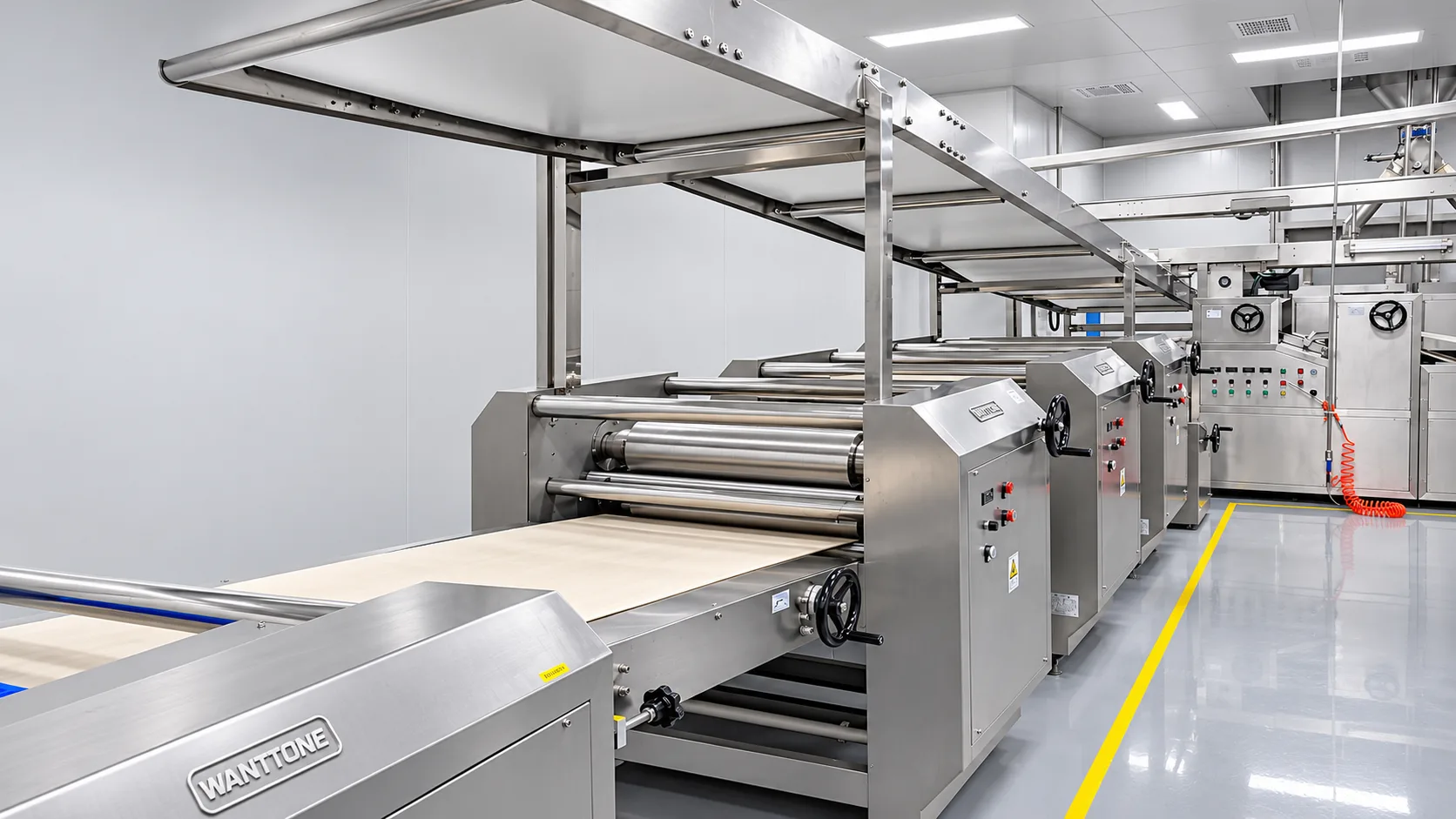
A primary sheeter turns the bulk feed into a continuous sheet. Progressive gauge rolls then reduce that sheet toward the thickness required for the biscuit. The objective is consistent geometry without creating an unstable sheet. Adjustments to roll gaps, feed and conveyor speeds must be considered together rather than treated as unrelated operator settings.
For a layered cracker, the process may include lamination before final gauging. For a plain hard-sweet biscuit, the appropriate preparation can differ. Confirm the exact route with the recipe trial. A machine list containing a laminator does not prove that a recipe needs it, and omitting a necessary dough-preparation stage cannot be corrected merely by increasing cutting speed.
At the cutter, the agreed design forms the outline and any docking or pattern features. The surrounding web is separated for controlled return. Check how pieces transfer toward the oven and whether sheet tension or release changes the intended shape. Assess these conditions at normal line loading, not just with a few isolated pieces on a slow belt.
Wanttone’s dough-forming equipment category lets buyers identify the sheeter, gauge rolls and cutter as distinct functions. Request the arrangement that matches the product, with responsibility for the controls and conveyor transfers between each function.
Keep the recipe and sheet settings linked in the production record. If a biscuit begins to shrink or distort, the factory needs to know whether dough condition, gauging, transfer speed or baking changed. Adjusting every setting at once may recover a sample without establishing a repeatable cause. During commissioning, ask the supplier to explain the approved adjustment sequence and the observations that should trigger technical assistance.
The same discipline applies to the returned cutting web. Identify where recovered material waits, how operators distinguish batches, and how the approved process prevents uncontrolled accumulation. A web-return conveyor is equipment; a controlled material-return procedure is part of operating the biscuit process. Both should be clear before the line enters routine commercial production.
Hard-Sweet Biscuits vs Laminated Crackers: How Does the Route Differ?
| Question | Hard-sweet biscuit route | Laminated / fermented cracker route |
|---|---|---|
| Dough preparation | Recipe-specific mixing and resting | May include fermentation and its handling |
| Sheet structure | Consistent sheet for gauging and cutting | Layer formation where required by the product |
| Forming controls | Thickness, registration and release | Layer integrity plus thickness and cutting |
| Oven trial | Color, moisture, texture and shape | These checks plus the intended layered texture |
| Procurement scope | Confirm necessary sheeting and cutting | Define extra preparation and lamination stages |
A buyer should judge the biscuit after baking and cooling. The same sheet thickness does not necessarily produce the same finished thickness or texture from different recipes. Agree the product standard, then use the process trial to establish the settings and equipment arrangement needed to achieve it. Avoid treating a cutter pattern as a complete product recipe.
Returned web requires its own control discussion. Ask how it is blended with fresh dough, how holding is managed and how changes in that material affect the sheet. The appropriate procedure belongs to the recipe and factory process. An arbitrary universal return percentage should not be copied into the purchase specification without supporting trials.
For a portfolio that also includes rotary-moulded short-dough biscuits, compare a combined line against a dedicated hard route. The rotary moulder performs a different forming function. Its inclusion can broaden the planned range, but it does not remove differences in preparation, baking, cleaning and downstream operation.

Which Parameters Must Be Controlled Through the Forming Section?
Define the controls in terms of product outcomes. The operator needs to maintain stable feed, sheet geometry and transfer conditions, while maintenance staff need access to settings, adjustment points and the relevant drawings. Agree which parameters are recipe settings and which changes require a responsible technical person.
| Variable | Why it matters | What to observe in a trial |
|---|---|---|
| Dough condition | Changes sheetability and return behavior | Consistent feed after normal holding |
| Gauging | Controls sheet geometry | Stable thickness across working width |
| Conveyor coordination | Affects tension and transfer | No persistent stretching, folding or accumulation |
| Cut registration | Defines shape and pattern position | Repeatable cuts at normal production rate |
| Web separation | Protects pieces and manages recovery | Clean separation without routine manual correction |
Sample across the band and through the run. An average result can hide a difference between edge and center lanes, while an early sample can conceal drift after the line reaches a normal operating condition. Record where samples came from and the settings used, so the buyer and supplier can discuss an observed difference using the same evidence.
Separate mechanical adjustment from product approval. A digital setting or a repeatable roller position is useful, but it does not establish the final biscuit result by itself. Check product weight, outline, docking appearance and behavior after baking against the agreed standard. Record any recipe or material conditions that changed during the trial.
Include cleaning and inspection access in the technical review. The selected structure should let the factory perform its required tasks within the agreed responsibilities. Review Wanttone’s quality-control information together with the actual inspection and acceptance plan for the quoted equipment.
How Do Oven Length and Packing Capacity Limit Hard Biscuit Output?
The former can only produce sustainable output when baking, cooling and packing keep pace. Wanttone’s combined-line specification lists working widths of 600–1,800 mm and typical oven lengths of 30–80 m across different configurations. These published options do not establish a fixed capacity for each width or a universal biscuit baking schedule.
Consider an illustrative effective bake length of 48 m and a validated recipe dwell of eight minutes. The corresponding belt speed is 48 ÷ 8 = 6 m/min. This is an engineering relationship, not a recommended oven size or bake time. The actual acceptable dwell and loading must come from product trials and the proposed oven configuration.
| Nominal output | Eight-hour theoretical kg | Scenario saleable kg |
|---|---|---|
| 500 kg/h | 4,000 | 3,104 |
| 1,000 kg/h | 8,000 | 6,208 |
| 1,500 kg/h | 12,000 | 9,312 |
The scenario calculation is nominal kg/h × 8 × 0.80 × 0.97. Utilization and yield are explicit editorial assumptions, not supplier guarantees. Use the factory’s own operating evidence when available, and avoid subtracting the same losses again in a second calculation.
At a finished-biscuit flow of 1,000 kg/h, a 125 g package requires 133.3 packs/minute before allowing for wrapper stops. The required handover may involve counting, stacking or another arrangement. Specify the packaging system using actual product and film, then verify it with the upstream line during the agreed test.
What Is a Researched Price Range for a Hard Biscuit Production Line?
A useful benchmark must identify the equipment package and capacity. Guangdong Shunde Huaji Machinery’s public seller catalog lists soft-and-hard industrial lines at the following FOB ranges, checked November 17, 2026. The catalog includes both dough routes; its advertised price is not a Wanttone quotation for a dedicated hard-biscuit configuration.
| Advertised scope | Estimated FOB USD | Comparison limit |
|---|---|---|
| 1,000 kg/h soft-and-hard line | $400,000–$700,000 | Supplier-specific configuration and recipe basis |
| 1,500 kg/h soft-and-hard line | $500,000–$1,200,000 | Confirm module list, oven and service boundaries |
Use the figures for initial screening, then obtain a quotation for your actual hard-biscuit route. Ask whether the price includes dough preparation, lamination where needed, sheeting, gauging, cutting, web return, baking, cooling and the packing interface. Separate optional soft-dough equipment or finishing modules so that the comparison reflects your launch requirements.
These are estimated public price ranges, not final offers. An installed factory also requires destination-specific freight, import-side costs, building work, utilities and commissioning arrangements. Ask the responsible suppliers for those quotations instead of adding an unexplained percentage to the machine price.
Send the product and plant brief through Wanttone’s project inquiry page. The resulting offer should state its technical scope and acceptance criteria. Compare energy and labor on the same recipe and saleable-output basis rather than assuming a lower equipment price necessarily creates a lower manufacturing cost.
How Should Hard Biscuit Buyers Localize the Factory Brief?
What Should Buyers in the United States Ask?
For US buyers, define the intended packaged product carefully because everyday use of “biscuit” differs from UK terminology. A Marie-type hard-sweet product and a cracker need a clear recipe and finished-product brief. Reading Bakery Systems in Pennsylvania offers hard-and-soft biscuit technologies. Compare a US proposal with Wanttone on sheeting, cutting, baking and the actual packing specification for the regional customers you intend to serve.
What Should Buyers in the United Kingdom Ask?
For UK factories supplying London retail or Midlands distribution, a portfolio of hard-sweet biscuits and laminated crackers can create different dough-preparation requirements. Baker Perkins in Peterborough supplies sheeting and cutting technology. Ask each shortlisted supplier, including Wanttone, to demonstrate the hardest planned recipe and the changeover between product families. Agree the inspection standard and final retail package before selecting the maximum line output.
What Should Buyers in Saudi Arabia Ask?
For Saudi projects serving Riyadh, Jeddah or Dammam, specify the actual heating supply, factory conditions and package sizes. Evaluate the biscuit after cooling and transport-style handling, not only at the oven exit. Compare exporting manufacturers on training, commissioning and replacement wear parts. Review the destination’s Arabic label requirements with the relevant guidance before approving the packaging artwork.
What Should Buyers in Nigeria Ask?
For a Nigerian hard-biscuit project serving Lagos or Ogun State, connect pack size and product durability to the downstream scope. Small affordable packs may require a high number of wrapping cycles at a modest product tonnage. Confirm site utilities and the equipment handover boundaries with the project team. Ask Wanttone to explain the preparation, web-return and packing arrangement for the intended product rather than selecting solely by catalog width.
What Should Buyers in China Ask?
For buyers sourcing a hard biscuit production line in China, consider Wanttone in Yangjiang, Guangdong. Its machinery roots date to 1981, and its own biscuit production supports practical discussion of dough behavior and operating routines. Request a route-specific trial with your ingredients, then compare the evidence against drawings, utilities, agreed output and the complete acceptance schedule.
WITS / UN Comtrade records 2024 imports in the broader sweet-biscuit, waffle and wafer category of 843,029 tonnes for the United States and 255,677 tonnes for the United Kingdom. These trade volumes do not isolate hard biscuits or reveal the contracts available to your factory. Use them as context, then build the production plan from actual product demand and credible customer commitments.
What Should a Hard Biscuit Line Acceptance Run Include?
Prepare the trial with the supplier before dispatch or travel. Identify the recipe, materials, target output, sample locations and required measurements. Define the duration, the handover point and which normal operating tasks will be included. If packaging is excluded, do not describe the result as a fully packed saleable output test.
Observe the dough web during steady production and normal replenishment. Check the separation of cut pieces, recovery of surrounding web and behavior at each conveyor transfer. Record manual corrections and stops, even where acceptable biscuits continue to be produced. Routine intervention is relevant to the labor and output assumptions behind the quotation.
Evaluate the product after baking and cooling, with retained samples from different lanes and periods. Record accepted kilograms, rejects, breakage and the conditions that caused adjustment. If the buyer and supplier disagree about appearance or texture, resolve that against the signed product reference rather than changing the acceptance rule during the test.
Complete the review with cleaning, tooling, maintenance access and operator guidance. Then define what site acceptance will demonstrate after installation with the destination’s utilities and staff. The test record should help the factory reproduce an approved process, diagnose a deviation and identify who is responsible for the next corrective action.

Why Discuss a Hard Biscuit Production Line with Wanttone?
Wanttone operates in Yangjiang, Guangdong, China, combining biscuit machinery engineering with commercial food production. The current company profile identifies machinery operations beginning in 1981 and its own biscuit factory beginning in 1993. These are distinct milestones and provide a practical starting point for discussing forming, baking and factory routines.
For a hard-biscuit project, ask Wanttone to compare the required sheeting, cutting and preparation route with the products you intend to launch. Review the combined line and the cracker configuration where relevant, then agree the trial that will establish recipe suitability.
For a new factory, define utilities, floor space and the full packing scope. For an expansion, identify the interfaces to retained mixers, ovens and wrappers. Use the capacity expansion application to frame the discussion. A useful recommendation is an engineering proposal with documented limits and acceptance conditions, not simply the largest available capacity.
FAQ: What Else Should Hard Biscuit Line Buyers Ask?
Does a hard biscuit line always need fermentation?
No. Fermentation and resting requirements follow the product and recipe. Appropriate crackers may need additional fermentation handling, while a hard-sweet biscuit can follow a different preparation route. Confirm the process through recipe trials.
How does a rotary cutter differ from a rotary moulder?
A rotary cutter forms discrete pieces from a gauged dough sheet. A rotary moulder fills engraved cavities with suitable short dough and releases shaped pieces. The technologies address different dough-processing requirements.
Does working width determine output?
Width is one input. Recipe, piece loading, baking time, cooling and packing can constrain output. Ask for saleable kg/h for each launch product and verify the complete contracted handover during an acceptance run.
What industrial line price ranges were researched?
Supplier-specific soft-and-hard lines were advertised at $400,000–$700,000 FOB for 1,000 kg/h and $500,000–$1,200,000 FOB for 1,500 kg/h. These are estimated references, not dedicated Wanttone hard-biscuit quotes. Request a project offer.
What should I send Wanttone for a hard biscuit proposal?
Provide recipes or samples, dough-preparation requirements, biscuit dimensions, target output, shift schedule, packing format, drawings, utilities and destination. Include retained equipment interfaces and agreed product acceptance criteria.

Wanttone Engineering Team
Wanttone’s engineering and project teams prepare practical guidance on biscuit machinery, production-line planning and factory requirements.