Quick Answer
An automatic biscuit production line works by coordinating material flow, forming speeds, oven movement, cooling and packing through connected machines and control logic. PLC and touchscreen controls can manage selected recipes, drive settings and status information, while the exact sensors, interfaces and stop behavior depend on the contracted configuration. “Automatic” does not mean that all ingredient handling, quality approval, cleaning and maintenance happen without people.
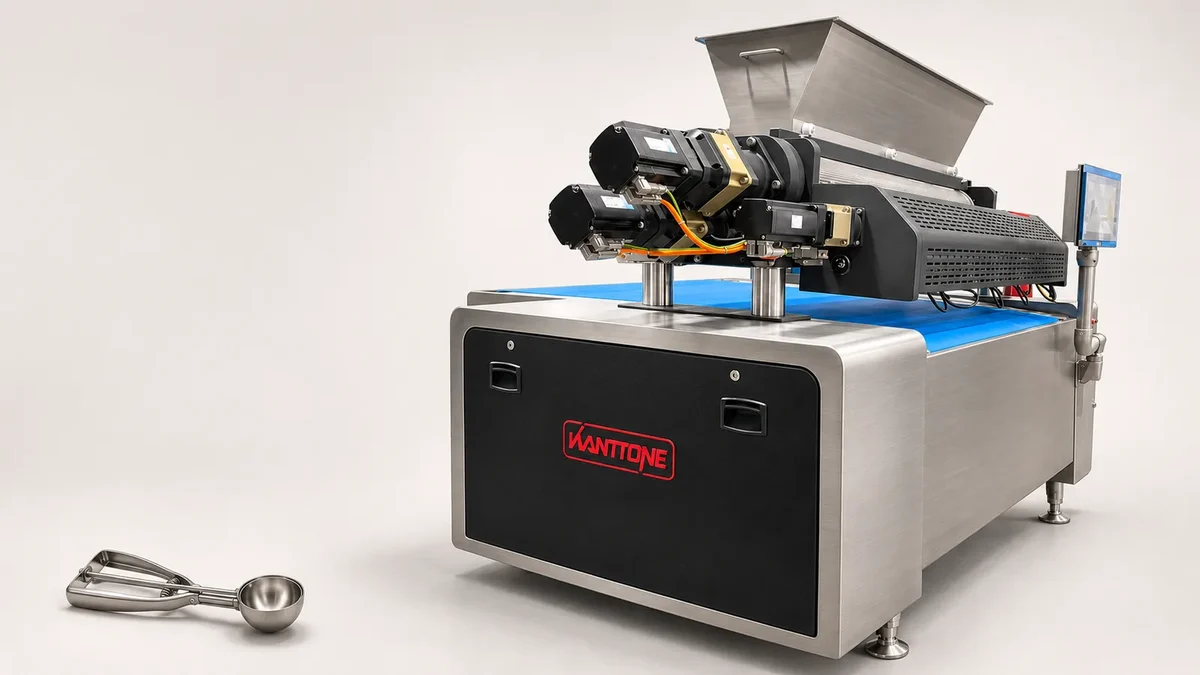
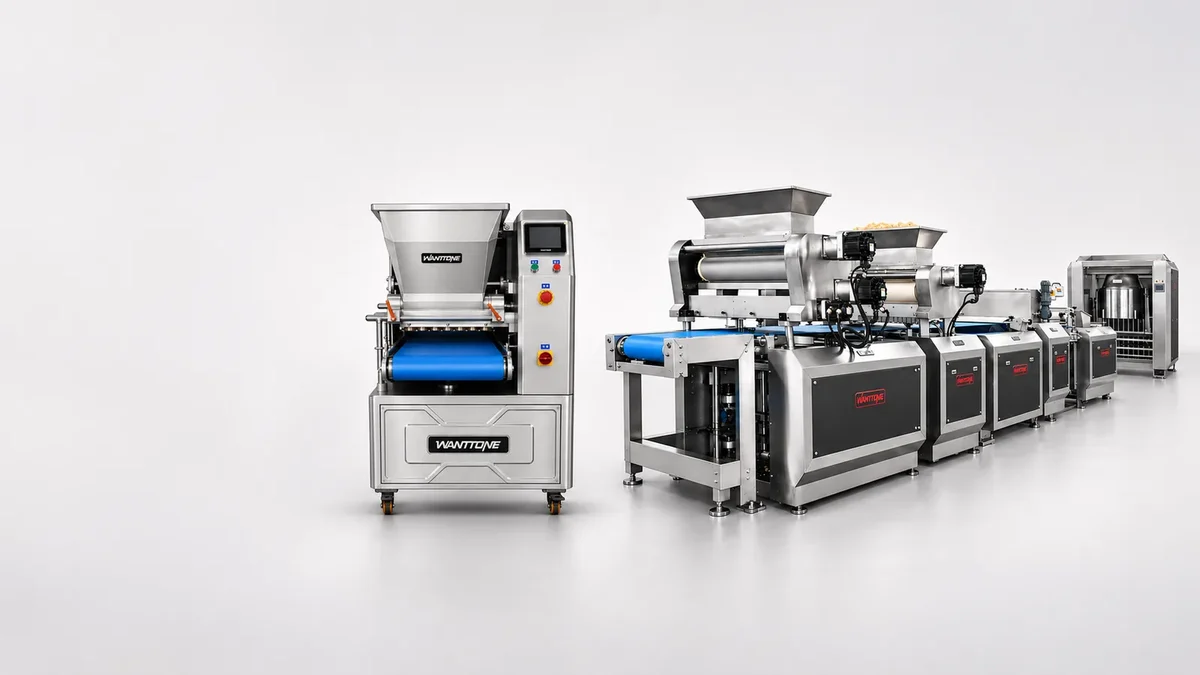
Wanttone’s soft and hard biscuit line lists PLC and touchscreen control, with optional remote monitoring. Buyers should specify what is automated, what remains manual and how each machine responds to a downstream interruption. Reviewed industrial-line advertisements provide US$400,000–700,000 FOB at 1,000 kg/h and US$500,000–1,200,000 FOB at 1,500 kg/h as estimated references, not Wanttone quotes.
What Must Be Coordinated Between the Machines?
The control problem begins with material availability. Mixing and dough preparation must supply the former without uncontrolled waiting or frequent starvation. Dough feeding must match the approved product condition and the downstream consumption rate. The buyer should ask how the proposed system indicates a shortage and which operator action is required when preparation cannot keep pace.
Forming and conveyor movement must maintain the agreed sheet or piece arrangement. On a sheeted biscuit route, changes in relative speeds can affect sheet condition and transfers. On a moulded route, feed, release and discharge must be coordinated with the oven infeed. The proposal should identify which settings are linked and which are independently adjustable.
Baking introduces a different timing requirement. A tunnel oven contains product that cannot be treated like a stationary buffer of unbaked dough. Its response to a loss of downstream availability must be defined by the responsible equipment supplier for the actual oven and product. Ask for a written operational description rather than assuming that one common stop command is appropriate for every machine.
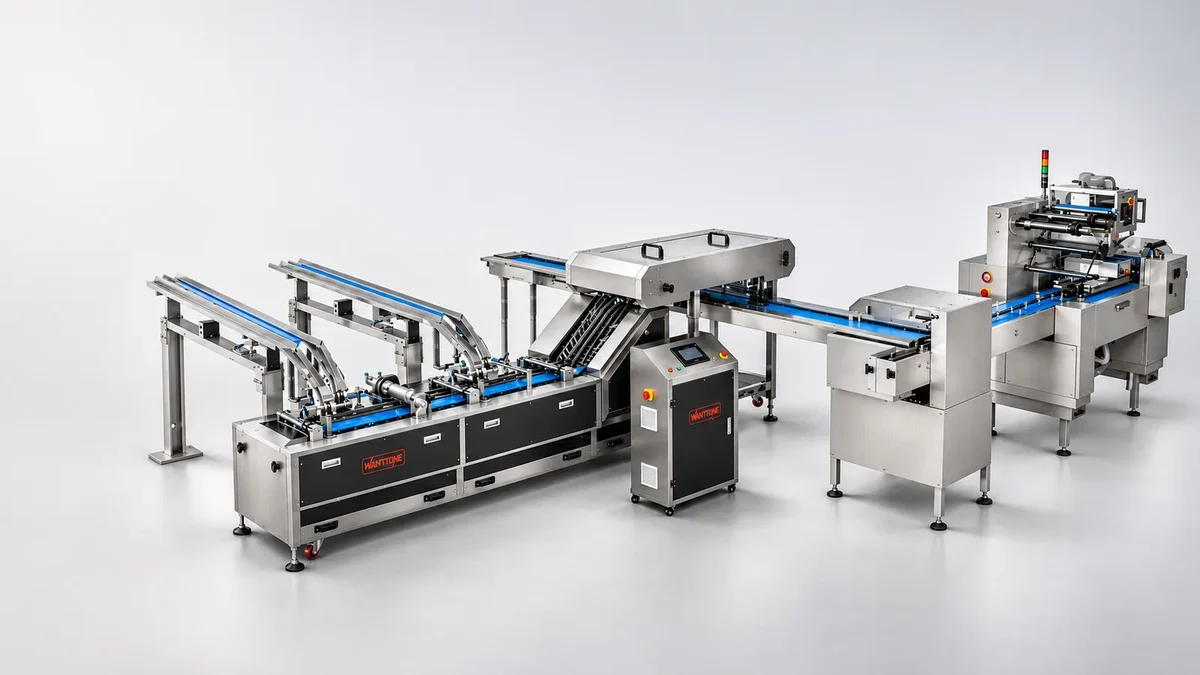
After baking, cooling and packing determine how quickly product can leave the process. The available accumulation and handling arrangement should be matched to the biscuit’s fragility and condition. A control system cannot compensate indefinitely for an undersized wrapper. Review the complete packing handover as part of the automation scope.
Request a responsibility schedule for the signals between separately supplied machines. A former, oven and wrapper can each work well independently while the combined line remains unstable because the status signals, permitted speeds or recovery responsibilities were never agreed.
Automatic vs Semi-Automatic Biscuit Lines: What Is Actually Different?
| Function | More manual arrangement | Connected automated scope to define |
|---|---|---|
| Dough transfer | Operators move and replenish dough | Agreed feeding equipment and shortage indication |
| Speed changes | Local adjustment at each module | Defined coordinated setpoints and permitted ranges |
| Product handover | Manual alignment or correction | Matched transfers and status interfaces |
| Operating records | Manual logs | Selected parameters and events recorded where included |
| Changeover | Operator-led setup | Recipe assistance plus required physical tasks |
This comparison describes possible scope differences, not a guarantee that every fully automatic advertisement includes the functions in the third column. Specify each function in the request for quotation and ask the bidder to mark it as included, optional or outside scope. Doing so turns the word automatic into a reviewable equipment and controls schedule.
Automation does not remove the product-development task. Operators and technical staff still need to establish approved dough conditions, tooling, bake profiles and quality limits. A recipe screen can recall a setting, but cannot establish that the setting produces an acceptable biscuit with a changed flour, fat or inclusion.
A staged automation project can be sensible where the existing plant already has reliable equipment. Identify the manual task that limits output or consistency, then assess the machinery, controls and interfaces needed to improve it. Review Wanttone’s expansion application using the actual retained equipment rather than replacing an entire line simply to obtain a broader automation label.
Which Controls and Documentation Should Buyers Specify?
Wanttone publishes the following reference options for its combined line. Treat them as a starting configuration range and ask for the exact controls, functions and documents in the offered package. Optional remote monitoring is not the same as a complete production-data system.
| Wanttone published reference | Buyer clarification | Evidence to request |
|---|---|---|
| PLC + touchscreen | Which recipes, permissions and status screens are included? | Screen list and functional description |
| Optional remote monitoring | What data and support access are included? | Access and responsibility agreement |
| 600–1800 mm working-width options | How are drives and transfers coordinated? | Machine layout and interface schedule |
| 100–5000 kg/h range across configurations | Which recipe and handover define output? | Product-specific performance schedule |
Ask for a functional description before approving final drawings. It should explain the normal operating sequence, the information exchanged at interfaces and the conditions requiring operator attention. The buyer does not need to dictate every programming detail, but should understand what the delivered system will do and what lies outside the supplier’s commitment.
Define operator and maintenance documentation as deliverables. The team needs the agreed drawings, settings backup, component identification and instructions appropriate to its responsibilities. Confirm who holds approved software and recipe versions and how changes are recorded. A spare touchscreen or replacement controller is less useful if the factory cannot restore the approved configuration.
Where remote access is proposed, follow the buyer’s own access rules and establish who can approve a connection. Do not assume that enabling remote monitoring transfers responsibility for product decisions or site operation to the equipment manufacturer. Clarify the support purpose, data available and actions that remain with the factory.
If event records or production reports are included, define the meaning of each recorded value. Specify whether a counter measures formed pieces, baked pieces, packs or accepted kilograms. Agree how an operator records a product change and how timestamps relate across equipment. A large collection of data is less useful than a small set of correctly defined measures that helps explain a loss. Ask the supplier to demonstrate a sample report using an observed event, then confirm which reports and data exports are part of the delivered scope rather than optional future development.
How Much Output Can Reduced Downtime Actually Add?
Compare automation proposals using explicit operating assumptions rather than promised percentage savings. The following scenario holds nominal speed at 1,000 kg/h, the shift at eight hours and saleable yield at 98%. Only the proportion of scheduled time running at the assumed rate changes. The values are editorial scenarios, not measured Wanttone improvements.
| Running utilization | Calculated saleable kg/shift | Difference from 65% case |
|---|---|---|
| 65% | 5,096 | Baseline |
| 75% | 5,880 | 784 kg |
| 85% | 6,664 | 1,568 kg |
Saleable output is 1,000 × 8 × utilization × 0.98. Raising the illustrative utilization from 65% to 75% adds 784 kg per shift under those conditions, but no particular automation function guarantees that increase. The factory must identify the actual losses and confirm whether the proposal can address them. Do not count both the same reduction in stops and a second overlapping availability benefit.
Use loss categories that lead to action: waiting for dough, setup and cleaning, transfer interruptions, wrapper stops, quality holds and planned maintenance. Measure the baseline and the intended improvement using the same definitions. Distinguish an event that stops the whole line from a local fault that does not immediately affect output.
Before assigning a value to recovered output, establish that it can be sold and packed. At 1,000 kg/h, a 200 g pack requires 83.3 packs/minute at full product flow. If the wrapper is the constraint, improving former uptime alone may simply create more accumulation or stops. The business case should connect the proposed control improvement to the factory’s real bottleneck.
What Happens When the Wrapper or Another Machine Stops?
Ask the supplier to describe interruption handling for the actual product and equipment. The line may contain unbaked dough, product inside the oven, fragile warm biscuits and cooled product waiting for packing. Those conditions have different consequences. The operating response should be engineered for the specific installation, not copied from a generic conveyor demonstration.
Define the capacity and limits of any agreed accumulation arrangement. It should preserve product quality and provide a clear response when its permitted limit is reached. Do not assume that a longer conveyor creates an unlimited buffer. Ask how the operator identifies affected product and how the system communicates the cause of the interruption.
Recovery should be part of commissioning. Within the supplier’s safe test procedure, observe representative planned interruptions and the subsequent return to acceptable product. Record what information is shown, which actions are automatic and which require the operator or maintenance team. The buyer should not improvise safety logic, bypasses or oven stop behavior during a production emergency.
Include upstream and downstream suppliers in the interface review. If one vendor owns the oven and another owns the wrapper, assign responsibility for the exchanged status information and the final operating description. A signed responsibility matrix is more valuable than an assumption that common component brands guarantee compatible behavior.
Review Wanttone oven options alongside the forming and packing scope. The objective is a line that responds predictably to normal operating events while protecting the agreed product and maintaining the equipment’s required operating conditions.

What Is a Researched Budget for an Automatic Biscuit Line?
A public price benchmark should identify the line scope and capacity. Guangdong Shunde Huaji Machinery’s seller-published catalog lists industrial soft-and-hard lines at the following ranges, checked November 17, 2026. These advertisements provide a budget reference for connected equipment, not a price for a standardized automation package or a Wanttone offer.
| Advertised line | Estimated FOB USD | Controls qualification |
|---|---|---|
| 1,000 kg/h soft-and-hard line | $400,000–$700,000 | Confirm functions, interfaces and documentation |
| 1,500 kg/h soft-and-hard line | $500,000–$1,200,000 | Confirm optional monitoring and integration scope |
Do not infer the automation premium from the difference between these ranges. Capacity, oven, forming routes, supplier scope and services differ. Ask for the price of each optional function in the actual proposal. Separate automatic feeding, transfer equipment, packing interfaces, remote monitoring and any additional data collection so the buyer can understand what each investment changes.
These figures are estimated reference ranges, not final quotations. A project also needs destination-specific estimates for freight, utilities, installation, building work, commissioning and training. Existing equipment integration may create engineering work that is absent from a new standalone package. Obtain a Wanttone automation proposal with an itemized responsibility and equipment schedule.
For the operating-cost comparison, measure labor, stops, rejects, energy and maintenance using a common product and schedule. Automation may shift work from repetitive handling toward operation and maintenance, so the factory should plan skills and training rather than assuming a published labor reduction will apply unchanged to its own site.
How Should Automatic-Line Requirements Be Localized by Market?
What Should Buyers in the United States Ask?
For a US plant serving California or Texas snack customers, connect recipe control, product identification and cleaning routines with the factory’s own food-safety program. Reading Bakery Systems in Pennsylvania offers connected biscuit technologies. Compare a US proposal with Wanttone on the functional description, operator access and the exact output test. Confirm the wrapper interface for the customer’s pack formats rather than evaluating automation only at the former.
What Should Buyers in the United Kingdom Ask?
For a UK biscuit manufacturer supplying London retail or Midlands distribution, frequent recipe and package changes may make setup consistency more valuable than a higher maximum speed. Baker Perkins in Peterborough provides biscuit-forming technology. Compare the practical changeover and documentation proposed by each supplier, including Wanttone. Specify how operators identify the approved recipe and how product and label changes are confirmed through the factory’s procedures.
What Should Buyers in Saudi Arabia Ask?
For Saudi projects in Riyadh, Jeddah or Dammam, provide the actual utilities and factory environment before defining oven and controls arrangements. Ask how alarms, manuals and operator training will be communicated to the team that runs the equipment. Compare exporting manufacturers on commissioning and support responsibilities. Final retail artwork and Arabic information remain a destination packaging requirement, separate from the PLC recipe screen.
What Should Buyers in Nigeria Ask?
For a Nigerian factory serving Lagos or Ogun State distribution, identify the tasks and losses that automation is expected to address. Confirm site utilities, the intended package weights and the equipment that will be retained. Ask Wanttone and other bidders to define normal interruption and recovery responsibilities. A line described as automatic still needs a trained team and an agreed plan for maintenance, spare parts and product approval.
What Should Buyers in China Ask?
For buyers selecting an automatic biscuit production line manufacturer in China, consider Wanttone in Yangjiang, Guangdong. Its own biscuit production creates a practical basis for discussing recurring stops, feeding, transfers and operating routines. Request the proposed control functions in writing and verify them during commissioning. The machinery history dating to 1981 supports the shortlist, while the actual product trial and interface agreement support the purchase.
World Bank WITS reports 2024 imports of the broader sweet-biscuit, waffle and wafer category of approximately US$1.306 billion for the United Kingdom and US$525.70 million for Saudi Arabia. These figures can inform commercial screening but do not determine an automation requirement. Use customer orders, product mix and measured factory losses to decide which functions deserve investment.
Why Discuss Biscuit Automation with Wanttone?
Wanttone combines machinery engineering with its own commercial biscuit production in Yangjiang, Guangdong, China. Its current company introduction identifies machinery roots in 1981 and its own biscuit factory in 1993. That combination provides a practical starting point for discussing dough supply, forming, baking, cleaning and operator routines.
Use the combined biscuit line as the start of a configuration discussion, then define the automatic functions you require. Ask Wanttone to distinguish included controls from optional monitoring, packing connections and destination work. The buyer should be able to trace each important function to an item in the proposal and an acceptance activity.
For an expansion, submit the retained equipment drawings and current loss information through the expansion application. For a new factory, use the startup planning application to establish building, utilities and workforce requirements. A useful automation proposal explains how the process will operate day to day, not merely which controller brand is installed.

FAQ: What Else Should Automatic Biscuit Line Buyers Ask?
Does an automatic biscuit line need no operators?
No. The exact division of work follows the contracted scope. Product approval, cleaning, ingredient handling, adjustments and maintenance still need defined responsibilities and training. Ask which tasks are included, optional or manual.
Does PLC control guarantee that separately supplied machines will work together?
No. Interfaces, permissible operating states, transfer conditions and responsibility must be defined. Request a functional description and agreed commissioning tests for the actual former, oven and packing arrangement.
Can automation guarantee a fixed output improvement?
Not from the label alone. Measure the actual losses and establish which proposed function addresses them. The utilization comparison in this guide is an illustrative calculation, not a measured Wanttone performance promise.
What automatic-line prices were found?
Reviewed industrial soft-and-hard line advertisements show $400,000–$700,000 FOB at 1,000 kg/h and $500,000–$1,200,000 FOB at 1,500 kg/h. Scope differs. These estimated ranges are not Wanttone quotations or a standardized controls price.
What should I send Wanttone for an automation proposal?
Provide the product brief, output and shift schedule, existing equipment, utility information, packing format and destination. Describe current stops, manual tasks and the functions you want to improve, then agree a measurable acceptance plan.

Wanttone Engineering Team
Wanttone’s engineering and project teams prepare practical guidance on biscuit machinery, production-line planning and factory requirements.