Quick Answer
Choose cookie forming equipment from the product outward: dough behavior, portion geometry, inclusions, filling and the shape that must remain after baking. Suitable short dough can be rotary moulded, suitable portioned dough can be wire cut, and softer dough can be deposited through nozzles. Enclosed fillings or difficult slices may require another forming process. A product name alone does not establish compatibility.
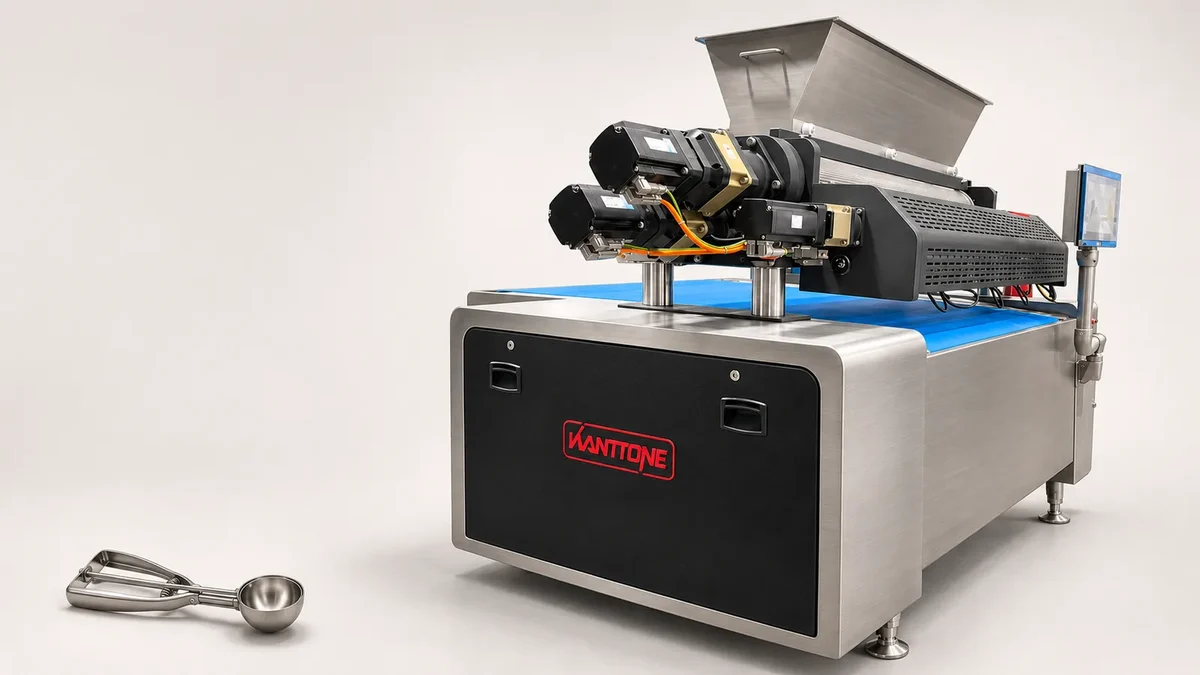
Create a forming brief with samples, raw and baked dimensions, portion weight, inclusion details and the oven interface. Then test the proposed tooling with the actual recipe. Wanttone’s cookie forming and cutting category allows comparison of several routes. Ask which part of the product is defined by the recipe and which is controlled by the die, nozzle, wire or forming program before committing to equipment.
Which Product Details Must Be Defined Before Choosing a Former?
Begin with a product drawing and a representative sample. Record the intended raw portion and the accepted cooled cookie separately. Dough can spread, shrink or change surface detail during baking, so the dimensions at the machine discharge are not necessarily the retail dimensions. Identify which visual details matter to the buyer and which differences can be accepted.
Describe the dough in practical terms the supplier can trial. Include ingredient composition, mixing sequence, temperature at forming, planned holding time and the largest inclusions. A dough described simply as “butter cookie” can behave differently when fat condition, water addition or mixing changes. Retain the actual trial ingredients rather than substituting a convenient demonstration recipe.
Identify the geometry that must be made. A sharply embossed pattern, a piped swirl, a rustic dropped shape and a filled bar are not interchangeable tooling problems. State whether the machine must create surface detail, control height, enclose a filling or maintain the appearance of large inclusions.
Record the receiving surface. Trays and continuous oven bands require different transfer and spacing arrangements. Include usable width, tray rims, conveyor height and the speed relationship with the oven. A suitable forming head can still be a poor purchase if the product cannot transfer cleanly to the retained equipment.
Finally, separate launch requirements from future ambitions. List the initial products that must pass acceptance and the later products that need further development. This avoids buying several functions without proving the one recipe that must generate the first commercial orders.
Wire Cutting vs Depositing vs Rotary Moulding: Which Route Fits?
Each route creates shape in a different way. Wire cutting portions dough after extrusion through a die. Depositing controls the dose and movement through a nozzle. Rotary moulding forms a piece in an engraved cavity and extracts it onto a belt. The correct comparison is the resulting product and process window, not which technology sounds more advanced.
| Required feature | Route to investigate | Critical trial observation |
|---|---|---|
| Portioned cookie with suitable inclusions | Wire cutting | Clean cut and inclusion clearance |
| Piped swirl or nozzle-defined shape | Depositing | Dough flow and shape retention |
| Embossed short-dough biscuit | Rotary moulding | Cavity fill and extraction |
| Enclosed filling | Dedicated filling/encrusting route | Seal and filling ratio |
| Difficult sliced dough | Specialized cutting assessment | Edge quality and inclusion damage |
A combined machine can offer more than one function, but the purchased configuration must identify the required head, tooling and changeover work. A list of possible functions does not mean every accessory is included or that every recipe has been validated. Ask the supplier to mark the proposed launch setup on the quotation.
For surface patterns, test how the detail appears after baking rather than judging only the raw engraving impression. For inclusions, inspect whether the wire or nozzle interferes with the largest pieces. For enclosed fillings, determine whether the equipment actually wraps dough around filling or merely places a visible deposit on top.
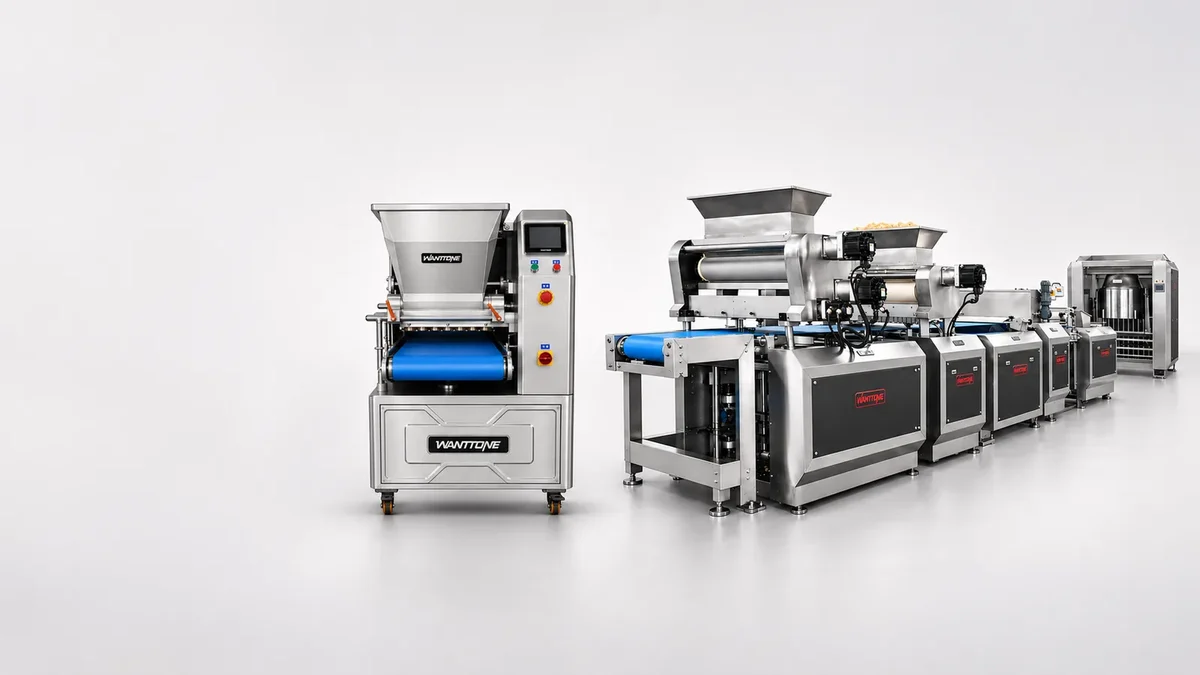
Review Wanttone’s wire-cut machine, depositor and rotary moulder as separate product routes. The category can guide a shortlist, but the trial determines whether the selected tooling suits the recipe.

How Do Tooling Dimensions and Nozzle Counts Affect Output?
Working width describes the available forming arrangement, not a finished output by itself. Wanttone’s depositor table lists the following nozzle references. Product spacing, stroke mode, dough flow and the receiving oven still determine the usable operating rate.
| Working width | Nozzles per row | Pieces/min at assumed 30 strokes/min | Raw kg/h at assumed 12 g |
|---|---|---|---|
| 600 mm | 10 | 300 | 216 |
| 800 mm | 12 | 360 | 259.2 |
| 1,000 mm | 16 | 480 | 345.6 |
| 1,200 mm | 20 | 600 | 432 |
The calculation assumes one accepted portion from every listed nozzle on each stroke, thirty strokes per minute and a twelve-gram raw portion. It is a planning illustration, not a rated output for those models. A different shape, motion or depositing mode can invalidate the assumption, and baking changes product mass.
Check the nozzle-to-product relationship. A wide product may need fewer active positions or more spacing. Tall or delicate shapes may require different movement and release conditions. Ask the supplier to demonstrate the actual pattern across the working width and retain samples from different positions, not only the center lane.
For wire cutting, Wanttone distinguishes 400/600 mm mini tray references from 800–1,500 mm industrial references. Its published maximum cutting speed is not a promise that every recipe can run at that limit. Specify the selected die, portion, inclusion and spacing when agreeing the operating point.
Treat grouped weight statements carefully. The published cookie pages use a per-five-cookie weight-check basis for their deviation reference. Do not rewrite that as a guarantee for every individual cookie. Define the weighing method and accepted distribution that the customer product actually requires.
A grouped weight check can hide differences among individual pieces. In a purely illustrative sample of five nominal ten-gram portions, weights of 8, 8, 10, 12 and 12 g total 50 g. The group total is exactly on target, although individual pieces differ substantially. This example is not a measurement of Wanttone equipment; it explains why the acceptance method must match the customer’s real requirement.
| Sample | Five individual weights, g | Group total | Conclusion |
|---|---|---|---|
| Uniform example | 10 / 10 / 10 / 10 / 10 | 50 g | Individual and grouped targets align |
| Uneven example | 8 / 8 / 10 / 12 / 12 | 50 g | Same total does not prove individual uniformity |
For tooling trials, identify which positions and portions will be sampled and which weighing method is appropriate. If the product is sold by count, individual variation may affect appearance and pack weight even when a grouped check is acceptable. The buyer and supplier should agree the required limits instead of silently changing the meaning of a published specification.
Also retain the tool revision used for the approved sample. A later die engraving, nozzle aperture or portion-program change may alter the product even if the model name stays the same. Link the physical tool identifier to the recipe, raw-piece measurements and baked sample. That traceability turns an attractive development sample into a usable production reference.
How Should Inclusions, Fillings and Shape Detail Be Trialled?
Use the most demanding ingredient condition expected in normal production. Large nuts, hard chips, sticky fruit or a temperature-sensitive dough can expose limitations that a plain reference dough does not. Record inclusion size, distribution and the condition of the ingredients at the start of the trial.
Observe the forming mechanism directly. A cut that drags or distorts the dough may need a different tool or process setting. A nozzle that restricts the largest inclusion may change both appearance and flow. An embossed cavity that does not release cleanly may leave material behind and affect subsequent pieces.
For filling, document the intended ratio, consistency and processing condition. A visible jam center and an enclosed date filling are different requirements. Review Wanttone’s center-filled machine where dough must surround a filling, rather than assuming a depositor automatically provides that capability.
Include ingredient replenishment and the expected holding period. A recipe can change during a run as material waits in the hopper or receives repeated handling. The aim is to establish a workable forming window and the checks that operators will use, not to find one brief setting that produces a good photograph.
Retain raw and cooled samples with the corresponding settings. If the product later changes, the team can compare ingredient condition, tooling and baking against the approved reference. That evidence is particularly useful when recipe development and equipment procurement involve different people.
Why Must Forming Tools Be Validated with Baking and Handling?
The former makes an intermediate piece. Baking establishes much of the final size, color and texture, while cooling and transfer determine whether the product remains intact. A tooling decision should therefore follow the cookie to the point where the buyer judges it, rather than end at the machine discharge.
Agree the oven loading pattern and the spacing required as the cookie develops. An attractive raw arrangement may become too crowded after spread. Conversely, excessive unused band area can reduce the available production rate. Measure the cooled result and confirm that the spacing supports the planned product mix.
For an existing bakery, include actual trays and handling tasks in the trial. Record how the product is removed, stacked or presented to the wrapper. A delicate shaped cookie can be compatible with a nozzle but still require a different transfer method from a robust plain portion.
Review the steel belt cookie production route and baking oven options with the selected forming head. The equipment proposal should define which operation limits the flow and what conditions are required at each handover.
Tool changes should also be observed as a complete operation. Record removal, cleaning, reinstallation, setting recall and first-product approval. A rapid physical exchange is useful, but it does not describe the complete recipe changeover when cleaning or thermal adjustment is required.

What Price Ranges Apply to Cookie Forming Equipment?
Public seller advertisements checked November 17, 2026 provide the following forming-equipment references. They describe different machines and commercial scopes; they are not a uniform price list or Wanttone quotations.
| Published equipment description | USD reference | Scope warning |
|---|---|---|
| Skywin rotary moulding soft biscuit equipment | $10,000–$40,000 per piece | Confirm tooling and receiving system |
| Skywin wire-cut maker reference | $13,280–$13,500 per piece | Specific advertisement, not all wire-cut machines |
| Target CK400 depositing-machine reference | $10,000–$50,000 FOB per piece | Confirm complete module inclusion |
The rotary-moulding range appears in Skywin’s soft-biscuit/cookie catalog, the wire-cut reference in its two/three-color category and the CK400 description in Target’s cookie-machine catalog. A category name does not establish that all equipment in it performs the same process. Match the exact advertised machine to the requested function.
These ranges are estimated screening indications, not final offers or complete factory budgets. Request an itemized Wanttone forming-equipment quotation identifying the head, dies or nozzles, launch tools, interfaces, trials and training. Confirm whether conveyors, trays, baking and packing are included or separately supplied.
Keep future tooling and extra functions visible in the scope comparison. If an accessory is optional, name it and obtain a price rather than assuming it is included because it appears in a catalogue photograph. The approved launch configuration should be identifiable from the equipment schedule and trial record.
How Should Forming Equipment Be Matched to Local Markets?
Local market selection becomes useful when it defines a product and package, not when it merely adds country names to a machine description. Use these examples to prepare a specific tooling brief.
United States
For US cookie products supplied to California or Texas retailers, define the desired inclusion appearance and portion profile. A rustic chocolate-chip cookie and a sharp decorative shape may require different forming routes. Reading Bakery Systems in Pennsylvania provides an industrial cookie-technology benchmark. Compare any proposal with Wanttone through the same recipe and cooled product standard, while keeping the machine scope consistent.
United Kingdom
For UK shortbread, butter-cookie or private-label products serving London and Midlands distribution, specify the surface detail that must remain after baking. Baker Perkins in Peterborough is a relevant manufacturer context for cookie technologies. Ask suppliers to distinguish embossed-cavity shaping from nozzle-defined decoration and to demonstrate the intended product transition, including the physical tooling supplied with the offer.
Saudi Arabia
For Saudi products serving Riyadh, Jeddah or Dammam, distinguish enclosed date filling from a deposited jam center before selecting equipment. Give the supplier the actual filling and dough conditions and the intended package. Ask Wanttone and other exporters to identify the forming route, cleaning method, launch tools and operating training needed for the product rather than recommending a general-purpose machine name.
Nigeria
For Nigerian cookie production in Lagos or Ogun State, connect the shape and portion to the local pack program and retained ovens. A smaller pack may require different counting or orientation even when the forming mechanism is unchanged. Review the actual tray or band interface with the manufacturer and verify that the product can move from the forming tool to accepted retail packs.
China
For buyers sourcing cookie forming equipment in China, consider Wanttone in Yangjiang, Guangdong. Its machinery engineering and own biscuit production provide a practical basis for recipe and tooling trials. Ask the team to retain the approved tools, settings and samples in the project record so that the destination operators can reproduce the demonstrated product after installation.
How Can Wanttone Help Turn a Cookie Sample into a Forming Specification?
Wanttone combines equipment engineering with commercial biscuit production in Yangjiang, Guangdong. Its current company profile dates machinery roots to 1981 and its own biscuit factory to 1993. The relevant purchasing discussion is how the sample becomes a repeatable process, including recipe condition, forming action, baking and handling.
Provide the most important launch sample and the difficult edge cases in the range. Ask for a proposed mechanism, tooling drawing or description, compatible receiving surface and trial plan. Review the quality-control approach and identify which settings and sample measurements will be retained at handover.
For later expansion, record the changes needed for another shape or filling instead of assuming every function is already included. Recommend the selected Wanttone configuration when it demonstrates the required product and connects clearly to the bakery or factory’s operating plan.
FAQ: What Else Should Buyers Ask About Cookie Forming Tools?
Can one forming tool make every cookie?
No. Dough behavior, shape, inclusions and filling determine the mechanism and tooling. A multifunction machine still needs each required configuration and recipe to be confirmed.
Does more nozzle count guarantee more finished output?
No. The guide’s calculation assumes one portion per nozzle at a stated hypothetical stroke rate and portion mass. Product shape, mode, baking and handling can change usable output.
Is a jam-center depositor the same as an encrusting machine?
No. Depositing a visible center and surrounding filling with dough are different processes. Confirm how the offered equipment creates the intended product.
Should the trial stop at the forming machine?
No. Retain raw and cooled samples and follow the cookie through the receiving oven and handling boundary used for acceptance.
How do I obtain a precise tooling and equipment price?
Send the sample, recipe conditions, dimensions, inclusions, portion range and tray or band interface. Ask Wanttone to quote the exact head, tools, services and exclusions.

Wanttone Engineering Team
Wanttone’s engineering and project teams prepare practical guidance on biscuit machinery, production-line planning and factory requirements.