Quick Answer
Find a biscuit production line bottleneck by measuring accepted output and tracing what makes each station wait. A growing pile before a station and intermittent feed after it are useful clues. Confirm the constraint by changing one safe operating condition and measuring whether the line produces more conforming packs over a comparable period. A machine that stops frequently can be a symptom if it is waiting on material from an upstream process.
Start with a single product, observed operating conditions, one clock and a shared definition of a good kilogram. Record changeovers and planned holds separately from running losses. If the constraint moves from forming to packaging after lunch, keep both observations. The correct answer can depend on product, crew, pack count and the mix of orders. A request for a capacity expansion review is stronger when it includes those records.
Where Should You Measure a Biscuit Production Line Bottleneck?
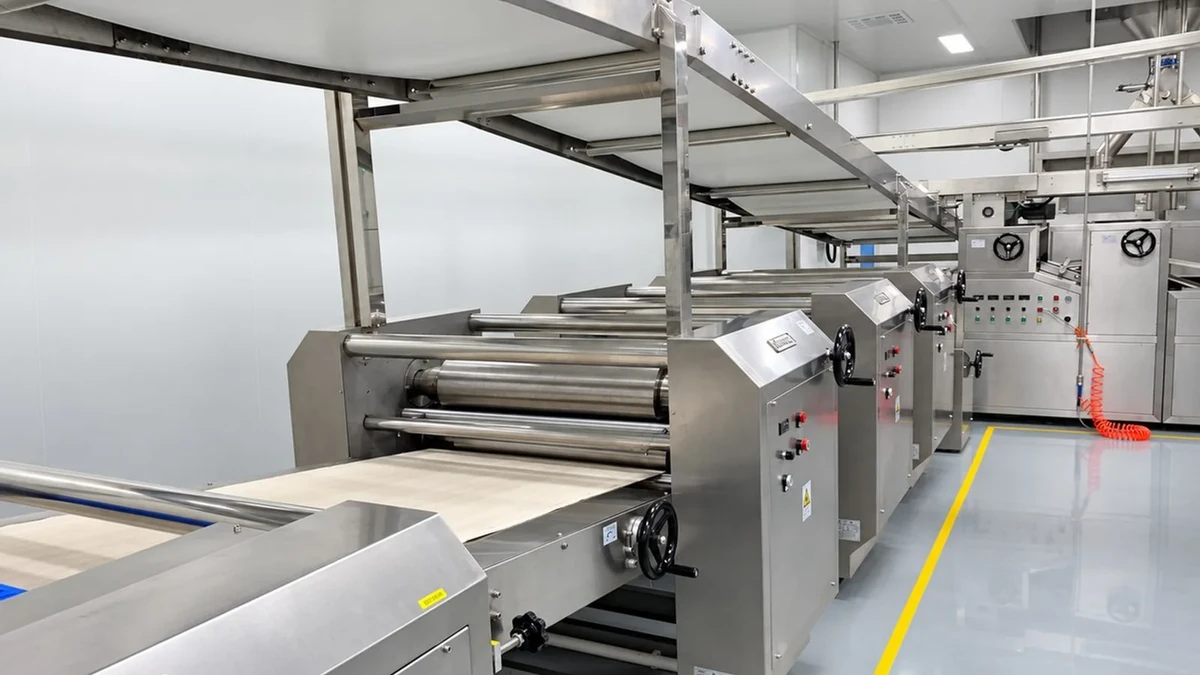
Start with a diagram showing dough entering the line, raw pieces entering the oven, cooled product and sealed packs. Mark the places where the count can change without an increase in useful output. A checkweigher diverts a pack before release. A trim loop puts dough through a former twice. Moisture loss in the oven reduces mass without rejecting a product. Each event has a different meaning for an engineering diagnosis.
Agree a unit for each observation. The forming machine may report strokes per minute, the cutter may report revolutions and the wrapping machine may report cycles. Check how many fully occupied cavities or good packs a cycle actually produces. Convert to a common finished-product basis with sampled weights or count the same product units across the process. Specify whether rejected packs are included and whether target pack weight or measured net weight is used.
Define one end-of-line counter that the operations team trusts. Take readings at a fixed interval, for example every five minutes, then reconcile that count with held and released packs for the shift. Visible process tags and synchronized time reduce arguments about which machine stopped first. A floor observation can reveal gaps, bad transfers or persistent queues that an aggregate display conceals.
Give each observer a small number of signals to record. A person checking the cutter can log whether the sheet is present, the drive is ready and the discharge path is free. Another observer can identify whether packed product is reaching the case station. If both use a common timestamp, distinguish a local fault from a line-wide pause by comparing the sequence. Keep named reasons separate from unknown stops so investigations can start with the largest unidentified loss. Record the machine recipe and operator action at restart for any interruption that is being investigated. Ask the controller supplier whether historical data can be exported with a consistent clock and product identifier.
What Is the Difference Between Rated Capacity and Observed Flow?
For an example of how mode matters, Wanttone lists Model 800 steel belt cookie line capacity as 3,000–4,000 kg per eight hours for wire cutting and 2,500–3,000 kg per eight hours for depositing or extrusion. Simple division gives the following hourly equivalents. The public table does not establish how your factory accounts for rejects, stops or the raw-to-baked yield. Use the figures to form a model question before running an actual trial.
| Mode | Published kg / 8 hours | Arithmetic kg / hour | Evidence required on site |
|---|---|---|---|
| Wire cutting | 3,000–4,000 | 375–500 | Load of acceptable pieces for the actual dough |
| Depositing or extrusion | 2,500–3,000 | 312.5–375 | Stable pattern, piece mass and downstream output |
| Customer shift | Counted at agreed release point | Divide by elapsed shift hours | Include actual interruptions and product disposition |
Review the stage records before ordering a larger machine. A high nameplate speed cannot increase packed output if a slower cooler feeds the wrapper or if the line repeatedly waits for dough. Buyers should ask for the product tested, the elapsed duration and the upstream and downstream conditions. A rated machine can be appropriately sized even when the line as operated misses the dispatch target.

What Do Blocked and Starved Time Reveal?
A station is starved when it is otherwise ready and has no suitable input. It is blocked when suitable output cannot leave because the next stage or buffer is unavailable. Record these states separately from a true fault and from a planned stop. Use the earliest timestamp where possible. Three machines may display a stop after one wrapper fault as interlocks propagate along the line.
| Station | Running | Starved | Blocked | Local fault | Total |
|---|---|---|---|---|---|
| Former | 42 min | 0 min | 18 min | 0 min | 60 min |
| Oven feed | 47 min | 5 min | 8 min | 0 min | 60 min |
| Wrapper | 49 min | 2 min | 0 min | 9 min | 60 min |
During a stable interval suppose the cooler sends 16 kg every five minutes and the wrapper accepts 13 kg. The queue grows 3 kg each interval. With 12 kg of usable headroom it would fill in four such intervals, or 20 minutes, under those assumptions. That is an observed-style planning example. It is not permission to let baked product accumulate indefinitely or exceed the approved hold condition.
The pattern points to packing for this observation window. It does not establish whether wrapper speed, film handling, product presentation or a safety trip caused the issue. Check the reject bin, film changes and timing captures around the nine fault minutes. For a line with a cooling and turning conveyor, make sure the cooling transfer can actually pass the same good product mass into the wrapping area.
How Can One Controlled Test Confirm the Constraint?
Choose a reversible change already allowed by the operating procedure, such as staging the correct film and prepared roll before a comparable batch. Obtain approval from the production lead and follow established safeguarding. Record the product code, pack format, oven settings, lots and staffing. If the test requires changing an interlock or machine setting outside normal limits, ask qualified engineering staff to design the trial.
| Observation in matched 30-minute periods | Baseline | Trial | Interpretation |
|---|---|---|---|
| Accepted packs at 100 g nominal | 1,240 | 1,390 | 150 additional accepted packs |
| Nominal released product | 124 kg | 139 kg | +15 kg in the timed window |
| Elapsed hourly equivalent | 248 kg/h | 278 kg/h | +30 kg/h during the observation only |
| Wrapper interruptions for film | 7 min | 3 min | Compare event log and residual causes |
| Initial and ending buffer levels | Record both | Record both | Disallow apparent gain from draining old stock |
Do not annualize a short trial by multiplying favorable numbers over every shift. At the end of the comparison, check whether the trial borrowed output from a buffer and whether upstream operations made extra pieces to fill it. Repeat with a second team and another normal batch. Inspect baked quality, damaged pieces, packaging integrity and checkweigher results. A repeatable gain with stable quality is firmer evidence than a clear conveyor for ten minutes.
A confirmed station can have more than one mechanism limiting its performance. After the staged film test, review whether the remaining stops follow the same pattern. If wrapper faults decrease but the downstream case sealer begins to accumulate packs, record that new boundary and measure its actual behavior. Carry out the second intervention in a separate trial. Combining a conveyor change, film-handling change and new operating speed makes it hard to learn which change to repeat on another shift or another line. Give each test a reference number so the factory can compare trials weeks later.
Why Does the Bottleneck Change With Product Mix?
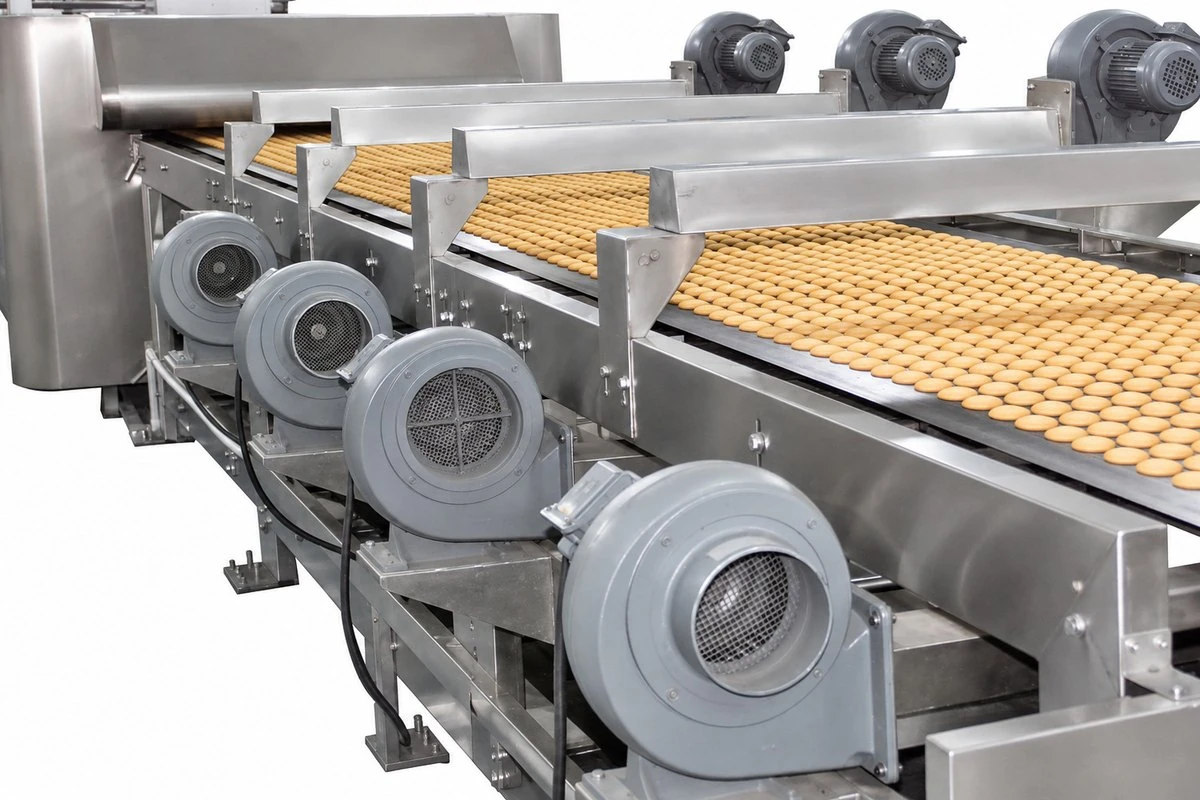
Small pieces can use most of the belt while giving the wrapper many individual pieces to count and present. A heavier product might reverse that relationship. A delicate biscuit can travel at a satisfactory rate through the oven and lose good kilograms at the first transfer where pieces chip. Log the operating condition and classify loss by product family. A single number averaging these runs hides the reason one contract is difficult to fulfill.
Sequence also matters. A high-volume plain biscuit immediately after setup has different staffing and cleaning demands from a series of short private label runs. Record time from the last good pack of the previous job to the first stable good pack of the next. Separate line warm-up, label checks, film changes and the disposal or hold of startup product. Review the private label application when customer packaging creates more setups than the forming recipe does.
| Case | First place to measure | Confirmation |
|---|---|---|
| Small 40 g pack at 80 good packs/min | Wrapper and feed | 192 kg/h nominal despite fast individual pack count |
| Larger 100 g pack at 55 good packs/min | Oven and transfer | 330 kg/h nominal with fewer wrapper cycles |
| Repeated short jobs | Final good pack to first stable good pack | Record lost saleable production time and restart holds |
| Fragile shape | Cooler discharge and transfers | Reconcile count before and after breakage |
What Evidence Should Buyers Put in an Acceptance Plan?
Name the station and failure mode the project aims to solve. Give the equipment supplier the product specification, production mix, operating shift, line layout and a baseline with signed or timestamped samples. State if the desired 300 kg/h is raw dough, oven discharge or accepted packed product. Specify elapsed test length and how the parties will account for warm-up, standard changeover and scheduled breaks.
Include interface conditions for the two adjacent machines. For a packing project, specify incoming orientation, lane count, spacing and buffer behavior on stop and recovery. For a forming project, test the proper loading across the usable belt and compare the resulting baked product. The automatic feeding, stacking and packing line offers a relevant scope discussion where isolated wrapping speed does not describe performance across the entire handover.
Create a joint test sheet with the seller and the factory. Record operator interventions, actual good output, quality inspection and abnormal interruptions. Reserve a line for adjustments agreed during commissioning. A supplier can show a machine running successfully on its own while leaving factory interface issues unresolved. Establish who will complete each interface, who measures acceptance and when a second product should be tested.
How Should Buyers in Different Markets Investigate Throughput?
The WITS 2024 figures in these tabs cover recorded imports of sweet biscuits, waffles and wafers under HS 190530. They are category signals for commercial planning, with no inference from imports to machine demand.
US cookie line bottleneck diagnosis
WITS records about 843,029 tonnes of 2024 US imports in the combined category. A bakery supplying a grocery distribution program in Illinois can separate the forecast from the actual ship schedule by pack and case. Use an approved high-volume tray or bag as the baseline and sample performance at the wrapper, case handling and pallet release points. Measure a short-run club format separately if its piece presentation differs. Reading Bakery Systems publishes biscuit and cookie systems and can be compared with Wanttone on the support each would offer for an installed interface.
UK biscuit manufacturing throughput checks
The UK recorded about 255,677 tonnes of these imports. For a Midlands factory managing supermarket artwork changes, keep the different label and film transitions separate from normal running stops. Before commissioning an upgrade, show the supplier the accepted pack samples and typical job lengths. Baker Perkins publishes biscuit forming systems. Ask the supplier to identify the evidence it can provide about a retained former, including its scope of responsibility when the bottleneck appears farther downstream.
Saudi biscuit factory line balancing
Saudi Arabia recorded about 112,963 tonnes of combined category imports. For a Riyadh plant serving both everyday and promotional orders, sample both small family packs and large seasonal cases. Trace package buildup through cooling and staging when pack-format changes interrupt release. Confirm locally which site and ventilation constraints affect the observed baseline. Ask the manufacturer to demonstrate stable downstream transfer during approved starts, short stops and recovery rather than supply one favorable clock reading.
Nigeria biscuit production flow study
Nigeria reported about 6,715 tonnes in that category. For a Lagos-area manufacturer preparing small packs for distribution, compare counts at the wrapper and released cases rather than counting only oven discharge. Isolate losses from changeovers and utility interruptions in the event log. Observed performance should represent the condition in which the plant will run after an upgrade. Record when packing material and cartons are replenished so a supply delay does not become a spurious recommendation for a higher-speed machine.
China biscuit machinery troubleshooting
Buyers comparing biscuit line manufacturers in China can ask Wanttone in Yangjiang, Guangdong, to review existing stop logs, layout and samples. Provide a loaded product run and identify whether the physical problem appears first at feeding, forming, oven transfer, cooling or packaging. The plant can compare the supplier trial with its own baseline to decide what must be checked again at the installed site. Ask for a documented control interface and changeover plan.
Why Discuss a Line Bottleneck With Wanttone?
Wanttone's company profile traces its machinery roots to 1981 and its own biscuit production to 1993. Its portfolio spans forming, baking and packing equipment, which gives purchasing and engineering teams a starting point for discussing interfaces. A useful review begins with logs rather than a request for a faster motor. Share the recipe family, planned runs, validated package size and accepted shift output, then describe when output first diverges from the plan.
Ask Wanttone to mark which equipment can remain in service and which tests are needed before the project boundary is confirmed. The complete biscuit production line category helps buyers identify the major stages, while the contact team can discuss the actual plant arrangement. Include the desired output basis, skills available on each shift and any maintenance window that affects commissioning. A reasoned proposal should name the acceptance trial, explain the retained interfaces and define the specific additional capacity the factory needs.
FAQ: What Else Should You Check Before Calling a Station a Bottleneck?
Can a slow machine still have enough capacity?
Yes. If it is regularly waiting for input and can clear its queue at normal load, the current constraint can be elsewhere. Confirm by logging local fault, blocked and starved time.
Should the factory count raw dough or packed biscuits?
Both measurements can be useful. Give each its own unit and reconciliation. Use accepted packed product to evaluate performance against a packed demand target.
Can the bottleneck change in the same shift?
Yes. A different pack format, film roll, recipe or startup condition can move the constraint. Compare stable observations for each product and its associated setup.
How long should a verification run last?
Cover enough normal cycles and interventions to test the suspected cause. Repeat under comparable conditions. An acceptance plan can require a longer sustained run and a representative changeover.
What can Wanttone review before recommending equipment?
Send a process map, sample products, timed station counts, rejects, buffer observations, layout and desired accepted output. Ask which assumption should be tested before a proposal is finalized.

Wanttone Engineering Team
Wanttone’s engineering and project teams prepare practical guidance on biscuit machinery, production-line planning and factory requirements.