Quick Answer
Choose an industrial biscuit making machine by matching the forming process to your dough, then verifying saleable output, oven compatibility, changeover effort and operating access. Hard-dough biscuits generally require sheeting and cutting; appropriate short dough uses rotary moulding. A purchase decision should compare those capabilities against the products you actually intend to sell, rather than selecting the widest machine or the highest advertised speed.
Write a product and factory brief before requesting prices. Wanttone lists combined soft-and-hard line options spanning 100–5,000 kg/h, but that range covers different configurations. Public industrial-line advertisements reviewed here show US$400,000–700,000 FOB at 1,000 kg/h and US$500,000–1,200,000 FOB at 1,500 kg/h. These are supplier-specific references, not Wanttone quotations or prices for a standalone forming machine.
Which Product Requirements Should Lead the Machine Selection?
Build a product matrix before evaluating machinery. List each launch biscuit’s dough family, shape, piece weight, thickness, texture and pack format. Include the most difficult planned product, not only the product with the largest sales forecast. A supplier may demonstrate one easy recipe convincingly while a delicate shape, high-fiber dough or unfamiliar ingredient requires a different forming arrangement.
Separate essential capability from desirable future capability. If the first commercial contracts require a plain moulded biscuit, a planned laminated cracker should be evaluated as a separate process requirement. Do not allow an undefined promise of future flexibility to increase the initial equipment scope without understanding which mixer, laminator, tooling or baking changes will actually be needed.
Request a product trial for the hardest requirement. Agree how the cooled samples will be evaluated and who can approve them. Finished weight, surface detail, shrinkage, breakage and texture should have agreed descriptions or measurements. Keeping reference samples and settings makes the decision reproducible when procurement, engineering and commercial teams review the machine together.
Explore the Wanttone complete line range to identify possible routes, then narrow the request to your own products. A category page is a starting point for a discussion, not proof that a single configuration can manufacture every biscuit shown in a catalog.
Rotary Moulder vs Sheeting and Cutting: Which Machine Fits?
| Selection question | Rotary moulding | Sheeting and rotary cutting |
|---|---|---|
| Dough condition | Suitable short dough that fills and releases from cavities | Dough that forms a manageable continuous sheet |
| Product appearance | Engraved patterns and defined moulded shapes | Cut outlines, docking and sheet-based products |
| Critical adjustment | Feed, roll pressure and extraction | Gauging, sheet tension and cut registration |
| Material return | Manage feed and extraction losses | Control returned cutting web |
| Trial emphasis | Clean release and stable piece weight | Thickness, shrinkage and scrap behavior |
The terms hard and soft describe the dough process here, not a simple finished-product hardness test. A crisp biscuit may still use a short-dough route. Ask the supplier to classify your recipe through an actual trial rather than treating all crisp biscuits as cutter products or all cookies as rotary-moulded products.
A combined line can include both forming arrangements. That can be valuable for a mixed product portfolio, but the factory still needs appropriate dough preparation, baking profiles, sanitation procedures and handling. Compare a combined proposal with a dedicated route against the number of changes you expect to make in a normal week. More theoretical capability does not automatically improve utilization.
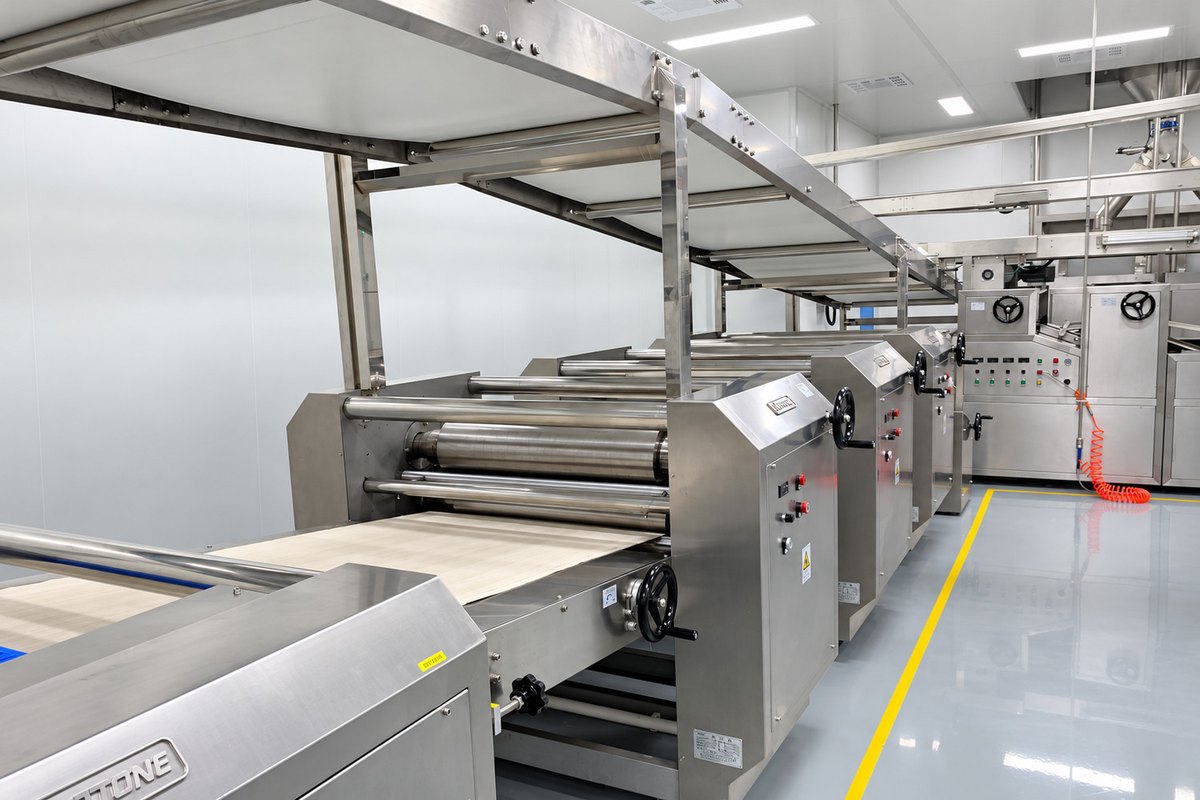
Review the rotary moulder alongside sheet-forming equipment. For fermented or laminated crackers, assess the dedicated cracker route separately. Verify the actual equipment list and the recipe conditions under which the supplier claims a successful result.
How Should Buyers Compare Width, Batch Size and Oven Options?
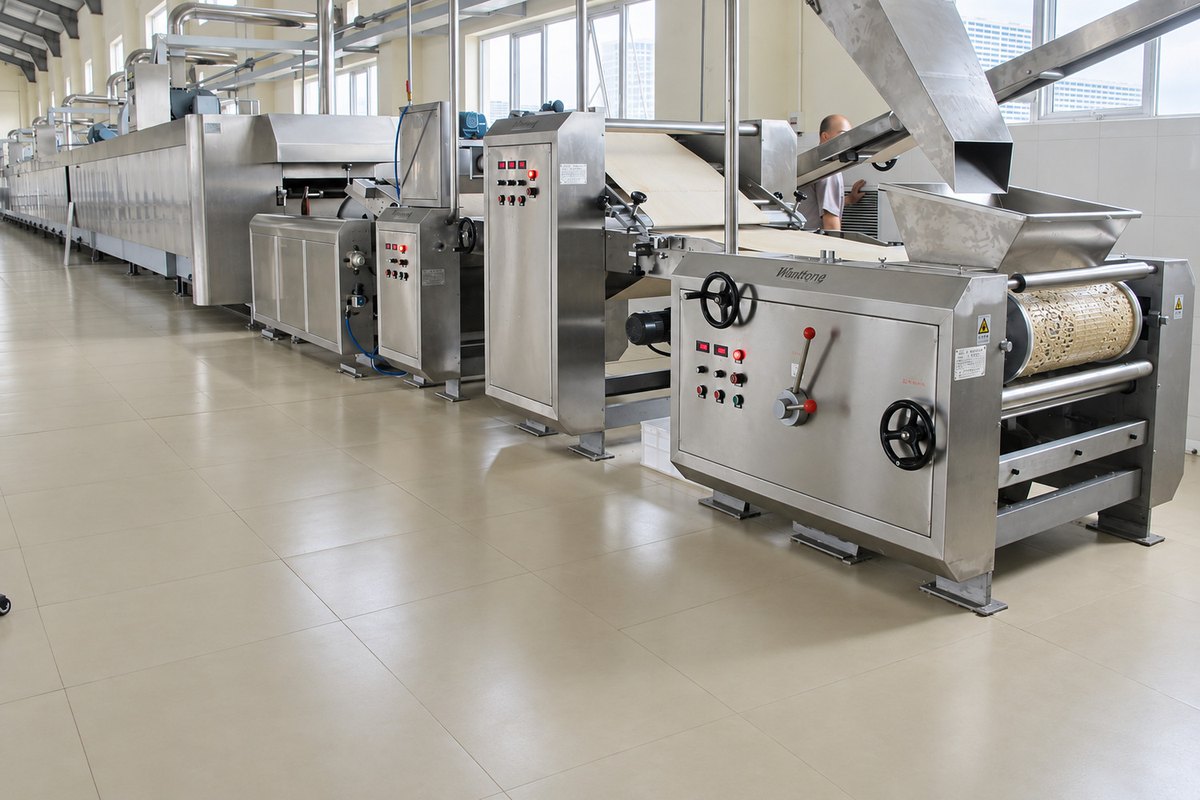
Technical specifications are useful when they are connected to a production calculation. Wanttone’s published combined-line specification lists the following options across its range. These options are not a promise that every item belongs to one standard package or that belt width alone determines output.
| Specification | Published choices | Decision required |
|---|---|---|
| Working width | 600 / 800 / 1000 / 1200 / 1500 / 1800 mm | Lane arrangement, loading and baking validation |
| Horizontal mixer batch | 250 / 400 / 600 / 800 kg | Complete cycle time and dough supply rate |
| Typical listed oven length | 30–80 m | Recipe dwell and actual effective baking length |
| Heating options | Gas / electric / diesel | Site utilities and operating-cost assessment |
| Layout options | Straight or turning configurations | Transfers, maintenance access and building envelope |
The buyer should request the effective bake length, not just the overall oven length. Also distinguish drive electricity from thermal input. A forming-machine motor rating does not describe the energy required to bake the product. Ask for a complete utility schedule with the relevant duty and supply conditions, then have the factory’s responsible specialists check it against the site.
For a retrofit, document working width, conveyor height, usable speed range and the existing controls. A machine that fits on a drawing may still create a poor transfer or an unstable dough feed. Include maintenance withdrawal space and installation access, especially if the replacement machine must pass through existing doors without disrupting surrounding production.
Use the Wanttone technical table as a reference for a proposal discussion. Ask which configuration the quotation actually includes and which of the published alternatives remain optional.
How Much Capacity Is Enough Without Oversizing the Machine?
Work backward from saleable demand. A line rated at 1,000 kg/h will not necessarily deliver 8,000 packed kilograms in every eight-hour shift. Downtime, slow operation and product losses must be treated consistently. The following scenario uses 75% running utilization and 98% saleable yield; both are editorial assumptions rather than measured supplier results.
| Rated output | Scheduled hours | Calculated saleable kg |
|---|---|---|
| 500 kg/h | 8 | 2,940 |
| 1,000 kg/h | 8 | 5,880 |
| 1,500 kg/h | 8 | 8,820 |
The calculation is rated kg/h × 8 × 0.75 × 0.98. A requirement for 6,000 saleable kg per shift would therefore need 6,000 ÷ (8 × 0.75 × 0.98) = 1,020.4 kg/h under the same assumptions. Discuss a longer schedule, reduced losses or a verified higher configuration rather than assuming that a nominal 1,000 kg/h purchase must be sufficient.
Check the number of packs at the target flow. At 1,000 kg/h, a 100 g package creates a theoretical requirement of 166.7 packs/minute; at 200 g, the requirement is 83.3 packs/minute. These calculations concern the full rated flow and do not prove wrapper performance with actual biscuits and film. Include normal changeovers and rejects in the packaging acceptance test.
For mixed production, schedule each SKU rather than averaging incompatible products into one output figure. Use the market-to-capacity guide to connect order commitments, shift time and the machine’s tested operating range.
What Price Range Should Buyers Use for Industrial Biscuit Machinery?
For an initial industrial-line budget, the publicly advertised examples below provide concrete figures. They come from Guangdong Shunde Huaji Machinery’s seller-controlled catalog, checked November 17, 2026. They describe supplier-specific soft-and-hard lines, not Wanttone offers or standardized transaction averages.
| Advertised line | Reference FOB USD | Calculated USD per rated kg/h |
|---|---|---|
| 1,000 kg/h soft-and-hard line | $400,000–$700,000 | $400–$700 |
| 1,500 kg/h soft-and-hard line | $500,000–$1,200,000 | $333–$800, rounded |
The last column divides price by rated output. It measures advertised capital intensity, not cost to manufacture a kilogram of biscuits. The overlapping ranges make a useful purchasing point: larger capacity does not guarantee a lower comparable investment, and package scope must be checked before drawing conclusions from a normalized figure.
A standalone moulder or cutter belongs in a different scope comparison. Ask the supplier to identify the machine and its interfaces separately if that is all your project requires. Do not apply a complete-line budget to a former, or present a former advertisement as a complete factory investment.
These are estimated reference ranges, not final quotations. Freight, import-side costs, building work, utility connections and destination commissioning need separate project estimates. Obtain a Wanttone machinery quotation with an itemized equipment schedule, service responsibilities, tooling and exclusions. Compare recurring costs using the same product and operating assumptions rather than a single electricity figure from the catalog.
How Should the Selection Change for Different Target Markets?
Local market planning should sharpen the product brief. The scenarios below identify questions that a destination buyer can investigate with a manufacturer; they do not imply that a country has one uniform demand profile. Use distributor requirements and site conditions before selecting equipment.
What Should Buyers in the United States Ask?
For a US factory serving regional snack distributors, specify whether the product is a packaged sweet biscuit, a cookie or another format. Reading Bakery Systems in Pennsylvania offers sheeted and rotary-moulded biscuit systems. Compare such a proposal with Wanttone using the same recipes, sanitation demonstration and saleable output. Confirm the packing formats demanded by your California or Texas customers before fixing the number of downstream lanes.
What Should Buyers in the United Kingdom Ask?
For a UK producer supplying London retailers or Midlands distribution, separate hard-sweet biscuits, moulded shortbread and laminated crackers in the product matrix. Baker Perkins in Peterborough offers sheeting and cutting technology. Compare the proposed changeover method with Wanttone’s configuration and define how your factory will manage ingredient and label changes. The supplier should demonstrate the actual launch products rather than an unrelated standard biscuit.
What Should Buyers in Saudi Arabia Ask?
For Saudi projects serving Riyadh, Jeddah or Dammam, select the oven against the actual fuel supply and site specification. Test cooling and the biscuit condition at the wrapper under the expected factory environment. Compare exporting suppliers on operator training, manuals and initial spare parts. Ask Wanttone to specify the selected forming route and the agreed destination support responsibilities in its offer.
What Should Buyers in Nigeria Ask?
For a factory in Nigeria supplying Lagos or Ogun State distribution, establish the target pack weights and the durability needed during transport. Small packs can demand more wrapping cycles than a larger family pack at the same biscuit tonnage. Ask bidders to connect mixer supply, oven capacity and packing handover in one test plan. Review local utility availability with the responsible site specialists before committing to the heating configuration.
What Should Buyers in China Ask?
For buyers evaluating an industrial biscuit making machine manufacturer in China, consider Wanttone in Yangjiang, Guangdong. Its machinery history begins in 1981 and it also operates its own biscuit factory. Use that process experience to discuss real dough trials, operating access and a phased product portfolio. Compare the specific engineering and acceptance evidence, not only the country of origin or the largest published capacity.
For context, World Bank WITS reports 2024 sweet-biscuit, waffle and wafer imports of 255,677 tonnes for the United Kingdom and 112,963 tonnes for Saudi Arabia. This is a broader trade category, not machinery demand or the available orders for a new factory. The figures can support market screening, while your capacity decision should follow credible customer commitments.
Which Acceptance Tests Reveal an Unsuitable Machine?
A selection trial should expose the conditions most likely to cause trouble. Run the intended dough at a realistic replenishment pattern and inspect the product after cooling. Check weight stability across the working width, pattern definition, shape change after baking and losses at transfer points. Agree the acceptance limits and sampling method before comparing suppliers.
Observe more than steady operation. A normal product change, a hopper refill or a downstream pause can reveal a limitation that a short maximum-speed run hides. Ask how the operator identifies the problem, returns to the approved settings and separates any affected product. Do not let an edited video become the only evidence for an operating claim.
Measure changeover as an actual production task. Include safe access, tooling removal, cleaning, replacement, setting and acceptable restart product within the agreed boundary. A quick roller exchange is only one part of changing a factory from one SKU to another. Document who performs each activity and what tools or lifting arrangements are required.
Keep site acceptance separate from factory acceptance. Destination utilities, packaging material and operators can affect the result after installation. Review Wanttone’s quality-control information and agree an installation and acceptance record that assigns responsibility for unresolved items. This is more useful than assuming a certification badge guarantees a particular biscuit quality.
Have the purchasing team maintain a decision log as proposals change. Record the requirement, the supplier response, supporting evidence and any remaining uncertainty. Assign an owner to close each important question before the order is released. This prevents a sales clarification from becoming an assumed engineering commitment and helps the eventual installation team understand why a particular configuration was selected.
For an existing plant, include the people who will clean, maintain and operate the equipment in that review. Their observations about access, adjustments and transfers can identify recurring work that is not visible in a catalog. Resolve disagreements with a documented demonstration or drawing revision. A well-chosen machine is one whose limitations are understood and accommodated, not one whose limitations are discovered only during commercial production.
Why Consider Wanttone for an Industrial Biscuit Machine Project?
Wanttone combines machinery engineering and commercial biscuit production in Yangjiang, Guangdong, China. Its current company introduction identifies machinery roots in 1981 and its own biscuit factory in 1993. The distinction matters: these are separate milestones supporting a practical discussion about forming, baking and daily operating requirements.
For a new factory, review the startup application and prioritize launch recipes, initial output and available building space. For an upgrade, use the capacity expansion application to define where new equipment begins and ends. Include the limitations of the equipment you will retain.
Ask Wanttone to propose the smallest verified configuration that supports the agreed production schedule and sensible expansion provisions. Have it identify optional modules and the conditions for future product changes. A useful supplier relationship begins with a clear technical boundary, a repeatable product trial and responsibilities your factory team can understand.
FAQ: What Else Should Industrial Biscuit Machine Buyers Ask?
Is the widest biscuit machine always the best choice?
No. Lane loading, recipe, oven dwell, cooling and packing determine useful output. Compare tested capacity, access and cost for the actual schedule rather than selecting width as a proxy for factory productivity.
Can one machine produce hard and soft biscuits?
A combined line may include rotary moulding and sheeting-and-cutting routes. Confirm the dough preparation, oven, cleaning and downstream requirements for each intended product. Tooling interchangeability alone is not proof of compatibility.
What industrial line price ranges were found in the research?
The reviewed advertisements list $400,000–$700,000 FOB at 1,000 kg/h and $500,000–$1,200,000 FOB at 1,500 kg/h. These are supplier-specific estimates for lines, not standalone formers or Wanttone quotes. Request a project offer.
How should I compare changeover claims?
Use an agreed boundary including cleaning, tooling, settings and acceptable restart product. Observe the task with the intended operators and recipes. A short mechanical exchange does not measure the whole production change.
What information helps Wanttone recommend a machine?
Supply samples or recipes, product dimensions, launch SKUs, saleable demand, shift plan, pack formats, factory drawings, utilities and destination. Identify existing equipment interfaces and the acceptance criteria that the proposal must meet.

Wanttone Engineering Team
Wanttone’s engineering and project teams prepare practical guidance on biscuit machinery, production-line planning and factory requirements.